.png)
 8 hours ago
17
8 hours ago
17
Canada’s dependence on the American market is a legitimate concern. But diversification is a long-term commercial strategy
Published Aug 25, 2026 • 4 minute read
See more Toronto Sun on Google — save as a Preferred Source
Advertisement 2

THIS CONTENT IS RESERVED FOR SUBSCRIBERS ONLY
Subscribe now to read the latest news in your city and across Canada.
- Unlimited online access to articles from across Canada with one account.
- Get exclusive access to the Toronto Sun ePaper, an electronic replica of the print edition that you can share, download and comment on.
- Enjoy insights and behind-the-scenes analysis from our award-winning journalists.
- Support local journalists and the next generation of journalists.
- Daily puzzles including the New York Times Crossword.
SUBSCRIBE TO UNLOCK MORE ARTICLES
Subscribe now to read the latest news in your city and across Canada.
- Unlimited online access to articles from across Canada with one account.
- Get exclusive access to the Toronto Sun ePaper, an electronic replica of the print edition that you can share, download and comment on.
- Enjoy insights and behind-the-scenes analysis from our award-winning journalists.
- Support local journalists and the next generation of journalists.
- Daily puzzles including the New York Times Crossword.
REGISTER / SIGN IN TO UNLOCK MORE ARTICLES
Create an account or sign in to continue with your reading experience.
- Access articles from across Canada with one account.
- Share your thoughts and join the conversation in the comments.
- Enjoy additional articles per month.
- Get email updates from your favourite authors.
THIS ARTICLE IS FREE TO READ REGISTER TO UNLOCK.
Create an account or sign in to continue with your reading experience.
- Access articles from across Canada with one account
- Share your thoughts and join the conversation in the comments
- Enjoy additional articles per month
- Get email updates from your favourite authors
Article content
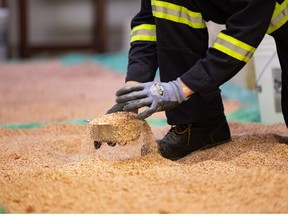
Potash is Canada’s “pink gold” — one of the country’s most valuable natural resources and a cornerstone of global food production.
Article content
Article content
With tensions escalating between Canada and the United States, some Canadians want Ottawa to impose a surtax on potash exports to the American market. The proposal appears compelling. The United States depends heavily on Canadian potash, an essential fertilizer used to produce corn, wheat, soybeans and many other crops. If Washington targets Canadian industries, why shouldn’t Canada retaliate with a resource American farmers cannot easily do without?
It sounds like leverage. In practice, it could become economic self-harm.
Canada is the world’s largest potash exporter, and Saskatchewan possesses some of the richest and most economical deposits anywhere. The United States imports most of the potash it consumes, with Canada supplying roughly four-fifths of those imports. Geography, rail connections and decades of commercial integration make Canadian potash the most convenient and economical option for American agriculture.
By signing up you consent to receive the above newsletter from Postmedia Network Inc.
Article content
Advertisement 3
Article content
A Canadian surtax would therefore raise costs for U.S. fertilizer distributors and farmers, at least initially. But that does not mean Americans would absorb the entire cost.
An export surtax is collected from the Canadian exporter. American buyers would immediately pressure Canadian producers to lower their selling prices to offset some — or eventually most — of the tax. Canadian companies would face a difficult choice: accept lower returns, lose sales or attempt to move millions of additional tonnes into overseas markets.
In the short term, Canada would possess considerable bargaining power. American farmers cannot instantly replace Canadian potash, particularly before a planting season. Prices would rise, fertilizer application could decline and agricultural margins would tighten.
Some of these costs could ultimately travel through the food supply chain. Potash is only one component of farm expenses, so a 10% surtax would not produce a corresponding 10% increase in food prices. Nevertheless, higher fertilizer costs would add pressure to crop prices and eventually affect livestock feed, processed foods and grocery bills.
Advertisement 4
Article content
The problem for Canada would emerge over time.
The United States can buy potash elsewhere. Israel and Germany are possible suppliers, while Russia and Belarus remain significant global producers, although geopolitical restrictions complicate those relationships. Washington could also support additional domestic production and invest in alternative supply chains.
Those options would be more expensive than buying from Saskatchewan. But once Canada deliberately makes its own product more expensive, alternatives begin to look more attractive.
Canada already has a significant international marketing network through Canpotex, the offshore marketing and logistics company for Saskatchewan potash produced by Nutrien and Mosaic. Canpotex sells more than 15 million tonnes annually to over 40 countries. Its five largest markets — Brazil, China, India, Indonesia and Malaysia — represent approximately 75% of its exports.
Canada has therefore developed an impressive global customer base. But the real question is whether those markets could suddenly absorb the enormous volume presently sold to the United States.
Advertisement 5
Article content
Natural Resources Canada reports that the United States receives approximately 53% of Canadian potash exports. Brazil receives about 14%, while China accounts for roughly 6%. Replacing the American market would require extraordinary growth in sales to countries such as Brazil, China, India, Indonesia and Malaysia.
That cannot happen overnight.
Potash is a globally traded commodity, but global demand does not automatically increase when Canada loses a customer. To sell substantially more abroad, Canadian producers would probably need to discount their product and displace Russian, Belarusian, Israeli or German suppliers. Those displaced tonnes could then be redirected toward the United States.
The result would be an expensive global reshuffling. Canadian potash would travel farther and potentially sell for less, while competing potash would travel farther to reach American farms and sell for more. Rail congestion, port capacity, vessels, long-term contracts and freight costs would all matter.
Advertisement 6
Article content
Canada would be surrendering the advantages of serving a large, nearby and deeply integrated customer.
The economic damage would extend beyond potash companies. Lower sales and reduced producer margins would affect employment, investment, railway activity, provincial royalties and federal and provincial tax revenues. Saskatchewan would carry much of the burden for a policy designed in Ottawa.
The United States would also almost certainly retaliate. Washington could select another Canadian industry with fewer alternatives and greater vulnerability. Once strategic commodities are weaponized, escalation becomes difficult to control.
There is also a serious legal problem. Article 2.15 of CUSMA prohibits a country from imposing an export tax on goods destined for another member unless the same tax is also applied when those goods are sold domestically. A surtax specifically targeting potash shipped to the United States would invite an immediate trade challenge.
Advertisement 7
Article content
Canada’s dependence on the American market is a legitimate concern. We should expand port and rail capacity, cultivate customers in emerging economies and continue diversifying exports. But diversification is a long-term commercial strategy, not an emergency switch Ottawa can activate during a trade dispute.
Our potash advantage is real. It gives Canada influence because American agriculture depends on a reliable and economical Canadian supply. But strategic leverage is most valuable when it strengthens our negotiating position. Once deployed recklessly, it can encourage customers to find substitutes and permanently weaken the relationship that created the leverage in the first place.
A potash surtax might deliver a satisfying political headline. It would certainly create short-term pain for American farmers. But over time, much of the bill would return to Canada through lower producer revenues, lost investment, reduced royalties and retaliation.
Potash is Canada’s pink gold. Ottawa should treat it as a strategic national asset — not tax it until our best customer starts looking elsewhere.
– Sylvain Charlebois is director of the Agri-Food Analytics Lab at Dalhousie University, co-host of The Food Professor Podcast.
Article content


























/https%3A%2F%2Fsportsmole-media-prod.s3.gra.io.cloud.ovh.net%2F24%2F39%2Fromelu-lukaku.jpg)
/https%3A%2F%2Fsportsmole-media-prod.s3.gra.io.cloud.ovh.net%2Fuploads%2F2026%2F02%2Ficonsport-350033-0038-1-1-6994d637b9198422666482.jpg)
 Bengali (BD) ·
  English (US) ·