.png)
 1 hour ago
7
Hall of Famer and Canadian women's hockey great opens up about life on and off the ice in her new book, Just a Girl: A Memoir.
Published Oct 29, 2026 • Last updated 21 minutes ago • 7 minute read
See more Toronto Sun on Google — save as a Preferred Source
Advertisement 2

THIS CONTENT IS RESERVED FOR SUBSCRIBERS ONLY
Subscribe now to read the latest news in your city and across Canada.
- Unlimited online access to articles from across Canada with one account.
- Get exclusive access to the Toronto Sun ePaper, an electronic replica of the print edition that you can share, download and comment on.
- Enjoy insights and behind-the-scenes analysis from our award-winning journalists.
- Support local journalists and the next generation of journalists.
- Daily puzzles including the New York Times Crossword.
SUBSCRIBE TO UNLOCK MORE ARTICLES
Subscribe now to read the latest news in your city and across Canada.
- Unlimited online access to articles from across Canada with one account.
- Get exclusive access to the Toronto Sun ePaper, an electronic replica of the print edition that you can share, download and comment on.
- Enjoy insights and behind-the-scenes analysis from our award-winning journalists.
- Support local journalists and the next generation of journalists.
- Daily puzzles including the New York Times Crossword.
REGISTER / SIGN IN TO UNLOCK MORE ARTICLES
Create an account or sign in to continue with your reading experience.
- Access articles from across Canada with one account.
- Share your thoughts and join the conversation in the comments.
- Enjoy additional articles per month.
- Get email updates from your favourite authors.
THIS ARTICLE IS FREE TO READ REGISTER TO UNLOCK.
Create an account or sign in to continue with your reading experience.
- Access articles from across Canada with one account
- Share your thoughts and join the conversation in the comments
- Enjoy additional articles per month
- Get email updates from your favourite authors
Article content
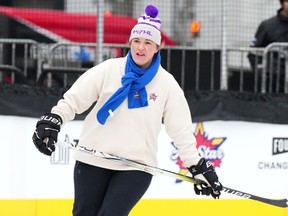
Cassie Campbell-Pascall had settled into a broadcast booth to start voicing the audio book for her new book, Just a Girl: A Memoir, and not even thirty words into the manuscript, the former Team Canada captain and long-time hockey broadcaster burst into tears, forcing a hard stop on her reading.
Article content
Article content
She did manage to complete the whole audio book eventually — and well in time for the memoir’s Oct. 6 release date — but on that first day in the booth, Campbell-Pascall skipped the dedication page altogether.
She recorded those words only after practising out loud five times at home to prove she could get through them without bawling.
“I didn’t think it was going to be emotional — that didn’t even cross my mind,” Campbell-Pascall said with a laugh, of the rush of feelings that hit her after reading her chosen dedication to her parents, her brothers and “the loves of my life,” husband Brad Pascall and daughter, Brooke.
That wasn’t all that got her crying, though. That same page of the memoir, written with veteran sports scribe Sean Fitz-Gerald — who is an employee of Postmedia — and published by Penguin Random House Canada, features a quote Campbell-Pascall has hanging in her office, words that tee up the pages ahead: “The world doesn’t need you to be perfect. It needs you to be real.”
Advertisement 3
Article content

We apologize, but this video has failed to load.
Just a Girl wastes no time in proving that’s what Campbell-Pascall sets out to do. The lone Canadian hockey player in history to captain this country to two Olympic gold medals, the woman who blazed trails on the ice and in broadcast booths, has chosen to be bravely vulnerable in telling her story.
In the first nine pages alone, concussions, menopause, her aching body and infertility are all introduced as threads that reappear later. The book opens with the words: “I have dedicated my life to hockey, and I have pledged my brain to science.”
What personal details does Campbell-Pascall share?
“I think it catches people off guard,” Campbell-Pascall, 52, said of the personal details she shares, which also include feeling like “the worst captain”, suffering from post-Olympic depression, being hit so hard she felt like she “swallowed” her own neck, and navigating a stretch when she was in danger of having the ‘C’ stripped from her jersey.
“I didn’t want it to be like, ‘Oh, look at all these things we’ve done,’ and about my career and things I’ve done behind the scenes. I wanted it to be real, and I wanted it to be vulnerable. That was really important to me,” she said. “And I think in a day and age of social media where everyone kind of pretends everything’s perfect, I wanted people to understand that even successful people struggle, and they have adversity.”
By signing up you consent to receive the above newsletter from Postmedia Network Inc.
Article content
Advertisement 4
Article content
Campbell-Pascall’s view on perfection is straightforward: “It’s kind of boring, and so unreal.”
She and Fitz-Gerald had countless conversations while putting the memoir together, many of them tearful on her end.
“There were lots of times where it got emotional and he’d be like, ‘Do you want to regroup?’ And I’d be like, ‘Nope. This is my story,’” she said.
Among the most emotional topics Campbell-Pascall tackles are the infertility issues she and Brad experienced while trying to grow their family, a struggle they kept private at the time.
“I think as a woman, you just sort of felt inadequate,” she said. “I remember going to the fertility clinic and I would wear a baseball hat and I didn’t want anyone to know that I was going through this. And we couldn’t really explain why. Brad and I just decided to keep it to ourselves.”
Only after she got pregnant did Campbell-Pascall talk to friends about the tough road to that point.
“Then you hear about so many more people that go through it, and yet we never spoke about it at the time, and you know how helpful that probably would have been,” she said. “We were able to have a healthy daughter, but going through that was hard. And I think sharing that on paper and going through that publicly, it was hard to share.”
Advertisement 5
Article content
Hockey legend’s fondest memories
Other memories were more fun to revisit, like a prank involving a giant vibrator in a teammate’s carry-on, interviewing Michelle Obama, becoming the first woman named to the Hockey Hall of Fame selection committee, and consuming many beers with teammates despite Hockey Canada’s hope that the women wouldn’t drink in public and tarnish the program’s image with “unladylike” behaviour.
The book moves at an incredible, active pace, which fits with Campbell-Pascall’s energy (she has a hard time sitting still).
“I love the way he told it — it was his idea to put it in the present sense,” Campbell-Pascall says, of Fitz-Gerald.
He’s the one who approached No. 77 with the idea to pen her memoir, some twenty years ago. By then she had retired from an historic on-ice career and had become the first woman to do colour commentary on Hockey Night in Canada.
Still, Campbell-Pascall told Fitz-Gerald: “I don’t feel like I’ve lived enough life.”
Advertisement 6
Article content
And so, she lived more life, “he kept asking,” she said, “and finally, three-and-a-half years ago, I said: OK.”
How did she get involved in the PWHL?
The opening pages situate the reader on a day in 2023, when Hall of Famer Jayna Hefford, Campbell-Pascall’s friend and former teammate, calls to tell her their dreams of a pro women’s league are coming true.
This, after many other efforts to see women paid a living wage to play both launched and folded. This, after so much hard work put in by so many, including Hefford and Campbell-Pascall.
“Cass, we did it,” as Hefford put it, and Campbell-Pascall greets the news with sobbing (she’s a crier). And so the work begins to get the PWHL off the ground and onto the ice.
The memoir revisits Campbell-Pascall living the path to that point and the many battles for recognition along the way, including the first Olympics to feature women’s hockey in 1998 in Nagano when her sport was called “a tiny mewling universe” by one prominent Toronto columnist.
Advertisement 7
Article content
“We were fighting for everything, every ounce of everything we could get out of people,” said Campbell-Pascall, who captained Canada from 2001-2006, then the longest tenure with the ‘C’ in this country’s hockey history.
She was also the face of her team for much of her career, a role she didn’t enjoy.
“I’m a ‘team-first’ person and it was the first time that I kind of felt like someone from the team was being separated from the rest of the group,” she said of being featured on advertisements, cereal boxes and earning the nickname ‘poster girl.’
“I never felt comfortable with it at all.”
She retired months after winning her second Olympic gold medal at her third Winter Games, after playing on “the Old Dog line” with fellow 30-somethings and with six world championships titles under her belt.
Historic move into the broadcast booth
Then Campbell-Pascall had to get her first full-time job. She shares a story from early in her broadcasting career, when a producer asked her to lower her voice a few octaves while on air.
Advertisement 8
Article content
“’Buddy,’ I think to myself, ‘I’m a woman,’ This is how my effing voice sounds,'” she writes.
Her second day at CBC, she landed on Hockey Night in Canada, sitting beside the late, great Bob Cole, filling in with colour commentary since Harry Neale was stuck in a snowstorm.
“It was a big shock to everyone and some people agreed with it, and some said I shouldn’t have had the opportunity,” Campbell-Pascall said, though she’s quick to point to the support she has received from inside the hockey world over her more than two decades on air.
These days, Campbell-Pascall splits her time professionally between ESPN broadcasts and as a special advisor to the PWHL. Earlier this year, she was inducted into the IIHF Hall of Fame.
While she remains in the spotlight, Campbell-Pascall hopes those who pick up her book “can see a little piece of me in them,” as she put it.
“Despite seeing someone on Saturday nights for 20 years, seeing someone play on the national team and be captain, there’s imperfections. There are things that people deal with. I think just the realness of me — that was my leadership style, I wore my heart on my sleeve and I was emotional and I was real. And I think that defined my leadership and in a certain sense, my life as well,” she said.
Advertisement 9
Article content
Read More
-

Larry Tanenbaum brings Brendan Shanahan back as PWHL adviser
-

Toronto Sceptres sign top pick Kirsten Simms


The title was her idea, and the words hit close to home.
“It kind of goes to my character, that I am just this girl that grew up in Brampton, Ontario. No big deal,” she said. “And then how many times as a woman, you know, walking into an arena, did you hear: ‘Oh, you’re just a girl, you can’t play hockey, girls can’t play hockey.’ ‘Oh, you’re just a girl, you can’t do that in the gym.’ ‘Oh, you’re just a girl, you can’t be in NHL broadcasting.’
“It’s this condescending term that we all have heard at some point in our lives, and I feel like I’ve stored those things in the back of my brain for so long. That saying has been such a motivating factor to me.”
In telling her story, Campbell-Pascall puts power behind those words.
As she said: “It’s more like, ‘You’re damn right I’m just a girl.’”
Article content




























 Bengali (BD) ·
 English (US) ·