.png)
 1 hour ago
6
1 hour ago
6
Article content
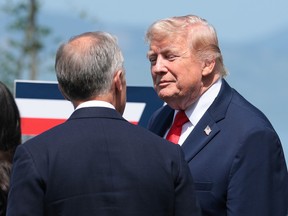
U.S. President Donald Trump’s abrupt return-to-office mandate for federal employees damaged morale and eroded trust across the U.S. public service, according to a recent study whose author believes Canada has failed to learn from those mistakes.

THIS CONTENT IS RESERVED FOR SUBSCRIBERS ONLY
Subscribe now to read the latest news in your city and across Canada.
- Unlimited digital access to the Ottawa Citizen.
- Analysis on all things Ottawa by Bruce Deachman,David Pugliese, and others, award-winning newsletters and virtual events.
- Opportunity to engage with our commenting community.
- Ottawa Citizen ePaper.
- Ottawa Citizen App.
SUBSCRIBE TO UNLOCK MORE ARTICLES
Subscribe now to read the latest news in your city and across Canada.
- Exclusive articles from David Pugliese, Andrew Duffy, Bruce Deachman and others. Plus, food reviews and event listings in the weekly newsletter, Ottawa, Out of Office.
- Unlimited online access to Ottawa Citizen and 15 news sites with one account.
- Ottawa Citizen ePaper, an electronic replica of the print edition to view on any device, share and comment on.
- Daily puzzles, including the New York Times Crossword.
- Support local journalism.
REGISTER / SIGN IN TO UNLOCK MORE ARTICLES
Create an account or sign in to continue with your reading experience.
- Access articles from across Canada with one account.
- Share your thoughts and join the conversation in the comments.
- Enjoy additional articles per month.
- Get email updates from your favourite authors.
Register to unlock this article — it’s free
Create an account or sign in to continue with your reading experience.
- Access articles from across Canada with one account
- Share your thoughts and join the conversation in the comments
- Enjoy additional articles per month
- Get email updates from your favourite authors
Sign In or Create an Account
or
Article content
The study, a peer-reviewed article published in the Review of Public Personnel Management, looked at the aftermath of a “dramatic” policy reversal that sent U.S. public servants back into the office full-time in 2025.
Article content
Article content
Article content
On the first day of his second term in office, Trump issued a presidential memorandum directing executive branch departments and agencies to “terminate” remote work agreements and bring workers back in-person.
Article content
At the same time, Trump pursued deep cuts to the public service through the Elon Musk-led Department of Government Efficiency, widely known as DOGE.
Article content
Étienne Charbonneau, the corresponding author on the study and a professor at the National School of Public Administration, said his research highlights the potential negative consequences of rigid return-to-office mandates.
Article content
Recognizing the move away from hybrid work was more immediate south of the border, Charbonneau said the Canadian government missed an opportunity to learn from the intense blowback to Trump’s actions.
Article content
“This happened right next door, and it was documented in a language that people in Ottawa could understand,” he said.
Article content
“Why are they doing the same mistakes many months after and not learning? Why haven’t they paid attention?”
Article content
Workforce ‘under strain’
Article content
Much like in Canada, many U.S. government organizations turned to hybrid work during the COVID-19 pandemic.
Article content
Article content
The practice varied widely from one workplace to the next. Regardless, by mid-2024, more than 200,000 U.S. federal public servants worked fully remote, according to the study, while many more were under some sort of hybrid work arrangement.
Article content
Article content
As a result, Trump’s January 2025 return-to-office mandate affected more than one million executive branch employees, with only limited exceptions.
Article content
The study examined three national surveys of U.S. federal employees conducted by the Federal News Network — a digital and radio news organization that covers the American government. The first survey was done before the return-to-office mandate, the second immediately afterward, and the final months later.
Article content
The study found many public servants responded to the return-to-office mandate with anger, frustration and a sense of betrayal. Many reported lower perceived productivity. For some, the loss of autonomy damaged trust in their employer.
Article content
Taken together, the findings pointed to a workforce “under strain,” the study found.
Article content
“Across waves, respondents emphasized that the return was not a neutral adjustment but an emotionally charged rupture, often described as ‘destroying morale,’ ‘eroding trust,’ or ‘making me not want to work for these people anymore,’” it read.



























 Bengali (BD) ·
  English (US) ·