.png)
 1 hour ago
6
1 hour ago
6
A state of emergency has been declared across Venezuela after successive quakes with magnitudes above 7 struck the country on Wednesday evening, causing widespread damage and triggering tsunami warnings.
In a brief broadcast, acting President Delcy Rodríguez said several states across the Latin American country have been severely hit, including the capital, Caracas, where she reported that buildings have collapsed. At least 32 people are dead, and more than 700 are injured, Rodríguez said early Thursday morning, but that toll did not yet count the state of La Guaira near the coast, which is among the worst hit regions and which she described as a “real tragedy.”
The U.S. Geological Survey says that “high casualties and extensive damage” are expected from the two quakes, with a significant probability of an eventual death toll in the thousands. The quakes struck during a public holiday commemorating an 1821 military victory that helped secure Venezuela’s independence from the Spanish Empire.
According to USGS data, the first quake, a magnitude 7.2 with a depth of 20.3 km (12.6 mi), struck at around 6:04 p.m. local time. Its epicenter was about 176 km (109 miles) west of Caracas.
Less than a minute later, at 6:05, a stronger magnitude 7.5 quake occurred, with its epicenter some 6.2 km (3.8 mi) east of the prior quake, about 33 km (18.9 mi) away from Venezuela’s Caribbean coastal town of Morón. The second quake had a depth of 10 km (6.2 mi).
Interior Minister Diosdado Cabello said in a statement that various state security and assistance agencies are responding to the situation. The country’s education ministry suspended classes nationwide, and schools will be used as shelters for affected families and collection centers.
The Simón Bolívar International Airport in Maiquetía, La Guaira, was also closed after suffering damage. Video from NBC 6 showed passengers scrambling for safety in the airport during the quake.
The strongest in more than a century
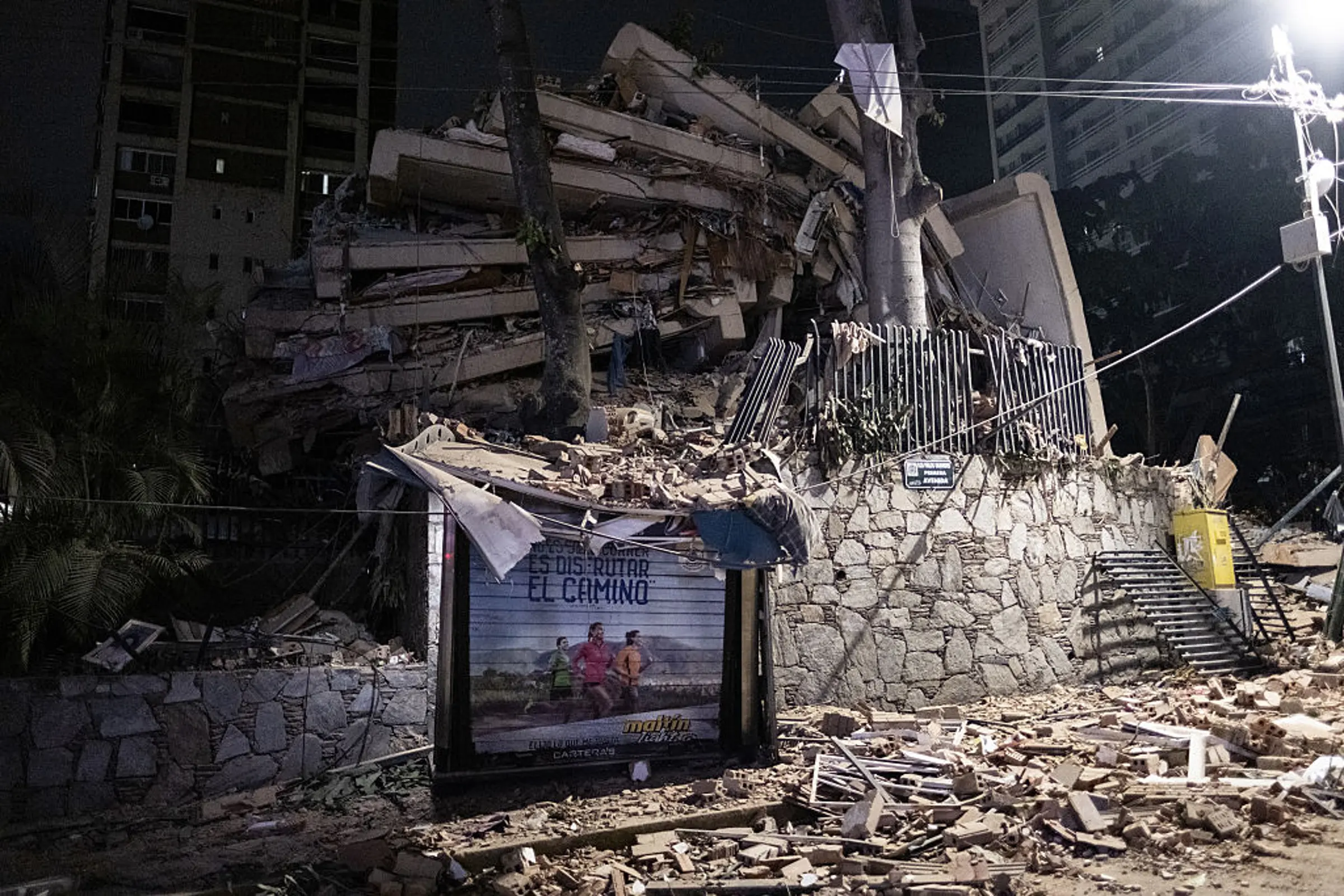
Rescue workers search through the rubble of a collapsed building following a powerful earthquake in Caracas, Venezuela, on June 24, 2026. Diko Betancourt—Anadolu/Getty Images
The two quakes occurred within a short time and distance from each other, a phenomenon known as an earthquake doublet. The second tremor, which was magnitude 7.5, was the strongest to hit Venezuela or its immediate coastal area in more than a century, according to the USGS catalog.
A magnitude 7.7 quake shook the country in 1900, with an epicenter near the country’s Caribbean coast. This so-called San Narciso Earthquake hit Caracas in the early morning and dealt extensive damage to churches, buildings, and homes. The USGS catalog said 21 people died and more than 50 were injured.
That 1900 quake also triggered a nearby tsunami and was followed by more than 250 aftershocks in the following months.
A New York Times report on the 1900 quake weeks later said that some 300 buildings collapsed, government buildings were damaged, and a “large part” of the population had lived in tents after.
Venezuela lies in a seismically active zone, where the Caribbean Plate and the South American Plate converge. According to the USGS, the magnitude 7.5 quake occurred “as a result of shallow strike-slip faulting near the complex plate boundary” between the two plates. Strike-slip faulting refers to the fractures on the Earth’s crust moving side to side.
Quakes above magnitude 7 in the region have also been recorded in the modern era, including a magnitude 7.3 one on Aug. 21, 2018, and a magnitude 7 one on July 9, 1997.
Promises of support pour in
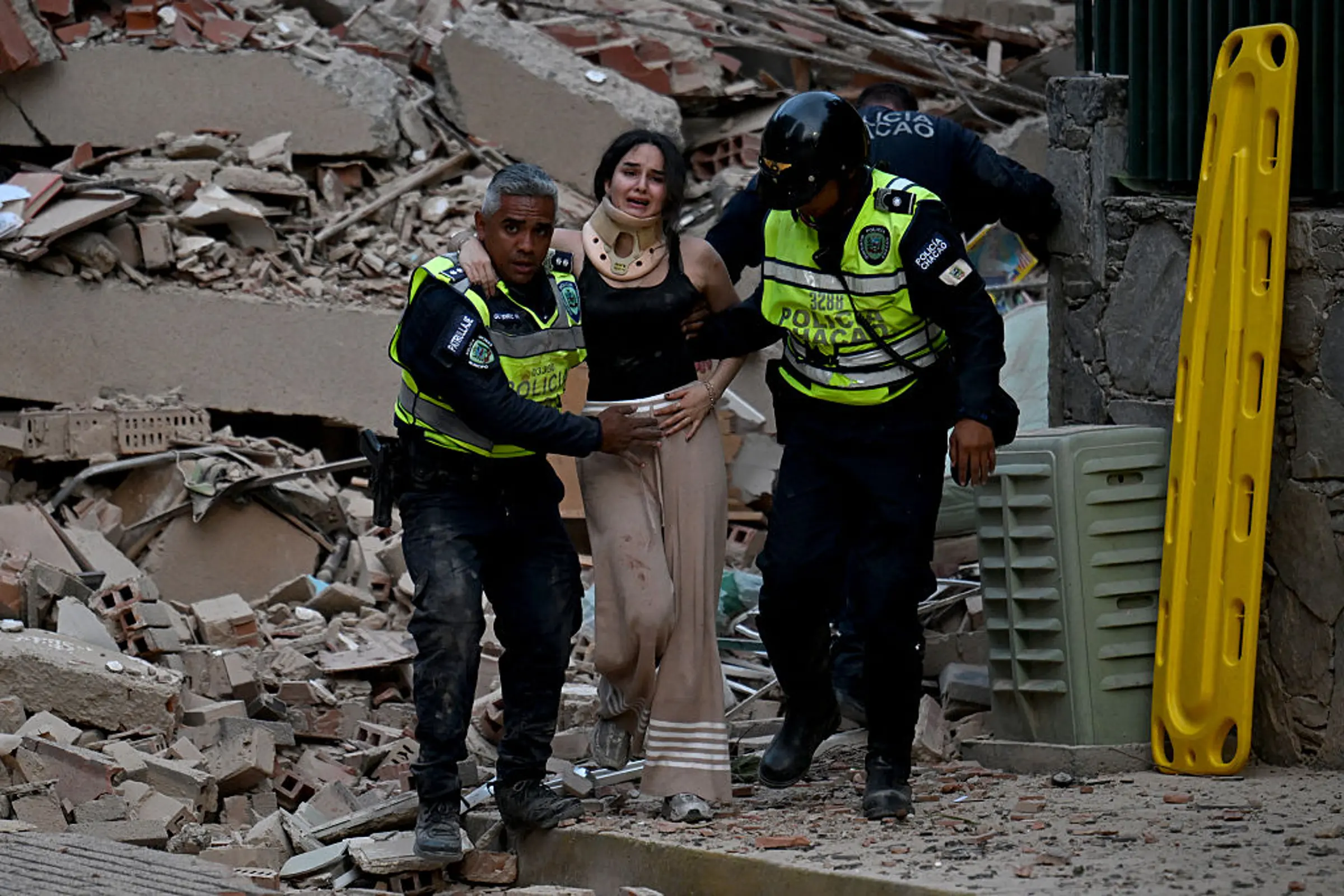
Municipal police officers evacuate an injured victim from a collapsed building following an earthquake in Caracas, Venezuela on June 24, 2026. Juan Barreto—AFP/Getty Images
As authorities assess the total damage from the Wednesday quakes and conduct rescue operations, key figures have extended their messages of support.
María Corina Machado, the country’s exiled opposition leader and 2025 Nobel Peace Prize recipient, posted on social media that she was praying for Venezuelans. “May strength, serenity, and solidarity prevail among us in the face of this difficult moment,” Machado wrote.
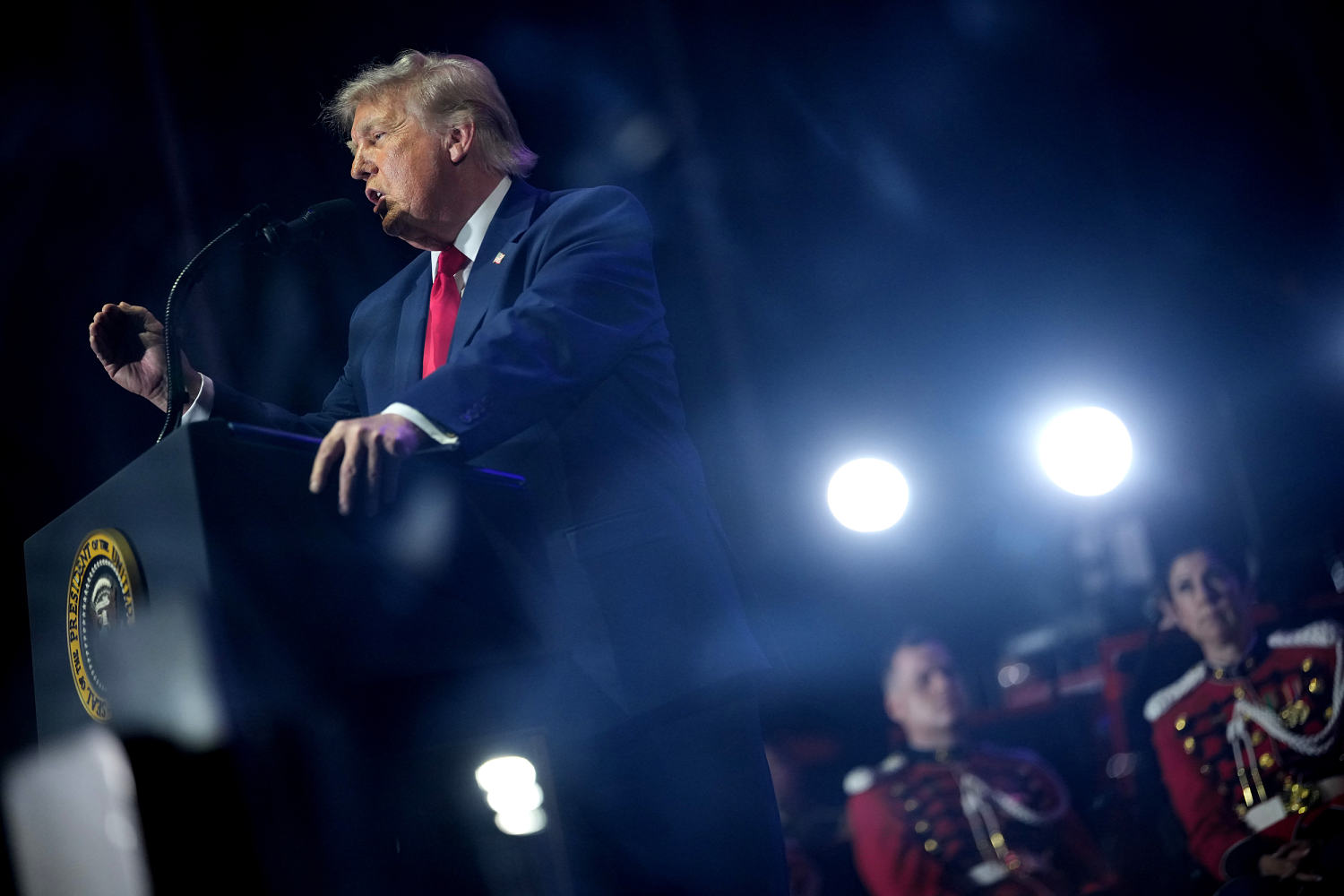
U.S. President Donald Trump, who has backed Rodríguez’s rule after forcibly ousting President Nicolás Maduro and who once said that he plans to run the South American nation, posted on Truth Social that “the U.S.A. stands ready, willing, and able to help” and that he has instructed American government agencies “to get ready to move quickly. We will be there for our new and great friends. Early reports are not good!!!”
Secretary of State Marco Rubio posted that his department is “immediately deploying” search and rescue teams, medical resources, and humanitarian assistance to Venezuela.
The leaders of Venezuela’s Latin American neighbors have also expressed solidarity. El Salvador President Nayib Bukele posted that the country has offered assistance to Venezuela, including “300 rescuers and paramedics, along with 50 tons of equipment, medicines, and essential supplies” that were “ready to depart for Caracas.”
Brazil’s President, Luiz Inácio Lula da Silva, posted that he has instructed the Brazilian Ministry of Foreign Affairs “to assess, together with the Brazilian Embassy in Caracas, the situation in the country and the measures of assistance that Brazil can adopt,” and reaffirmed his support for Rodríguez’s government in helping affected areas of Venezuela recover.
Ecuador’s President Daniel Noboa similarly promised humanitarian aid, saying that “Ecuador will respond with the speed and commitment that this moment demands.”






















/https%3A%2F%2Fsportsmole-media-prod.s3.gra.io.cloud.ovh.net%2Fuploads%2F2026%2F05%2Fscheffler-6a034d9fca412032057779.jpg)
/https%3A%2F%2Fsportsmole-media-prod.s3.gra.io.cloud.ovh.net%2Fuploads%2F2026%2F06%2Ficonsport-111147-0089-1-6a27d006a81d1227497324.jpg)
/https%3A%2F%2Fsportsmole-media-prod.s3.gra.io.cloud.ovh.net%2Fuploads%2F2026%2F06%2Fimago-xinhua-nestory-irankunda-celebrates-scoring-for-australia-in-the-world-cup-on-june-14-2026-6a2f348854d1b663111439.jpg)
 Bengali (BD) ·
  English (US) ·