.png)
 1 hour ago
8
1 hour ago
8
On Aug. 27-28, 2026, a very deep partial lunar eclipse will be visible from Europe, Africa, North America and South America, with just over 96% of the moon passing into Earth's shadow.
Lunar eclipses happen when Earth is between the sun and a full moon. During the event, the moon moves through Earth's umbra, the dark center of its shadow.
Where will the August 2026 partial lunar eclipse be visible?
The best views of the August 2026 partial lunar eclipse will be from North and South America. According to Time and Date, about 12% of the world's population — 987 million people — will see all phases of the eclipse (penumbral and partial), while around 16% — 1.3 billion — will see all of the partial phase. Viewing conditions will depend on the local weather, with western U.S. states, northern Chile and inland Brazil statistically offering the best odds of clear skies.
What will happen during the partial lunar eclipse?
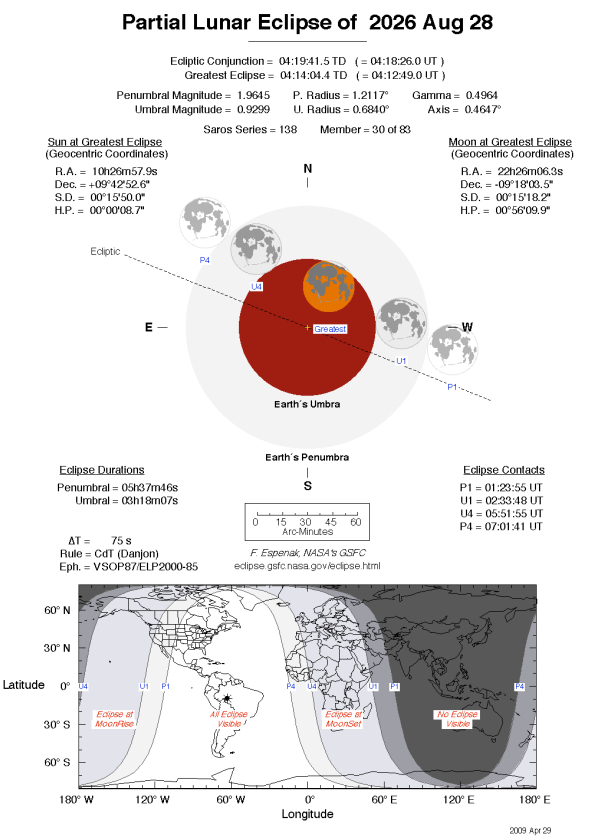
The Aug. 27-28, 2026, event will be the first deep partial lunar eclipse anywhere in the world since Sept. 18, 2024, and the last until Jan. 11-12, 2028 (when only 2.4% of the moon will be in Earth's umbral shadow). As such, 2026's partial lunar eclipse will be the most impressive lunar eclipse until a total lunar eclipse on Dec. 31, 2028.
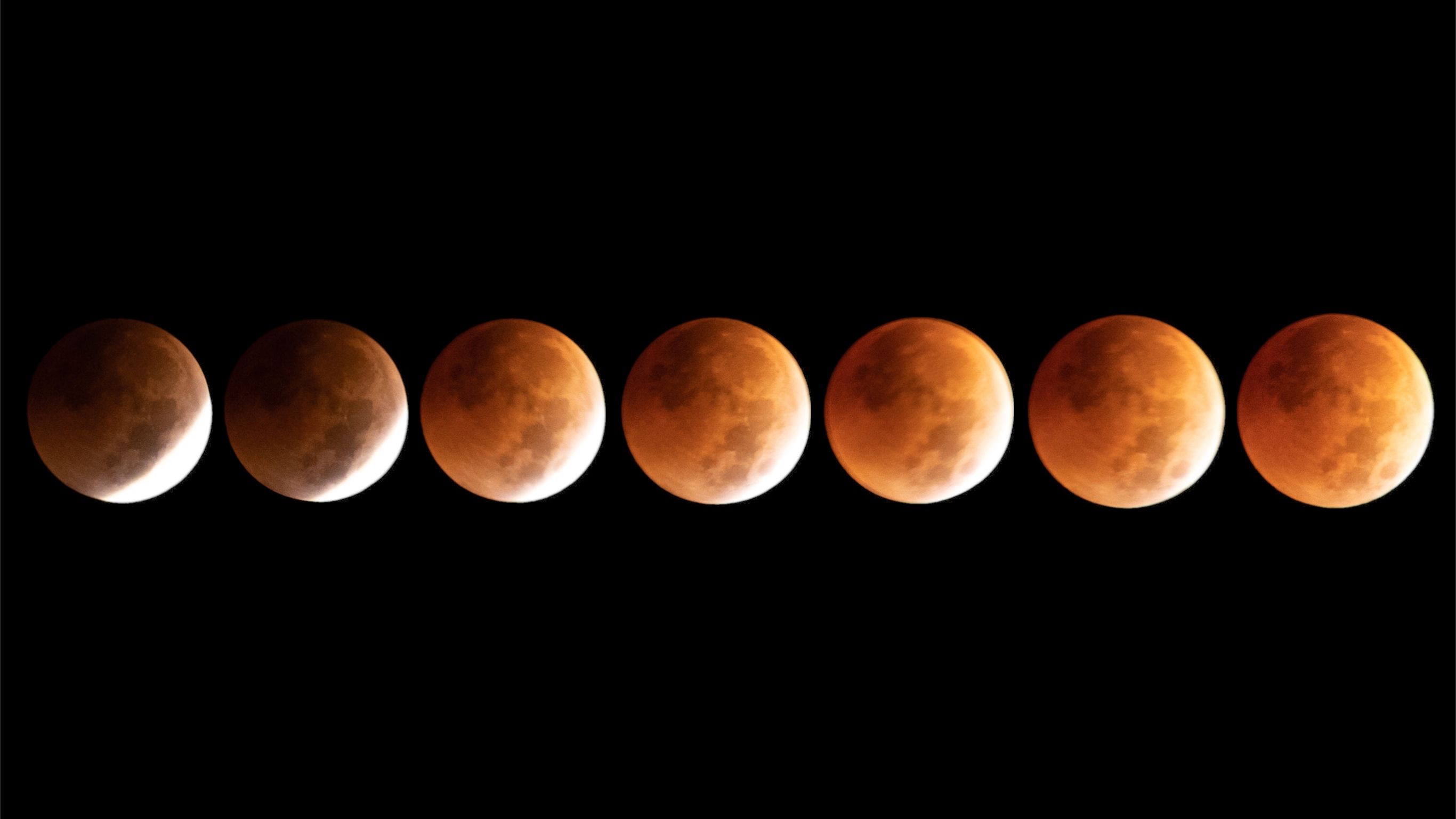
During the August 2026 eclipse, the full "Sturgeon Moon" will rise and, later that night, pass into Earth's umbral shadow. As it does, the full moon will dim and, as the partial eclipse reaches its peak, look slightly reddish-orange. However, it won't be a true "blood moon" because at no point will there be lunar totality — when the entire lunar surface falls under Earth's shadow. The eclipse — including both the slight penumbral (when the moon drifts into Earth's fuzzy outer shadow) and partial phases — will last 5 hours, 38 minutes.
This partial lunar eclipse will occur just over five days after the moon reaches apogee — its farthest point from Earth on its slightly elliptical orbit — making it of average apparent size.
What time is the August 2026 partial lunar eclipse in North America?
Lunar eclipses occur at the same universal time worldwide, but the local clock time and whether the moon is above the horizon vary by location. This one will happen between 9:23 p.m. EDT on Thursday, Aug. 27, and 3:01 a.m. EDT on Friday, Aug. 28 (0123 and 0701 GMT on Friday, Aug. 28, 2026) with the peak of the event — when 96.2% of the lunar surface will appear reddish — happening at 0412 GMT. That translates to the following local times in North America:
- Eastern time: 12:12 a.m. EDT on Friday, Aug. 28, 2026
- Central time: 11:12 p.m. CDT on Thursday, Aug. 27, 2026
- Mountain time: 10:12 p.m. MDT on Thursday, Aug. 27, 2026
- Pacific time: 9:12 p.m. PDT on Thursday, Aug. 27, 2026
- Alaska time: 8:12 p.m. AKDT on Thursday, Aug. 27, 2026
These are the times for maximum eclipse only. However, it's worth looking at the moon about 39 minutes before these times to see the edge of Earth's shadow inch across the lunar surface as the partial phase builds (and vice versa after maximum eclipse).
What time is the August 2026 partial lunar eclipse in Europe?
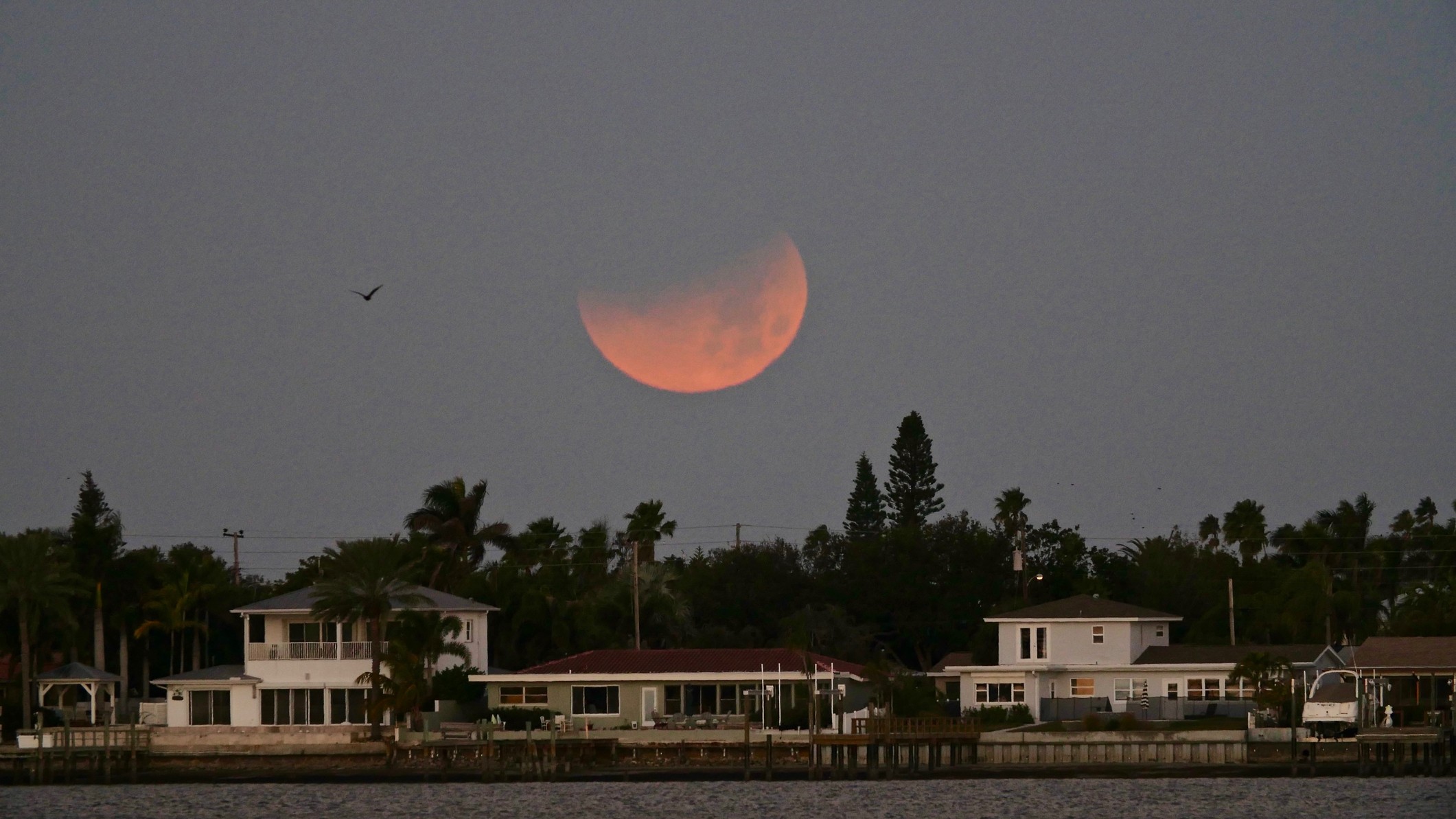
In Europe, the eclipse will occur early on Friday, Aug. 28, but it will set during the partial phase.
Here's when maximum eclipse will occur in various locations within Europe (further east of these locations, maximum eclipse is not visible):
- London, U.K.: 5:12 a.m. BST on Aug. 28, 2026 (sunrise at 6:06 a.m. BST, moonset at 6:15 a.m. BST)
- Paris, France: 6:12 a.m. CEST on Aug. 28, 2026 (sunrise at 7:01 a.m. CEST, moonset at 7:09 a.m. CEST)
- Madrid, Spain: 6:12 a.m. CEST on Aug. 28, 2026 (sunrise at 7:38 a.m. CEST, moonset at 7:46 a.m. CEST)
- Brussels, Belgium: 6:12 a.m. CEST on Aug. 28, 2026 (sunrise at 6:49 a.m. CEST, moonset at 6:58 a.m. CEST)
- Berlin, Germany: 6:12 a.m. CEST on Aug. 28, 2026 (sunrise at 6:10 a.m. CEST, moonset at 6:17 a.m. CEST)
When is the next total lunar eclipse?
Here are the dates and locations for upcoming total lunar eclipses:
- Dec. 31-Jan. 1, 2028-2029: A total lunar eclipse will be visible from Europe, Asia, Australia, Africa, Northern and Western North America, the Pacific Ocean, the Atlantic Ocean, the Indian Ocean and the Arctic.
- June 25-26, 2029: A total lunar eclipse will be visible from Europe, Western Asia, Africa, North America, South America, the Pacific Ocean, the Atlantic Ocean, the Indian Ocean and Antarctica.
- Dec. 20-21, 2029: A total lunar eclipse will be visible from Europe, Asia, Northern and Western Australia, Africa, North America, South America, the Pacific, the Atlantic, the Indian Ocean and the Arctic.
Additional resources
Want to look further ahead? You can find a concise summary of lunar eclipses out to 2026 here on Space.com. Read more about solar and lunar eclipses on EclipseWise.com, a website dedicated to predictions of eclipses, and find beautiful maps on eclipse cartographer Michael Zeiler's EclipseAtlas.com and interactive Google Maps on Xavier Jubier's eclipse website. You can find climate and weather predictions by meteorologist Jay Anderson on eclipsophile.com.
Bibliography
Jubier, X. (n.d.). Lunar eclipses: Interactive Google Maps. Retrieved May 5, 2026, from http://xjubier.free.fr/n/site_pages/Lunar_Eclipses.html
Time and Date. (n.d.). Partial Lunar Eclipse on 28 Aug 2026: Map & Times. Retrieved May 5, 2026, from: https://www.timeanddate.com/eclipse/map/2026-august-28
Cameron Smith, I. Partial Lunar Eclipse of 28 Aug, 2026 AD. Retrieved May 5, 2026, from: https://moonblink.info/Eclipse/eclipse/2026_08_28




















/https%3A%2F%2Fsportsmole-media-prod.s3.gra.io.cloud.ovh.net%2Fuploads%2F2026%2F05%2Fimago1077546153-2-6a0b8bbf76f8f531157643.jpg)
 Bengali (BD) ·
  English (US) ·