.png)
 5 hours ago
10
5 hours ago
10
World Turtle Day is shell-ebrated annually on May 23
Published May 22, 2026 • Last updated 5 minutes ago • 5 minute read
Advertisement 2

THIS CONTENT IS RESERVED FOR SUBSCRIBERS ONLY
Subscribe now to read the latest news in your city and across Canada.
- Unlimited online access to articles from across Canada with one account.
- Get exclusive access to the Toronto Sun ePaper, an electronic replica of the print edition that you can share, download and comment on.
- Enjoy insights and behind-the-scenes analysis from our award-winning journalists.
- Support local journalists and the next generation of journalists.
- Daily puzzles including the New York Times Crossword.
SUBSCRIBE TO UNLOCK MORE ARTICLES
Subscribe now to read the latest news in your city and across Canada.
- Unlimited online access to articles from across Canada with one account.
- Get exclusive access to the Toronto Sun ePaper, an electronic replica of the print edition that you can share, download and comment on.
- Enjoy insights and behind-the-scenes analysis from our award-winning journalists.
- Support local journalists and the next generation of journalists.
- Daily puzzles including the New York Times Crossword.
REGISTER / SIGN IN TO UNLOCK MORE ARTICLES
Create an account or sign in to continue with your reading experience.
- Access articles from across Canada with one account.
- Share your thoughts and join the conversation in the comments.
- Enjoy additional articles per month.
- Get email updates from your favourite authors.
THIS ARTICLE IS FREE TO READ REGISTER TO UNLOCK.
Create an account or sign in to continue with your reading experience.
- Access articles from across Canada with one account
- Share your thoughts and join the conversation in the comments
- Enjoy additional articles per month
- Get email updates from your favourite authors
Article content
Adding a new pet to the family is an exciting time, but also a big responsibility. Unfortunately for some pet turtles, their families are no longer up to the task of caring for them, and they end up abandoned and alone outdoors.
Article content
Recommended Videos
Article content
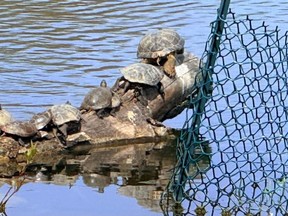
World Turtle Day, shell-ebrated annually on May 23, is the perfect time to give a voice to these animals.
Unlike the eight native turtle species in Canada, most pet turtles come from warmer climates in the southern U.S. or Mexico, including one of the most popular, the red-eared slider.
Lori Leckie, co-founder of the Peel Region-based Heart Lake Turtle Troopers, says there are many of these invasive species living in Greater Toronto Area wetlands. All of these turtles were — at some point — somebody’s pet. “Some of them look to be close to 50 years old,” Leckie said of the turtles in a wetland local to her group. “They’re huge, they’ve been there for decades.”
Dumped pets
While a pet owner may think of putting the turtle outside as setting them free or giving them a better life, Leckie argues, “There is not any good reason” to do so.”
By signing up you consent to receive the above newsletter from Postmedia Network Inc.
Article content
Advertisement 3
Article content
Putting an invasive turtle into Canadian wetlands is detrimental to both the pet, and the native turtles. “They might inadvertently put pathogens into our wetlands, i.e. any disease that these turtles might have, they’ll put into our ecosystem.” And vice versa, “Let’s say there’s a random virus in an ecosystem. So you’re putting your pet — who has had no exposure to any of these naturally occurring viruses and bacteria in our wetlands — it could be a death sentence.”
Some of the warm-climate turtles are able to adapt to the colder temperatures, but it can be harder for them to find the right spot to overwinter that provides them enough oxygen. (Native Canadian turtles spend winter in a hibernation-like state where their metabolism drops.)
Julia Phillips, Resource Conservation Manager at Rouge National Urban Park, agrees there are many potential dangers for a pet turtle who is unequipped for life in the wild, especially over the winter. “The idea is that for a select few, that they’ve found the right proper location that’s kept them at the right depth and the right warmth, but largely speaking, if you’re going to release a pet into the wild, it’s not going to be adapted to navigate like a wild turtle is. Then they’re going to end up in an area that’s not suitable for them because it doesn’t have enough oxygen to survive the winter, doesn’t have an appropriate amount of food, and habitat for them to survive long-term.
Advertisement 4
Article content
“It’s essentially cruel, to be dropping the turtles off in the wild, for a lot of reasons. They also pose a detriment to the native species.”
Some of the harms a non-native turtle can cause for native turtle species is, as Leckie said, diseases that an invasive turtle could pass to the native turtles, as well as competition for food, basking areas, or nesting sites. Phillips also added a non-native turtle could potentially attempt to breed with a native turtle, and because the eggs would not be viable, it’s wasting the female native turtle’s eggs for that breeding season.
Smaller-sized turtles can also fall victim to predation from animals such as raccoons, skunks, foxes, and coyotes.
Instead of tossing a turtle outside …
Pefferlaw-based Little ResQ is a rescue dedicated to helping pet turtles. Shelter Manager Marc Ouellette has been in the business of taking in unwanted pet turtles for 18 years, and does double duty, both adopting out pet turtles to new families, as well as running a sanctuary for non-native turtles where they can live out their days without disrupting the ecosystem. (These contained ponds are in a fenced area, separated into male and female, and have oxygen provided in the winter to give the turtles the best chance at survival. He also has a greenhouse to grow food and the turtles are fed a balanced diet.)
Advertisement 5
Article content
A family looking to rehome their pet turtle can contact Little ResQ to inquire about intake, and smaller-sized turtles will be put up for adoption, while larger ones go to the sanctuary. Those looking to adopt a pet turtle can visit Little ResQ by appointment, and visit the available animals, as well as learn all the necessary steps to care for and house a turtle.
“I tend to keep the smaller turtles for adoption,” Ouellette explains, “but the larger ones, they just don’t get adopted, so they would come to the sanctuary.”
Do your research
Ouellette says as turtles grow, the size of their housing needs to grow with them. One of the ways Little ResQ can help pet turtles remain with their families is by providing lower cost tanks, so those turtles who do need a bigger home can obtain one more affordably.
In addition to proper housing, lighting and places for basking, turtles also need a varied diet. “Turtles are omnivores,” Phillips explains. “They eat a very varied diet, so everything from insects to plant life, so they do require a lot of nutritional energy and appropriate mix of food to grow properly and thrive.”
Advertisement 6
Article content
Turtles live very long lives, and sliders can live for upwards of 50 years, which means long-term planning is required if a child wants a turtle as a pet. “I get a lot of calls in August,” Ouellette said, from students moving away for university.
Veterinary care for turtles also can be hard to come by, as turtles need to be seen by an exotic vet. (Ouellette recommends Links Road Animal Clinic in Toronto.)
How to help turtles
Anyone who comes across a turtle nest or non-native turtle within Rouge Park is encouraged to call the Parks Canada Shell-Phone line at 416-938-3017, to report it. Anyone observing a turtle in the wild can also report it to the citizen science app, iNaturalist, which scientists use to collect data. Injured turtles should be reported to the Ontario Turtle Conservation Centre at 705-741-5000, who will direct next steps.
Twitter: @shantoranelles
Article content






























 Bengali (BD) ·
  English (US) ·