.png)
 1 hour ago
6
1 hour ago
6
As New York opens its workweek, widespread transport disruption is expected as key negotiators struggle to end a strike that has shut down the busiest commuter rail service in North America.
Unions representing thousands of striking workers of the Long Island Rail Road (LIRR) service and operator Metropolitan Transportation Authority (MTA) had yet to reach an agreement by early Monday morning, after the workers walked off the job Saturday in protest of insufficient wages. The last time LIRR workers went on strike was in 1994.
The LIRR strike is the service’s first in more than 30 years and threatens to affect more than 250,000 daily commuters traveling between New York City and its eastern suburbs, forcing them to find alternative modes of transportation as they head to work.
The day's top headlines, curated by TIME editors.
At a press conference on Sunday, New York Gov. Kathy Hochul urged negotiators to reach a deal for the sake of commuters. “We all know that the railroad is the lifeblood of Long Island,” Hochul said. “Without it, life as we know it is simply not possible. The bottom line is, no one wins in a strike. Everyone is hurt.”
But in the wee hours of Monday morning, Matt Hollis, the national president of one of the unions involved, the Transportation Communications Union, said that the strike will extend to its third day. “We gave the MTA every opportunity to avoid this,” Hollis said in a statement. “Instead, heading into a busy workweek, MTA leadership once again demonstrated that it does not value either the riding public or in the hardworking men and women who keep this railroad moving.”
Hochul, who is seeking reelection this year, has blamed the Trump Administration for the strike. But President Donald Trump slammed Hochul for blaming him, writing on Truth Social on Saturday that he “never even heard about [the strike] until this morning.”
Trump faulted Hochul and said the issue would be “easy” for Bruce Blakeman, the Republican running against Hochul in the upcoming gubernatorial election, to resolve. He also offered to step in himself, saying, “If you can’t solve it, let me know, and I’ll show you how to properly get things done.”
Here’s what to know.
What caused the strike?
The LIRR closed down at 12:01 a.m. on Saturday after five unions representing some 3,500 workers, about half of the system’s labor force, walked out. These five unions are the Brotherhood of Locomotive Engineers and Trainmen, the Brotherhood of Railroad Signalmen, the International Association of Machinists and Aerospace Workers, the International Brotherhood of Electrical Workers, and the Transportation Communications Union.
The unions say the striking workers have not received raises since 2022 and have been negotiating a new contract with the MTA since 2023 amid rising living costs. But these negotiations have stalled over salaries and healthcare premiums. To avoid a work stoppage, the unions asked Trump to intervene, and the President in September 2025 and again in January this year ordered an emergency board of experts to help mediate and make recommendations. But a deal still wasn’t reached.
Before the strike began Saturday, both sides had tried to avert disruption to services. The unions and the MTA had earlier agreed to retroactive wage increases of 3% to 3.5% for each of the last three years, but a pay increase for this year remains the sticking point, with the unions originally seeking a 6.5% raise, while the MTA is reportedly trying to negotiate it closer to 3%.
Janno Lieber, MTA’s CEO, told CBS News on Sunday that the workers from these holdout unions are already among the “best paid workers” in the U.S., saying that the average salary is $136,000, and hundreds earned more than $200,000. Other authorities have claimed that the demanded wage increases could not be met without triggering fare hikes. Hochul said that the workers are demanding contracts that would result in fares needing to rise by as much as 8%.
In a statement Sunday, one of the involved unions—the International Association of Machinists and Aerospace Workers—rebutted the MTA’s and Hochul’s Sunday statements, asserting that the President’s emergency boards have sided with the workers and that the transport authority has “failed to bargain in a serious and constructive manner.”
How is the Trump Administration involved?
LIRR workers, unlike other MTA workers, are covered by the 1926 Railway Labor Act, which aims to prevent service disruptions by requiring elaborate dispute resolution procedures between carriers and employers. These procedures can include reviews by a Presidential Emergency Board and cooling-off periods.
The National Mediation Board is a federal agency that governs labor relations for railroads and airlines. In August 2025, the NMB released the unions involved in the LIRR negotiations from mediation, and the LIRR workers only needed to observe the 30-day cooling-off period before they could engage in “self-help” actions, like a walkout.
But with the unions subsequently requesting the intervention of two emergency boards, that cooling-off period was extended, and an imminent strike was thwarted. The second emergency board, which released a report on March 16, extended by 60 days the required cooling-off period.
In September, Hochul blamed the Trump Administration for cutting the mediation short and increasing the likelihood of a strike, and she called the NMB’s actions “reckless.” Hochul continued to pin the blame on the Administration on Sunday, claiming that the strike could have been averted if the Trump Administration “had not taken the highly unusual step last fall of releasing labor unions from mediation.”
The National Mediation Board summoned representatives of the unions and the MTA on Sunday to try and help negotiations anew, and talks are slated to resume on Monday morning.
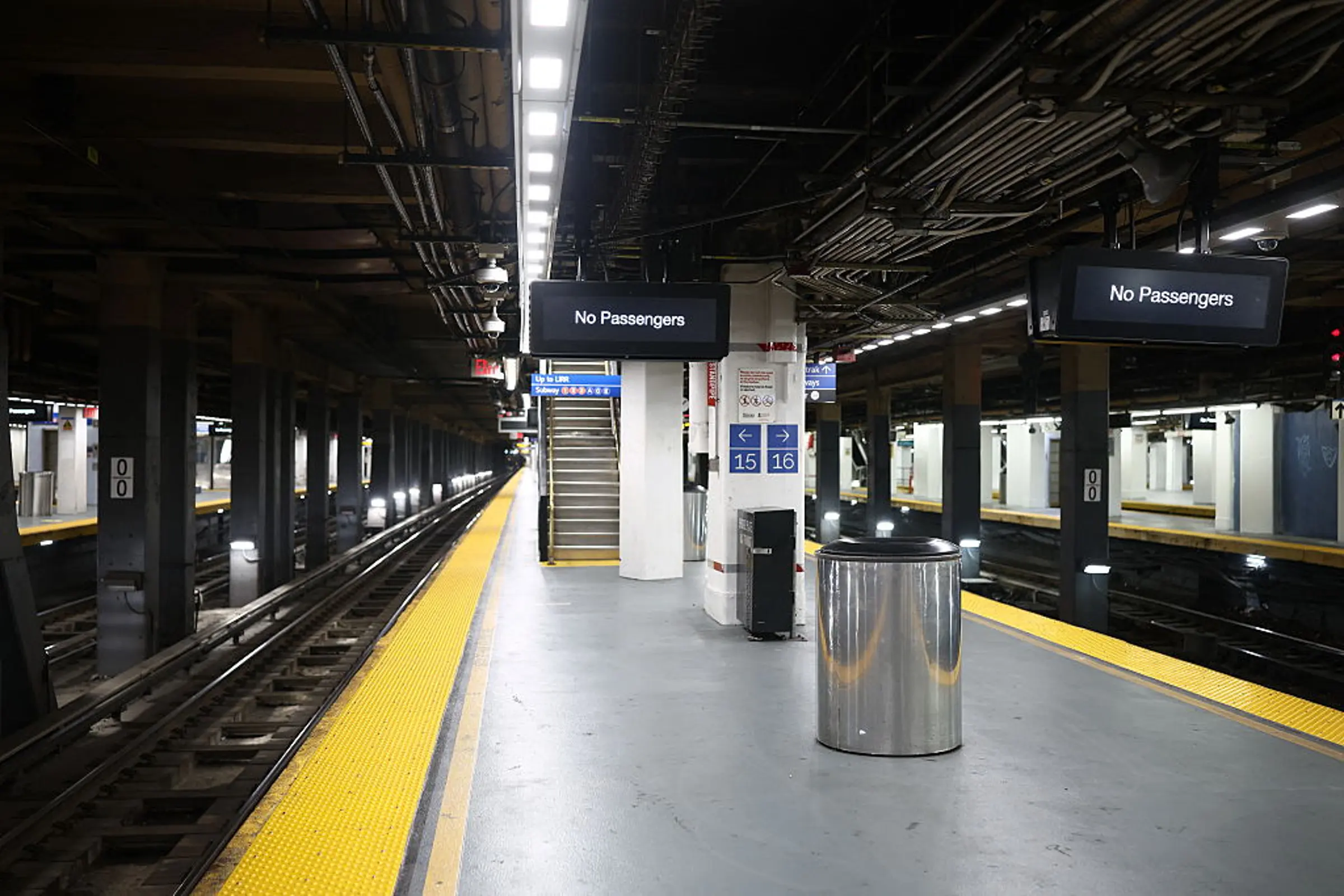
Empty train platforms at Penn Station are seen after the suspension of Long Island Rail Road (LIRR) service due to a strike, in New York, on May 17, 2026. Charly Triballeau—AFP/Getty Images
Who is affected by the strikes?
According to a 2025 report, the LIRR carried some 82 million passengers last year. During the weekdays, the average ridership was more than 250,000; on Saturdays, it was 137,000, and on Sundays, it was 112,000.
Hochul said in her Sunday press conference that thousands of people depending on the LIRR will be affected by the strike. Forcing these passengers to find alternative modes of transport, including driving cars, could potentially worsen traffic on New York’s major highways. She urged that by Monday, regular commuters could hopefully work from home to mitigate the impact of the strike.
The MTA said on its website that it will provide limited shuttle bus service on weekdays for essential workers and those who cannot work from home. Buses will run during peak hours— toward Manhattan from 4:30 a.m. to 9 a.m. and to Long Island from 3 to 7 p.m.—to or from six locations on Long Island to transfer points in Queens. The MTA added that riders in Nassau County should consider the NICE Bus to connect to or from points in Queens and access busier subway stations or transport hubs. But the plan does not cover all 126 stations in the LIRR’s 11 lines, leaving commutes still logistically difficult.
The MTA also said that, pending board approval, it will provide prorated refunds to May monthly ticket holders during days of strike-related service suspensions.




.jpg?branch=production&width=2400&quality=75&auto=webp&crop=16:9)



















/https%3A%2F%2Fsportsmole-media-prod.s3.gra.io.cloud.ovh.net%2Fuploads%2F2026%2F05%2Fchamp-69fa166311171530187348.jpg)
 Bengali (BD) ·
  English (US) ·