.png)
 2 hours ago
8
2 hours ago
8
A new Ukrainian campaign is turning Vladimir Putin’s main supply line into a road of ruin.
Subscribe to read this story ad-free
Get unlimited access to ad-free articles and exclusive content.

The key highway linking southern Russia, occupied Crimea and other Ukrainian territories under the Kremlin’s control is at the center of a major drone offensive by Kyiv that is laying waste to Russian logistics and causing fuel stations to run dry.
The 390-mile stretch, known as R-280 or “Novorossiya” (“New Russia”), is a crucial route for supplying Russian forces on the southern battlefields — as well as keeping the occupied territories supplied with fuel and food.
But in recent weeks, the route has been snarled by Ukrainian attacks on vehicles carrying critical supplies, triggering a growing crisis on the tourism-dependent peninsula.
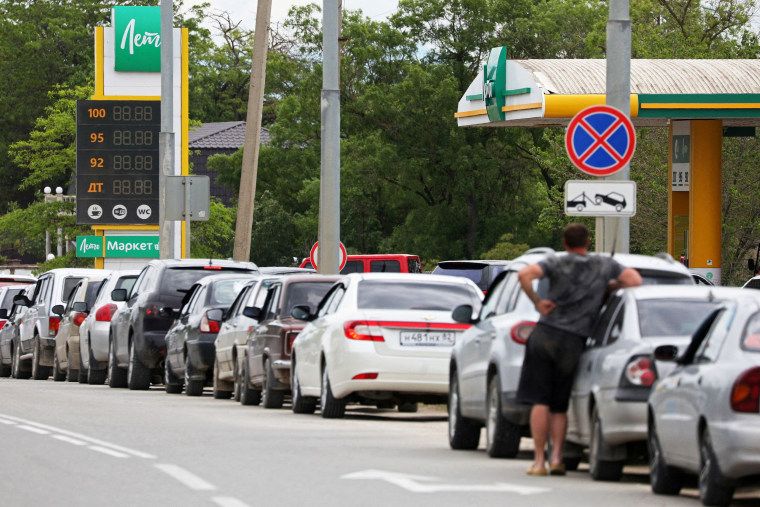 Cars line up for fuel at a gas station in Saki, Crimea, earlier this month.Alexey Pavlishak / Reuters
A fuel ‘lottery’ in Crimea
It’s not clear if Kyiv’s plan for a “logistical lockdown” of Russian operations in this occupied Ukrainian territory could shift the overall dynamics of the four-year war, but it’s already turning into a public relations nightmare for the Kremlin as it faces growing domestic discontent.
Frustrated residents and tourists have been sharing videos of interminable lines at gas stations, while local authorities in Crimea have turned to rationing their limited supplies as they admit they are not able to meet the demand.
One video geolocated by NBC News showed a line of cars stretching for hundreds of yards along a road on the peninsula, waiting for their turn at a gas station. Local Telegram chat groups seen by NBC News are filled with messages from residents desperately looking for gas.
A tutor from the Crimean port city of Sevastopol told NBC News she had abandoned any attempts to fuel up her car. “I don’t want to waste my time,” she said, adding that obtaining a government-issued voucher or QR code to get gas amid the rationing feels like “winning a lottery” these days.
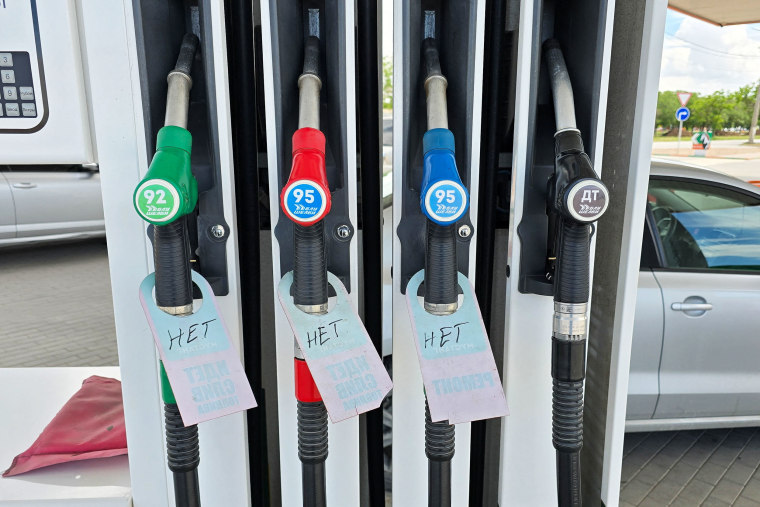 Signs reading "No" placed on fuel pump nozzles at a gas station in Yevpatoriya, Crimea, on Thursday.Alexey Pavlishak / Reuters
The Kremlin has said fuel shortages in Crimea were compounded by “completely unfounded” panic-buying, but spokesman Dmitry Peskov acknowledged “certain problems” when asked whether Crimea could be cut off from fuel supplies due to Ukrainian attacks.
“I think even if everyone suddenly lost their minds and tried to fuel up, this would not have happened if everything was all right on the outside,” said the tutor, who wanted to remain anonymous out of fear of repercussions for speaking on such a sensitive topic.
“The problem is that the fuel just can’t reach us. And how to solve this, I don’t think anybody knows.”
While there is an obvious shortage, people rushing to fuel up are aggravating the problem, said Evgeniy, a resident from the city of Simferopol in southern Crimea who works in transport security and also did not want his last name shared.
“If people did not try to make an extra buck by reselling gas, it wouldn’t be as bad,” said Evgeniy, 45.
‘No safe roads left’
The “Novorossiya” highway runs from Rostov-on-Don in southern Russia through the annexed territories of southern Ukraine to the city of Simferopol in the heart of Crimea.
This land corridor has been an invaluable alternative to the Kerch bridge, a key supply route that has come under repeated Ukrainian attacks in recent years.
Russian-installed officials in southern Ukraine have said that Ukrainian drones are dropping mines onto the highway, trying to create “the illusion of a blockade.”
Vladimir Saldo, the governor of the occupied part of the southern Kherson region, even compared it to the “Nazi siege of Leningrad” during World War II, describing the menacing of the highway from above as “barbaric.”
Saldo said “mobile fire teams” had been deployed to combat drones along the highway, where he accused Ukraine of targeting civilian vehicles. “This is the new reality,” he told state news agency Tass earlier this month, saying roads behind Russian lines have become more dangerous.
It’s a reality that Russia doesn’t seem to have been prepared for.
“Attacking that highway creates a problem for the Russians, which they really don’t have a solution for,” said Emil Kastehelmi, a military analyst with the Finland-based Black Bird Group.
Both sides in this war have been trading intense barrages of long-range attacks while battlefield progress and U.S.-led peace talks have stalled.
A dramatic leap in Ukraine’s drone capabilities has allowed Kyiv to inflict considerable pain on the Kremlin by hitting deeper inside Russia. But this highway-hitting “middle strike” campaign is driven by an intensified focus on Russian supply lines.
One Ukrainian drone brigade reported using a new “secret” drone to target the “Novorossiya” highway. And President Volodymyr Zelenskyy boasted last week that “there are practically no safe roads left for the occupier in the south and east of our country.”
In order to protect the highway, Russia would need to gather more air defense assets in the area, Kastehelmi said. “It’s a wide and deep area, which they would need to protect and monitor,” he said. That could leave other areas vulnerable, given Moscow’s strained resources.
In the meantime, military cargo traffic along the highway has decreased by 71% over the past two weeks, the commander of the Ukrainian drone forces, Robert Brovdi, said Tuesday. He called the operation “effective” but not a full blockade yet.
“The optics of this for Putin are awful,” said Bob Tollast, a land warfare expert at the Royal United Services Institute, a defense and security think tank in London.
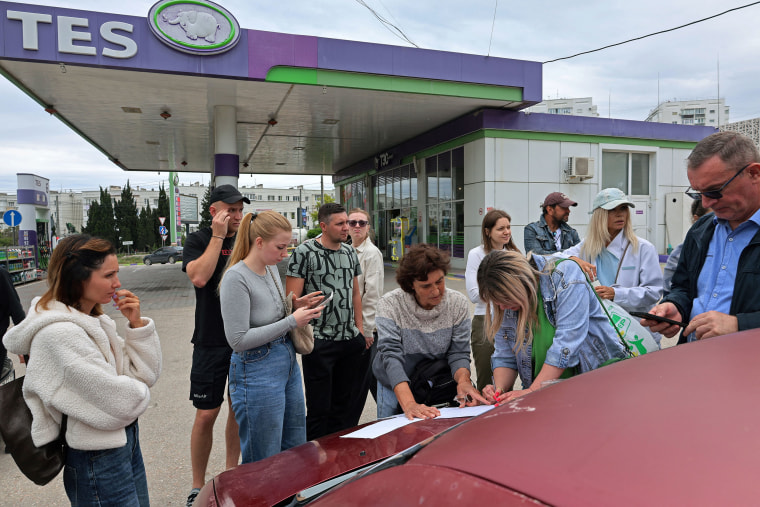 People put their names on a list to join the queue for fuel at a gas station after the authorities restricted fuel sales, in Sevastopol, Crimea, on June 1.Reuters
Since it was annexed in 2014, Crimea has become a hub of military firepower and logistics, Tollast said, and Russian forces have used the peninsula as a “jumping-off point” for operations in Ukraine.
Kyiv has long sought to threaten Russian logistics in Crimea, but absent sufficient Western weapons, it has been innovating with uncrewed surface vessels and high-payload drones to achieve that goal.
“This follows a long period of suppression and destruction of Russian air defenses there to make way for these strikes,” said Tollast. “It amounts to a humiliating picture for the Russians,” he added.
‘Constant cycle of adaptation’
The overall front line remains largely static, and prospects for any peace deal have only dimmed in recent weeks, with Putin dismissing a taunting public letter from Zelenskyy that urged him to join face-to-face talks.
If Ukraine can sustain its pressure on Russian logistics routes, including the “Novorossiya” highway, it could bring a settlement closer, said Mykola Bielieskov, a Ukrainian military analyst and research fellow at the National Institute for Strategic Studies.
“The ultimate goal is to create the basis for larger-scale counterattacks by the Ukrainian forces,” Bielieskov said of Kyiv’s motivation for targeting the highway. If Ukraine destroys Russian logistics faster than the Russians can take countermeasures to secure the routes, “then we will gain a certain advantage,” he added.
Russia’s influential military bloggers and former military officials have criticized the Kremlin for how unprepared it has seemed in the face of these highway attacks.
“For our logistics, the problem could become even greater if measures are not taken here and now,” wrote the prominent Arhangel Speznaza Telegram channel. Another blogger, Kirill Fedorov, suggested covering the entire length of the highway in anti-drone nets as a way to stop the attacks.
“The enemy is acting brazenly,” wrote lawmaker and retired military officer Andrei Gurulev on Telegram. “Some people think Crimea is just a resort. It’s not,” said Gurulev. “Today, it’s a front-line region, and the approach to ensuring its security must be tough and military.”
Kastehelmi, the military analyst, said Ukraine has “a small window of opportunity” as Moscow struggles to defend against the highway attacks, but the war has been “a constant cycle of adaptation” and the Russians are likely to find a solution eventually.
“I think that it will get worse for the Russians before it gets better,” Kastehelmi added.
























 Bengali (BD) ·
  English (US) ·