.png)
 1 hour ago
12
1 hour ago
12
Article content
More than 100 U.S. House Democrats voted this week to cut military aid to Israel, exposing a widening party divide that could reshape both November’s midterm elections and the future of one of Washington’s most durable foreign policy alliances.

THIS CONTENT IS RESERVED FOR SUBSCRIBERS
Enjoy the latest local, national and international news.
- Exclusive articles by Conrad Black, Barbara Kay and others. Plus, special edition NP Platformed and First Reading newsletters and virtual events.
- Unlimited online access to National Post.
- National Post ePaper, an electronic replica of the print edition to view on any device, share and comment on.
- Daily puzzles including the New York Times Crossword.
- Support local journalism.
SUBSCRIBE FOR MORE ARTICLES
Enjoy the latest local, national and international news.
- Exclusive articles by Conrad Black, Barbara Kay and others. Plus, special edition NP Platformed and First Reading newsletters and virtual events.
- Unlimited online access to National Post.
- National Post ePaper, an electronic replica of the print edition to view on any device, share and comment on.
- Daily puzzles including the New York Times Crossword.
- Support local journalism.
REGISTER / SIGN IN TO UNLOCK MORE ARTICLES
Create an account or sign in to continue with your reading experience.
- Access articles from across Canada with one account.
- Share your thoughts and join the conversation in the comments.
- Enjoy additional articles per month.
- Get email updates from your favourite authors.
THIS ARTICLE IS FREE TO READ REGISTER TO UNLOCK.
Create an account or sign in to continue with your reading experience.
- Access articles from across Canada with one account
- Share your thoughts and join the conversation in the comments
- Enjoy additional articles per month
- Get email updates from your favourite authors
Sign In or Create an Account
or
Article content
The measure, offered by conservative Kentucky congressman Thomas Massie, was defeated overwhelmingly after nearly all his fellow Republicans and 98 Democrats opposed it.
Article content
Article content
Article content
But the vote was striking because 103 Democrats backed ending the aid, while 10 others voted present — a near-even split that would have been almost unthinkable for most of the modern U.S.-Israel relationship.
Article content
By signing up you consent to receive the above newsletter from Postmedia Network Inc.
Article content
“When more than 100 House Democrats are willing to vote to cut military aid, that’s no longer a protest vote,” veteran political strategist Mike Fahey told AFP.
Article content
“That’s a signal that the party is undergoing a generational and ideological realignment.”
Article content
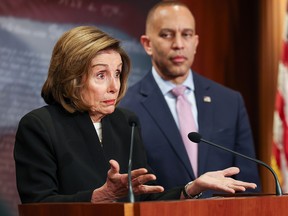
The revolt reached deep into Democratic leadership. House Minority Leader Hakeem Jeffries opposed the amendment, but his deputy Katherine Clark voted for it, as did former speaker Nancy Pelosi, one of Congress’s longest-serving defenders of the alliance.
Article content
“For the good of the Israeli people and the Palestinian people, it is clear U.S. policy must change,” Pelosi said.
Article content
Clark said Washington should not provide a “blank check” to any country that fails to comply with U.S. law, interests and values.
Article content
The amendment had little chance of becoming law. But it became a political marker, revealing how much support for Israel has eroded inside the Democratic Party after years of war in Gaza, mounting Palestinian casualties and frustration with Prime Minister Benjamin Netanyahu’s right-wing government.
Article content
Article content
It isn’t simply a Washington dynamic; opinion among left-leaning voters has shifted sharply.
Article content
Article content
A recent Washington Post-Ipsos poll found that nearly three-quarters of Democrats want to reduce or end military support for Israel, while 40 per cent want to eliminate it entirely.
Article content
Other surveys show a broader generational shift, with younger Americans far less willing to accept unconditional U.S. support for Israel than older voters.
Article content
The shift is already playing out in Democratic primaries.
Article content
Progressive candidates in New York, Pennsylvania, New Jersey and Colorado have won races while openly criticizing U.S. aid to Israel and attacking the influence of the American Israel Public Affairs Committee, the powerful pro-Israel lobby known as AIPAC.
Article content
In Michigan, a key battleground state, Senate candidate Abdul El-Sayed has made opposition to Israel’s war and U.S. military aid a central part of his campaign against Congresswoman Haley Stevens, a longtime Israel supporter backed by pro-Israel groups.
Article content
That fight has national implications.
Article content
Anger over Gaza helped weaken Democrats in Arab American areas of Michigan in the 2024 presidential election, when Donald Trump carried the state, and party strategists fear the issue could again depress turnout or intensify intra-party conflict.





























/https%3A%2F%2Fsportsmole-media-prod.s3.gra.io.cloud.ovh.net%2Fuploads%2F2026%2F07%2Fdaniel-mcgregor-huyer-zuma-press-wire-luciano-gonzalez-anadolu-abacapress-com-estadio-azteca-harry-kane-jude-bellingham-composite-6a49eb8857b70695441164.png)
 Bengali (BD) ·
  English (US) ·