.png)
 3 hours ago
10
3 hours ago
10
The United States and Iran will hold new talks Monday afternoon, President Donald Trump said, after announcing he called off intense new strikes to allow for a deal on the Strait of Hormuz and Tehran’s nuclear program.
Trump said earlier that he agreed to call off the attacks amid what he said were the “perimeters of a deal” that would include resuming shipping through the key global trade route.
Speaking on Air Force One on Sunday, Trump claimed that the canceled strikes were going to be “the biggest attack since World War II.” The president said that the U.S. is “holding” what would have been a “massive attack,” but that it could still take place “anytime we want.”
Trump, however, said that Iran does not have a deadline to come to an agreement.
“We’re ready to go anytime we want. Would I rather make a deal? I’m not looking to kill people,” Trump told reporters as he returned to Washington from a weekend in New Jersey.
Iran has yet to respond publicly to Trump’s comments about new talks. Trump has repeatedly threatened and then said he was canceling big attacks, citing progress in talks — only for the diplomacy to be upended by the two sides resuming tit-for-tat strikes.
This latest twist came after the most recent cycle of attacks failed to break Tehran’s stranglehold on the strait and in fact saw the war expand to the Red Sea and Egypt, threatening even greater fallout for the global economy.
New American casualties and rising energy prices intensified the domestic pressure on Trump, who appeared set to escalate the conflict only to again back away at the last minute.
Trump’s announcement that he had called of the attack came after the State Department on Saturday urged Americans across the Middle East to consider leaving the region or be prepared to depart on short notice. It also warned of flight disruptions and security risks.
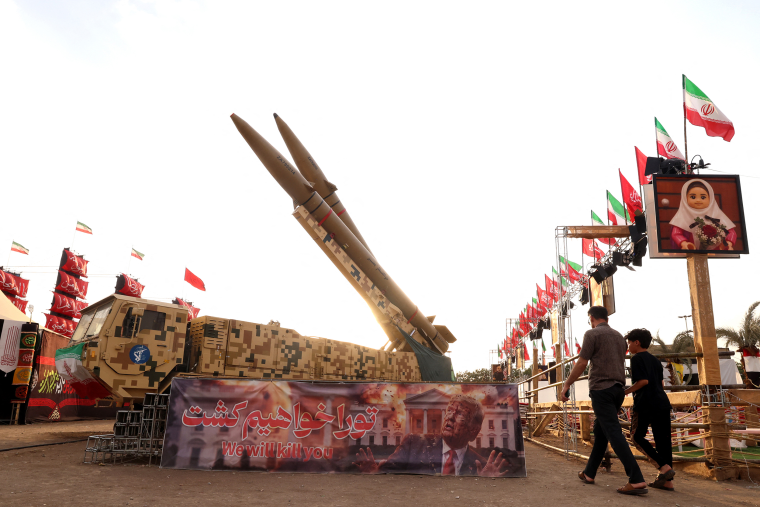 Iranian-made Zolfaghar missiles are displayed at Azadi Square in Tehran on Sunday.Atta Kenare / AFP via Getty Images
Trump earlier threatened Iran with additional attacks, saying Friday that the U.S. would be “hitting them very hard,” while Iran vowed to “punish” the U.S.
The conflict has now entered its sixth month, despite Trump’s repeated early predictions that the war would resolve itself “shortly.”
There was a brief reprieve from fighting in June when the two sides signed a memorandum of understanding outlining the process for talks to end the war.
But in early July, Trump declared the ceasefire to be “over,” and the countries resumed strikes.
The conflict has centered on the Strait of Hormuz, where Iran has attacked shipping and asserted its authority by insisting vessels must use its pre-approved routes through the crucial waterway. The U.S. and world powers have sought to break Tehran’s hold, insisting Iran shouldn’t be able to charge a toll for passage.
Iran and Oman, which also borders the strait, have been holding talks to try and resolve the trade route’s future.
Iranian Foreign Minister Abbas Araghchi held phone calls with his Saudi counterpart Prince Faisal bin Farhan and Pakistan’s army chief Asim Munir to discuss diplomatic efforts, Iran‘s state media reported on Sunday.
Saudi Crown Prince Mohammed bin Salman, a key regional player, spoke with Trump by phone Saturday. According to the Saudi state news agency, he told him that dialogue was needed to de-escalate Middle East tensions, and expressed concerns over plans for new strikes against Iran.























/https%3A%2F%2Fsportsmole-media-prod.s3.gra.io.cloud.ovh.net%2Fuploads%2F2026%2F07%2Fwc26-stencil-generic-1-player-email-6a5efced3be22784676779.jpg)
/https%3A%2F%2Fsportsmole-media-prod.s3.gra.io.cloud.ovh.net%2Fuploads%2F2026%2F04%2Fimago1075785696-69f1c41377d96073966575.jpg)
 Bengali (BD) ·
  English (US) ·