.png)
 8 hours ago
9
8 hours ago
9
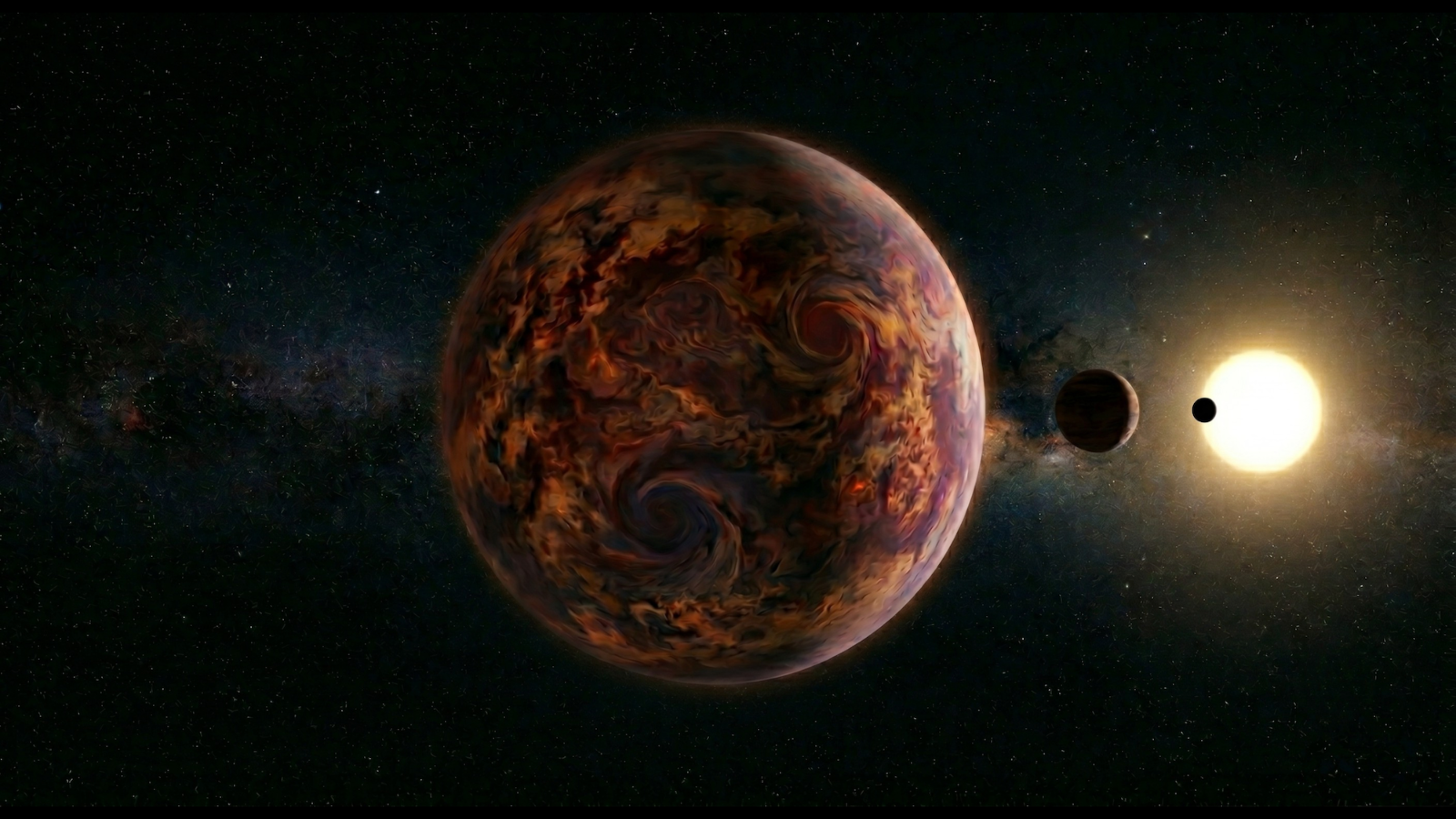
Using NASA's exoplanet-hunting spacecraft TESS (Transiting Exoplanet Survey Satellite), scientists have discovered a planetary system that scientists are calling "improbable." It could change how we think about the mechanisms behind planet formation.
The reason for the unusual arrangement of this planetary system is a failed star or brown dwarf designated TOI-201 c. Objects like this get the slightly unfair nickname of "failed stars" because, despite forming from a collapsing cloud of gas and dust like other stars, they fail to gather enough mass to trigger nuclear fusion of hydrogen to helium in their cores. Brown dwarfs have masses between 13 and 80 times that of Jupiter, or 0.013 to 0.08 the mass of the sun. That puts them right between the most massive planets and the smallest stars.
TOI-201 c is on a highly elliptical orbit, taking 2,881 days to orbit its star, which has resulted in planets including a super-Earth named TOI-201 d and a warm Jupiter named TOI-201 b, forming in a narrow zone within its orbit, something that isn't just new to astronomers; it is completely unexpected based on planetary formation models.
The 5.8-day orbit of TOI-201 d and the 53-day orbit of TOI-201 b are both perfectly aligned with the orbit of the brown dwarf. The brown dwarf creates gravitational instability at distances equivalent to the distance between Mars and the sun, but this didn't prevent planets from forming in the system.
"This discovery provides a crucial insight into how planets form even around massive, eccentric objects," team member and INAF researcher Aldo Bonomo said in an emailed statement.
The system challenges the idea that gas giant planets form at distances equivalent to 2 to 3 times the distance between Earth and the sun in the disks of gas and dust that surround stars during their infancy.
"The presence of the brown dwarf on such an elliptical orbit forced the planets to form and survive by occupying the innermost and hottest edges of the primordial disk," team member Luca Naponiello of the National Institute for Astrophysics (INAF) said in the statement. "Furthermore, the data show that during the close approach of the brown dwarf, the warm Jupiter undergoes strong and sudden variations in its transit timing, bearing witness to an intense and vigorous dynamic interaction currently underway between the two giants."
The system was discovered by TESS using a rare mono-transit event, which describes a planetary body making one crossing of the face of its star, causing a dip in starlight. This was followed by an observing campaign conducted from the ground.
It is extremely rare to discover objects like TOI-201 c with such long and eccentric orbital periods using transits they make of their parent star. This brown dwarf is the first one of these objects to have its mass confirmed, making it an important step forward in astronomy.
"It [TOI-201c] is the transiting object with the longest orbital period for which the mass is known," Naponiello said.
The team's results were published on Wednesday (June 17) in the journal Nature.
























/https%3A%2F%2Fsportsmole-media-prod.s3.gra.io.cloud.ovh.net%2Fuploads%2F2026%2F06%2Frio-ngumoha-email-sportmole-6a27b73e9a471352625861.png)
 Bengali (BD) ·
  English (US) ·