.png)
 5 hours ago
12
5 hours ago
12
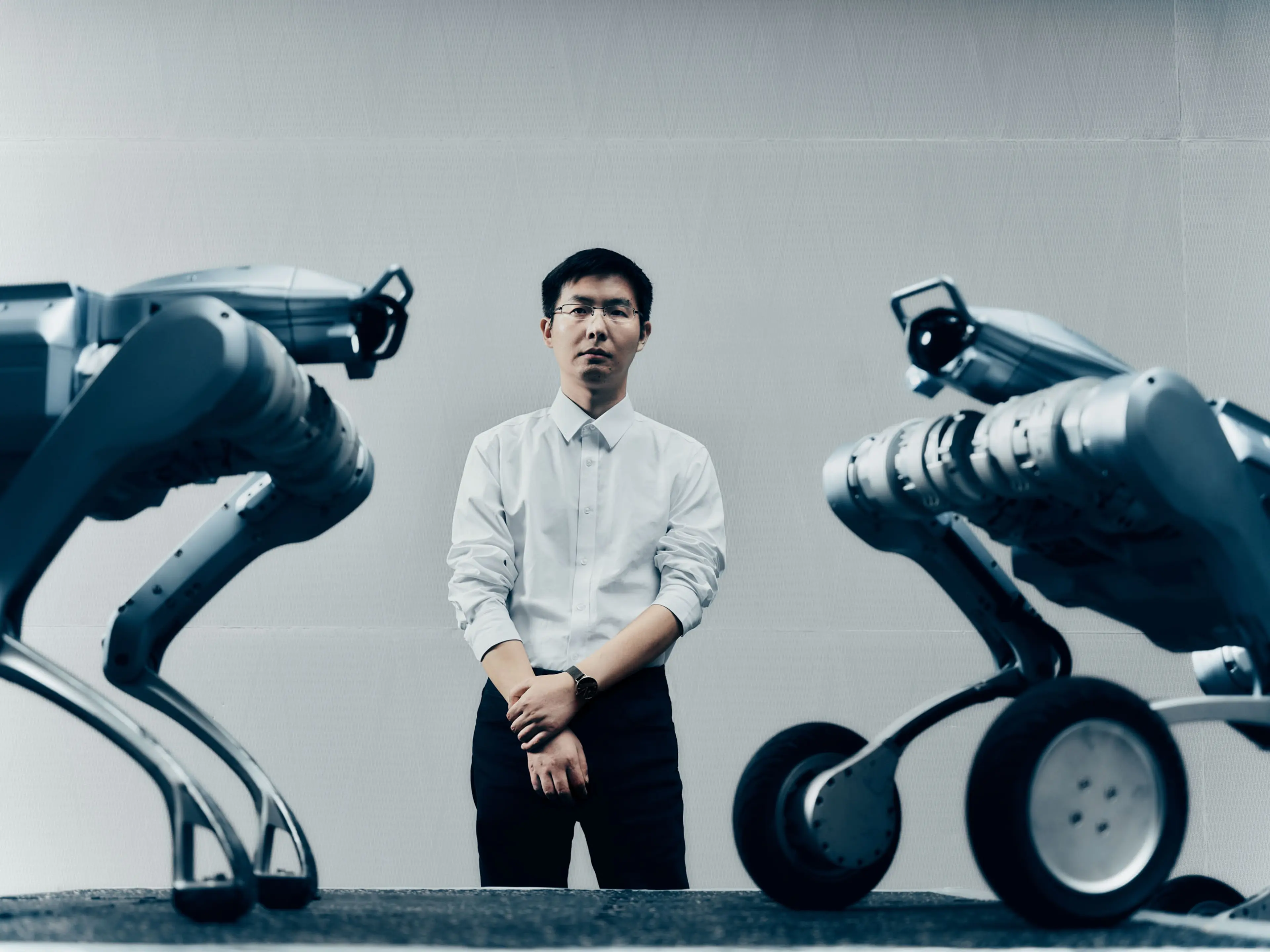
Unitree CEO Wang Xingxing was 26 when he founded the company.
Spectators typically leave a UFC fight with ringing ears and a sheepish resolve to get back to the gym. Wang Xingxing went straight to his laboratory.
“I thought I could make a bigger robot for boxing competitions,” says Wang, the founder and CEO of Hangzhou-based humanoid-robotics firm Unitree. “Then I thought, Why not do an even bigger one that can actually carry a human inside?”
The upshot of Wang’s creative fervor is the GD01, which Unitree bills as the world’s first mass-produced, transformable mecha robot. Standing 9 ft. tall and weighing half a ton, it can transport a pilot in its torso-mounted cockpit, walk on either two legs or four, and wield fists powerful enough to knock down walls. Heavy-duty mechanical hinges connect titanium-alloy limbs to a protective casing of carbon fiber, enabling smooth, deliberate strides on brutish red legs.
Wang showed off the GD01 exclusively to TIME as part of his first international media interview, revealing that beyond mixed martial arts, he took a dash of inspiration from James Cameron: “We actually drew some references from a similar robot featured in Avatar.”
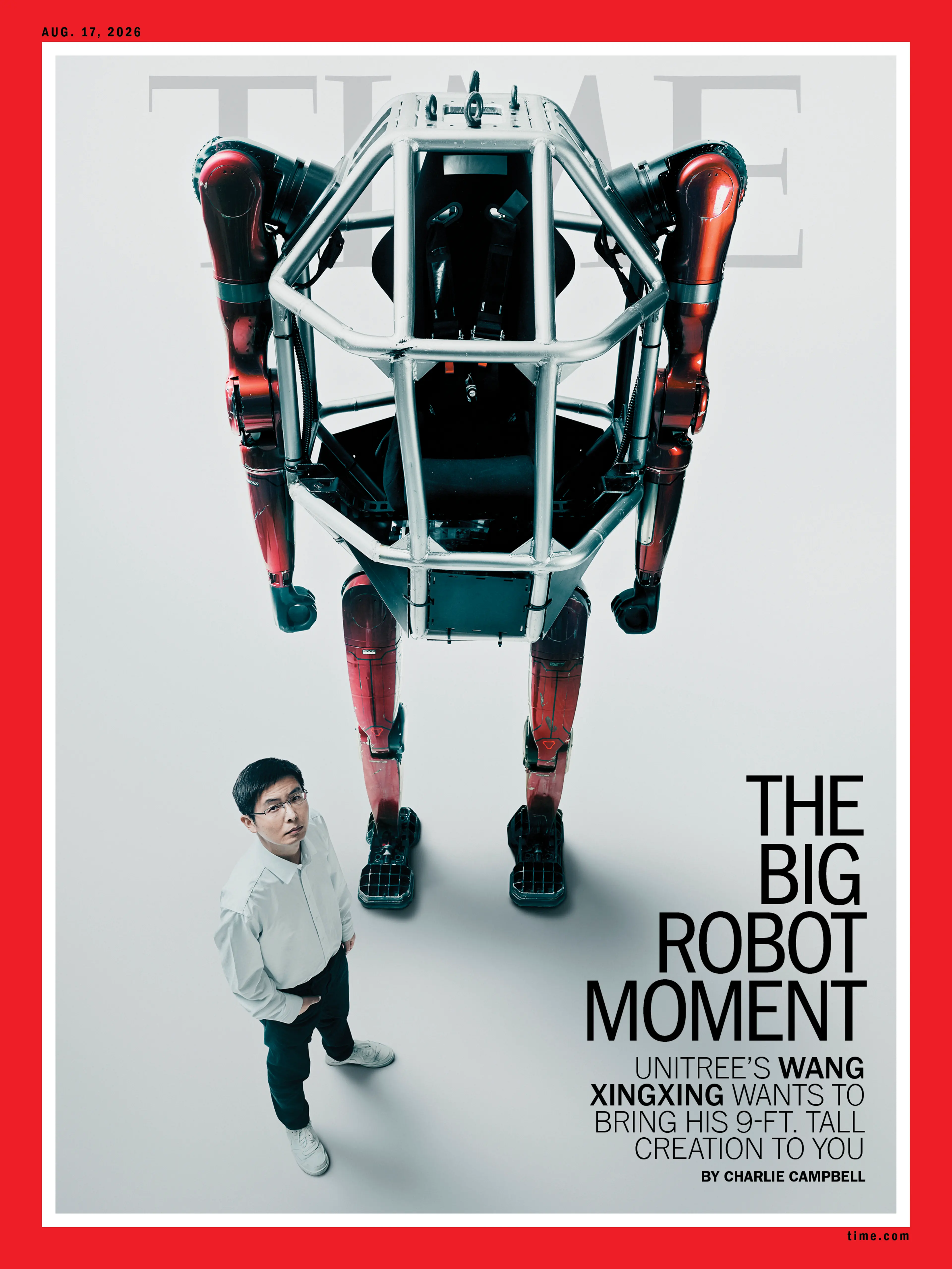
Photograph by Mattia Balsamini for TIME
Wang has done more than arguably anyone else to bring this science fiction closer to reality. A native of China’s coastal city of Ningbo, he founded Unitree in 2016 when he was just 26 years old and has moved from robot dogs to humanoid robots and now, with GD01, human mobility machines. But while the GD01 might inspire awe, humbler humanoids like Unitree’s flagship G1 are the ones set to become the workhorses of a global robotics transformation already gathering pace in China, the U.S., and beyond.
This is the next great tech frontier, one that has previously been the purview of Star Wars and Blade Runner: AI that walks, sees, hears and physically interacts with the real world. Morgan Stanley predicts that as many as 13 million humanoids could walk among us by 2035—equivalent to the population of Bolivia. That number is forecast to rise to 1 billion by 2050, when the industry could be worth $5 trillion.
Unitree is hardly alone staking a claim in this space. In January, Tesla announced the third generation of its Optimus humanoid robot with a goal to eventually produce 10 million units per year at factories in Fremont and Texas. In late June, California-based Figure dispatched its latest 03 humanoid to BMW’s Spartanburg plant in South Carolina, where its earlier 02 model helped assemble 30,000 cars last year. Oregon-based Agility, meanwhile, has secured deployments everywhere from Toyota to Latin American e-commerce giant Mercado Libre. But Unitree is the world leader in terms of volume, dispatching more than 5,500 units in 2025, comprising over a quarter of a global market that is only just waking. In June, Nvidia announced that its bleeding-edge Jetson Thor chip would be fitted into Unitree’s H2 humanoid for sale to research institutions around the globe.
We could be, Wang says, anything from two to 10 years away from a “ChatGPT moment” for humanoids, whereby a robot achieves sufficient “generalization” to be able to execute 80% of requested voice commands in an 80% unfamiliar environment. “Once the technology surpasses this ... inflection point, robots can gradually be rolled out for large-scale commercial use,” he says.
“We don’t see any significant competitors outside of China.”
—Elon Musk, on China’s dominance in the humanoid field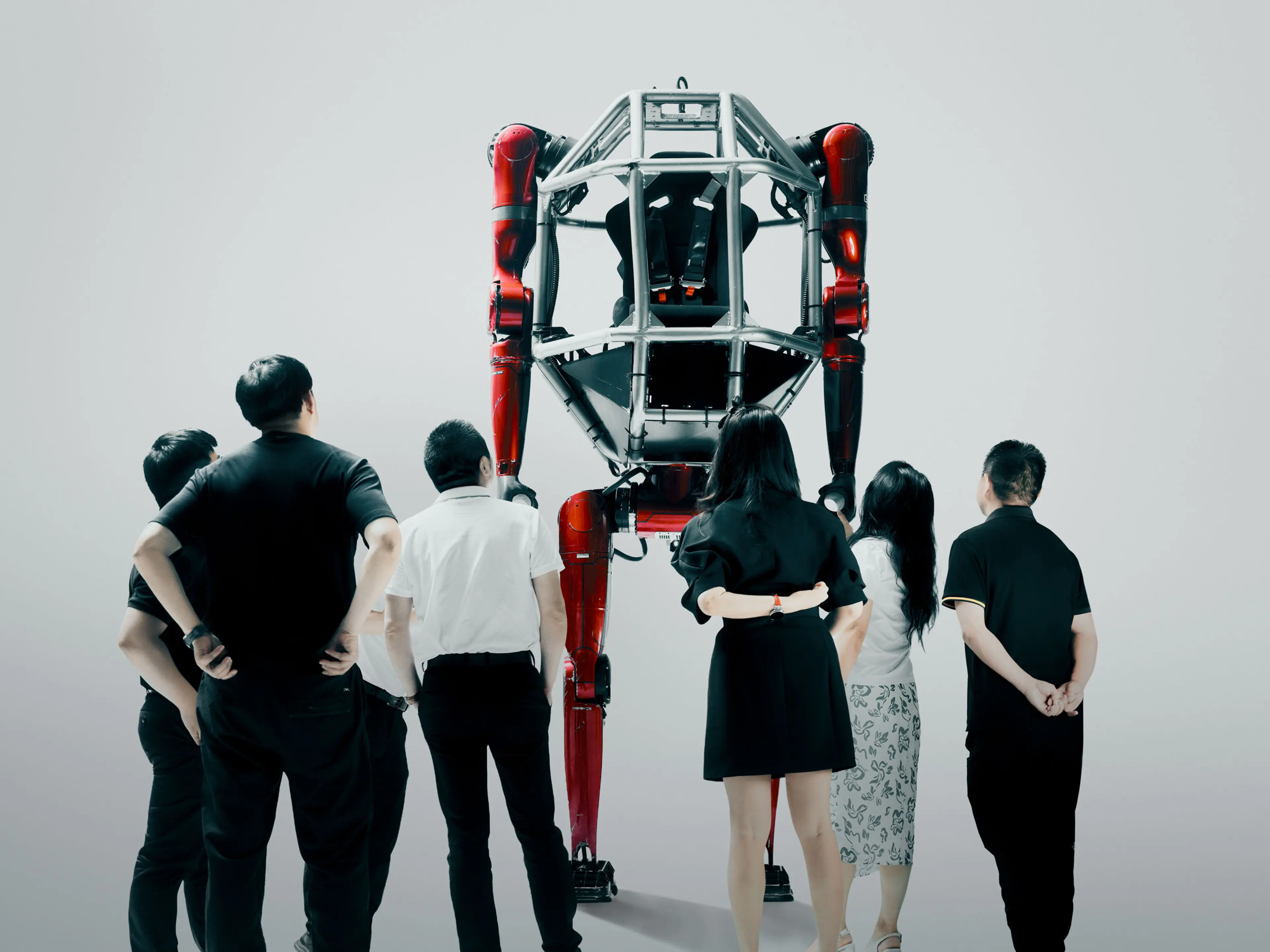
If the timeline for that breakthrough is a matter of debate, its potential impact is not. Nonunion robots (the only kind) could operate around the clock on assembly lines, replace some nurses in hospitals, and pick fruit under the hot sun.
The positive outlook is that wide-scale humanoid adoption will herald an unprecedented era of global abundance, automating mundane and dangerous labor while ushering in post-scarcity societies. There is a less rosy divination, however. Amid a mass labor displacement, robots concentrate even more wealth into fewer human hands. With production severed from wages, people could face an identity crisis as robots begin to dominate manual labor and service industries, while governments contend with strained social safety nets and rising competition between the U.S. and China—leaders in humanoids as they are in AI—over raw material and technology. On June 3, three U.S. lawmakers introduced the bipartisan Guard Act, which seeks to ban Chinese robots deemed to be a national-security threat. Unitree was singled out by John Moolenaar, a bill co-sponsor and chairman of the House Select Committee on China, who accused Wang’s firm of benefiting from “generous state subsidies” and threatening to bankrupt American competitors.
With AI, we’ve already seen how the ability of large language models (LLM) to parse huge reams of data also makes them susceptible to hallucinations and unintended consequences, like designing biological weapons. But while an LLM can suggest harm, a robot can enact it, auguring a terrifying new cybersecurity peril in the age of embodied AI. Online scams already siphon off staggering sums, but a hacked humanoid could move the threat from screens into homes, streets, nurseries, and factory floors.
The tension between these visions can be reduced to a choice of myth: Are Wang and his GD01, and indeed their competitors, akin to Luke Skywalker and the faithful, guileless C-3PO—or more like Frankenstein and his monster?
Wang, unsurprisingly, veers toward the positive, predicting that in 10 years every household may have a small robot that can do your laundry, grill your steak, and even provide basic care if you fall ill. They can also take on tasks most humans would rather avoid, from steep mountain farming to sewer maintenance.
But if that sounds like a future arriving faster than society can absorb it, Wang insists the transition will be gradual. “It will evolve step-by-step,” he says. “If society finds that robots don’t perform well in a certain sector, or if people simply don’t like them there, we can easily pivot and re-direct their application to other fields. So, everything remains well within controllable boundaries.”
Wang is an unlikely prophet of the AI age. Slight and bespectacled, he possesses none of the performative bravado associated with many technology founders. Instead, he speaks about robotics with quiet, unwavering conviction.
The possibilities and promises of a humanoid revolution have occupied him since he was 10 years old and first watched early televised robotics experiments performed at MIT by Marc Raibert, founder of Boston Dynamics. He spent his free time building model aircraft, conducting experiments, and, before long, assembling miniature turbojet engines.
In 2009, Wang enrolled at Zhejiang Sci-Tech University in Hangzhou, majoring in mechatronics engineering. As a first-year student, he says, he built his first small bipedal robot, capable of walking a few steps, on less than $30. That same price-conscious approach would underpin Unitree’s flourishing. While pursuing a master’s degree at Shanghai University, he developed a prototype quadruped robot, XDog, which still occupies pride of place in the Unitree headquarters. Departing from the hydraulic-powered designs popularized by his idols at Boston Dynamics, Wang opted for a cost-saving electric-motor model, which helped XDog win second prize in a national entrepreneurship competition.
After graduation and a stint at Shenzhen-based drone trailblazer DJI, Wang launched Unitree with 2 million RMB ($300,000) in capital from an angel investor. It has since become a cultural phenomenon; an estimated 600 million people watched videos of Unitree’s H2 and G1 humanoid robots swinging nunchucks and executing flips as part of February’s Spring Festival Gala—China’s equivalent to the Super Bowl halftime show. It was the second year that Unitree humanoids provided the headline act, and all eyes are on what Wang has planned next time. “I have no idea,” he confesses with a laugh.
In March, Unitree filed for an IPO that would value the firm at $6 billion, sparking a buying frenzy in mainland Chinese markets for companies that would benefit along with it, such as upstream suppliers.
But high expectations are both a blessing and a curse. While Unitree’s first-quarter revenue surged over 68% year-on-year to $62 million, adjusted net profit halved over the same period to just $6 million, which the company blamed on a significant spike in R&D and sales costs. Wang talks about “a flip side” to viral internet fame. “Because the hype gets so intense, it places a fair amount of pressure on our company and the industry as a whole,” he says. “Everyone starts expecting your technology to leap forward at a breakneck pace. But the truth is, deep tech breakthroughs require a certain amount of time.”
Unitree’s blossoming came just as the Chinese government began leaning into AI and robotics, which President Xi Jinping has highlighted as key examples of the “new growth drivers.” China’s Ministry of Industry and Information Technology in turn declared humanoids a “disruptive innovation” on the same level as smartphones and EVs—breakthroughs destined to transform human production and lifestyle, making leadership a matter of economic and national security. It’s a policy push backed by hard cash; since late 2024, Chinese cities have put together investment funds worth over $26 billion, according to Morgan Stanley. Unitree hasn’t disclosed the exact level of state support it receives, though as one of Hangzhou’s “Six Little Dragons”—elite local startups—it benefits from the city’s $14 billion Sci-Tech Fund. “China is an ass kicker, next level,” Elon Musk told a Tesla earnings call in January. “To the best of our knowledge, we don’t see any significant [humanoid robot] competitors outside of China.”
Meet Unitree’s GD01 Robot
Wang’s role leading that charge was evident when he appeared as the youngest member of a high-profile business symposium hosted by Xi last spring. More than 140 Chinese companies now make humanoid robots, yet the perception inside China is that Unitree is not just another robotics startup, but a hardware platform destined to replicate what BYD achieved for EVs and DJI did for drones. Wang’s strategy is simple but hard to beat: first, control the most difficult core components; leverage scale to relentlessly drive down costs; and use each product generation to unlock new markets.
Unitree has slashed the pretax price of its flagship G1 humanoid from $16,000 to $13,500 in just 18 months. (Still, with components that cost under $9,000, according to recent estimates by SemiAnalysis, that gives Unitree a handy 33% gross margin.) The R1 model now retails for under $5,000, and over six years the price of their “robot dogs” has dropped from $45,000 to under $2,000. Wang insists Unitree wins through manufacturing cost efficiency—for example, it produces its own actuators, the “muscles” responsible for movement, which account for 50% to 70% of a humanoid’s cost.
While the G1 might not boast the peak performance of some Western competitors in terms of load bearing and durability, it has crossed the “good enough” threshold for real-world deployment. With the ability to carry 5-kg payloads for 10 to 15 minutes continuously without overheating, it is moving out of R&D labs and into pilot deployments for warehouse logistics and material handling.
“Humanoid robot technology is still in its relatively early stages.”
—Wang Xingxing, Unitree CEO.jpg?branch=production&width=3840&quality=75&auto=webp)
Tourists watch the Unitree G1 humanoid robot performance by West Lake in Hangzhou, Zhejiang Province, China on June 17, 2026. CFOTO/Future Publishing/Getty Images
That said, to date only a fraction of humanoids sold are employed in actual useful work. The reason is very simple: today’s robots operate at about 30% to 50% of human efficiency for general factory and warehouse tasks, such as stacking and carrying boxes. Only 9% of Unitree’s sales go directly into industrial applications, with 17% for commercial venues such as tourist sites, exhibitions, and retail stores. That leaves 74% of Unitree’s humanoid sales to universities, research institutions, and individual developers looking to hone their own AI and motion-control capabilities. And the company is far from alone. The entire modern humanoid industry is essentially selling robots to people trying to build better robots. “Humanoid robots are just not ready for the mass market,” says Grace Shao, who publishes the AI Proem newsletter.
Wang is unconcerned, however, and compares this trend to the early days of the personal computer, when they were primarily purchased by those in the business: “As the software becomes increasingly mature, with more developers joining each year, the proportion of genuine industrial deployments is growing at an incredibly fast pace.”
For now, Unitree is still wrestling with the same white whale as its legion of competitors: the generalization gap, which Wang calls “the biggest headache for the entire global scientific community.” While today’s back-flipping machines are engineering marvels, they remain stubbornly task-specific. If you want a robot to pick up a pen and move it across a desk, you must program every granular motion. But to make AI truly useful in the physical world, robots must transition from executing rigid scripts to understanding novel commands—like being told to simply “go to the grocery store.”
Achieving this milestone will require overcoming two self-reinforcing problems: the scarcity of 3D data and the diversity of deployment environments. Unlike LLMs like ChatGPT, which can parse the virtually boundless internet, robots need manipulation data collected in the real physical world, which is costly and difficult to scale. It must typically be collected manually by repetitively training machines how to perform certain tasks, such as folding shirts, stocking refrigerators, or shaking a mai tai. Plus, explains Jiang Zheyuan, CEO of Beijing-based humanoid firm Noetix, “even if a well-performing manipulation strategy is trained for a specific task, the success rate often drops sharply when the environment changes slightly—for example, object displacement, different lighting, or different tabletop materials.”
Thanks to firms like Unitree, the hardware for humanoids is advancing quickly. The real battleground is over the robot brains, or vision-language-action (VLA) models, which are designed to turn human inputs into embodied AI performing intuitively and accurately. The VLA space alone will be worth $40.50 billion by 2035, predicts Kaiso Research, a market intelligence firm, and many of tech’s biggest players are aggressively pursuing their own models, including Nvidia’s GR00T N1.7, Google DeepMind’s RT-2-X, and Alibaba’s Qwen Robot Suite.
That battle is increasingly about one thing: collecting data. In New York City, for example, Micro AGI, which counts Unitree as a partner, is sending camera-wearing staff to clean apartments free of charge simply to generate 3D data to train its physical AI model. But as a dedicated robotics company, Unitree is arguably in a weaker position than Tesla, Xiaomi, or XPeng, which have diversified revenue streams and established supply chains. So solving this generalization gap is key to maintaining its status as today’s market champion. After all, its absolute sales are by any measure minuscule, meaning whoever closes the gap first could easily surge ahead.
There may be a game changer on the horizon: revolutionary new 6G connectivity would enable AI-native networks on which collective learning happens seamlessly across millions of connected devices. If one humanoid in a distant warehouse wrestles with a novel tool and finally masters it, that newly generated data can be instantly uploaded and shared across the entire global fleet. 6G will empower us “to make a digital twin of the world,” Cristiano Amon, CEO of $200 billion semiconductor firm Qualcomm, tells TIME.
Boosted connectivity would solve the robotics bottlenecks of weight and battery life. Navigating our world requires simultaneously processing 4K video, spatial lidar, audio, and delicate tactile or proprioceptive feedback. But carrying heavy computational hardware and the means to power it severely limits both robot agility and operating time. 6G could potentially combine cloud processing with network lag of a near instantaneous 0.1 to 1 millisecond. Suddenly, lightweight physical robots could be animated by a cloud-based AI brain operating in real time. When a robot fumbles, 6G provides a safety net via remote human teleoperation.
As these machines come online, a significant challenge will be securing any centralized network. Last year, cybersecurity analysts discovered a “backdoor” in Unitree’s Go1 robot dogs, whereby third parties could log onto a portal to see the robot’s location, view live camera feeds, and even control it remotely. In response, Unitree shut down the cloud service that enabled the breach. Wang insists his “robot products operate completely disconnected from the network. If the client does not permit it, the robot will not save any environmental information whatsoever.” Besides, he adds, the data stored on a robot is “entirely negligible” when compared with that kept on a smartphone.
Then there is the fear, familiar from fiction, that machines built to act on our behalf might one day be made to act against us. Even today’s robots have shown physical AI carries physical risk: viral clips capture Unitree machines swinging an arm or a leg into unsuspecting children who stray into the path of their choreography. As humanoids graduate to generalization, whether they’ll become more cautious or more dangerous is a key question facing the industry. Wang plays down the potential for renegade robots to wreak havoc. “That won’t happen,” he says. “These robots are engineered with rigorous hardware constraints and safety protections.”
The need for safety will hit home if human-shaped machines step off assembly lines and into living rooms. On June 30, Shenzhen-based UBtech launched its lifelike U1 humanoids specifically for companionship, featuring silicone skin and biomimetic facial expressions, and powered by what the company claims is world’s first empathic LLM “capable of recognizing more than 20 fine-grained emotional states.”
But the greatest obstacle to the household humanoid may not be technical. First proposed by Japanese roboticist Masahiro Mori in 1970, the “uncanny valley” hypothesis posits that as an object becomes more humanlike, our affection for it grows. Once it crosses a critical threshold—getting too close to human—our response plunges into revulsion. As firms experiment with anthropomorphic robots with real hair, it remains to be seen whether the valley can be bridged.
At Unitree’s headquarters, the GD01 was displayed hanging from a reinforced steel joist. Wang was unwilling to operate it or even climb inside. “It might not be safe,” he shrugs of his creation, which carries a retail price of $650,000. When TIME’s photographer asked for a nearby promotional background to be relocated, Unitree’s technicians protested that shifting it would interfere with the lidar of the nearby phalanx of G1s practicing that now iconic Spring Festival Gala acrobatic martial-arts display. When the performance finished, those technicians rushed to spray their now sizzling lidar with coolant following that four-minute exertion.
For all Unitree’s lead in the humanoid market, today’s machines remain strangely theatrical: bodies dressed as intelligence, rehearsing a role they have not yet learned to live. “Humanoid robot technology is still in its relatively early stages,” cautions Wang. “It will likely take some time before we see genuine, large-scale deployment. It won’t happen overnight.” Nearby, GD01—part prototype, part prophecy—stands sentinel, as if quietly rebuking his master’s prudence.





























/https%3A%2F%2Fsportsmole-media-prod.s3.gra.io.cloud.ovh.net%2Fuploads%2F2026%2F03%2Ficonsport-361551-0102-1-69b560866f7b6508942731.jpg)
 Bengali (BD) ·
  English (US) ·