.png)
 2 days ago
7
2 days ago
7
Here are some other things dermatologists and patients want you to know about basal cell carcinoma, including how to prevent it.
Author of the article:

Washington Post
Lindsey Bever
Published Aug 24, 2026 • Last updated 6 minutes ago • 5 minute read
See more Toronto Sun on Google — save as a Preferred Source
Advertisement 2

THIS CONTENT IS RESERVED FOR SUBSCRIBERS ONLY
Subscribe now to read the latest news in your city and across Canada.
- Unlimited online access to articles from across Canada with one account.
- Get exclusive access to the Toronto Sun ePaper, an electronic replica of the print edition that you can share, download and comment on.
- Enjoy insights and behind-the-scenes analysis from our award-winning journalists.
- Support local journalists and the next generation of journalists.
- Daily puzzles including the New York Times Crossword.
SUBSCRIBE TO UNLOCK MORE ARTICLES
Subscribe now to read the latest news in your city and across Canada.
- Unlimited online access to articles from across Canada with one account.
- Get exclusive access to the Toronto Sun ePaper, an electronic replica of the print edition that you can share, download and comment on.
- Enjoy insights and behind-the-scenes analysis from our award-winning journalists.
- Support local journalists and the next generation of journalists.
- Daily puzzles including the New York Times Crossword.
REGISTER / SIGN IN TO UNLOCK MORE ARTICLES
Create an account or sign in to continue with your reading experience.
- Access articles from across Canada with one account.
- Share your thoughts and join the conversation in the comments.
- Enjoy additional articles per month.
- Get email updates from your favourite authors.
THIS ARTICLE IS FREE TO READ REGISTER TO UNLOCK.
Create an account or sign in to continue with your reading experience.
- Access articles from across Canada with one account
- Share your thoughts and join the conversation in the comments
- Enjoy additional articles per month
- Get email updates from your favourite authors
Article content
Basal cell carcinoma is the most common type of cancer, affecting 1 in 5 adults in the United States during their lifetimes. Yet it can be easy to miss.
Article content
Article content
Alexa Frank thought the small, pink, flaky spot on her nose was an acne scar or eczema, a condition that causes dry, itchy skin.
It turned out to be basal cell carcinoma.
“I was completely shocked. I remember thinking, ‘I’m 23. How could I have skin cancer?'” said Frank, now 24, of Syosset, New York.
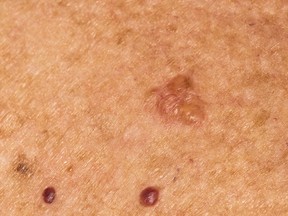
As in Frank’s case, basal cell carcinoma often can start off looking like a small, skin-colored bump, sore or scaly patch – easily mistaken for dry skin or a pimple on the mend. While very rarely life-threatening, it can grow deep into the skin, which is why experts said early detection is important for the best recovery.
Basal cell carcinoma can affect anyone, but it’s more common in people older than 40, those who are light-skinned, have a history of skin cancer or are immunocompromised, said Kelly Nelson, a professor of dermatology at the University of Texas MD Anderson Cancer Center in Houston.
By signing up you consent to receive the above newsletter from Postmedia Network Inc.
Article content
Advertisement 3
Article content
Here are some other things dermatologists and patients want you to know about basal cell carcinoma, including how to prevent it.
Basal cell carcinoma often appears on the face – particularly the nose, ears or bare scalp – as well as other areas with increased sun exposure, such as the neck, shoulders, arms and hands. It rarely spreads to other parts of the body, though it can grow into nearby tissue.
“I liken it to rust on a car. It’s not going to stop your engine, but it is something that we want to stop when it’s a small problem because if we let it get out of hand, it can become an issue, particularly if it’s close to important structures,” such as your eyes, Nelson said.
Depending on the type, it can form as a nodular bump with tiny blood vessels; a superficial patch that looks like dry skin; or a flat, firm scar-like lesion that can extend deeper beneath the skin, making it more difficult to treat, according to the American Academy of Dermatology.
Because basal cell carcinoma can be difficult for the untrained eye to spot, Nelson suggested using the “ugly duckling sign” – a self-check method that involves looking for a mole, spot or patch that looks different from any other on your body and then having it evaluated by a dermatologist. Additionally, a new hard, pink bump, a new sore, or a spot that bleeds and does not heal within a few weeks should be assessed, she said.
Advertisement 4
Article content
Although it’s best to identify it early, this type of skin cancer is typically slow-growing, expanding by an average of about 2 to 3 millimetres per year, Nelson said. So even if you don’t catch it on your own, as long as you’re diligent about getting routine annual dermatologic examinations, it can usually be found and treated before it causes significant problems, she said.
Once basal cell carcinoma is diagnosed through a biopsy, the recommended treatment may vary based on the type as well as the growth’s size, location and whether it is a new or returning cancer.
For higher-risk growths, Mohs surgery is the preferred treatment.
During Mohs surgery, a specialized dermatologist called a Mohs surgeon removes thin layers of cancerous tissue one at a time and examines each under a microscope until no more cancer cells are seen. Once the margins are clear, either the Mohs surgeon or a plastic surgeon will reconstruct the area, said Anthony Rossi, a dermatologist and Mohs surgeon at the Memorial Sloan Kettering Cancer Center in New York.
Advertisement 5
Article content
Stephanie Townes, 35, of Charlotte, had Mohs surgery to remove nodular basal cell carcinoma in 2025. She had been aware of a small, translucent mole next to her nose for years. But then it started to grow, itch and bleed. Initially, she decided to have it removed for cosmetic reasons.
But her dermatologist told her it was skin cancer.
“I was kind of laughing at the irony since I went in for vanity reasons, and it ended up being this news that I didn’t expect at all,” she said.
In retrospect, however, she said she was at higher risk. A competitive swimmer, she spent much of her adolescence in the sun, and her dad has had multiple surgeries to treat basal cell carcinoma, she said.
This year, Frank also had Mohs surgery. She then had plastic surgery to repair the area. “I went from having a tiny, pink spot that I was barely worried about to having a ton of stitches and a scar that was at least five times the size of the actual skin cancer,” she said.
Depending on the type, basal cell carcinoma can be removed surgically or through less-invasive procedures, such as using a scraping tool and electric current to remove the growth or even through prescription creams.
Advertisement 6
Article content
The cure rate for certain types of basal cell carcinoma is about 98 to 99 percent, though people who have had one non-melanoma skin cancer are at higher risk of developing another “because it’s a marker of how much UV exposure you’ve had and how much DNA damage you’ve had,” Rossi said.
Since having basal cell carcinoma, both Frank and Townes said they have become vigilant about wearing sunscreen and hats to help protect their skin. Frank even had the windows on her car tinted to reduce UV exposure.
Dermatologists recommend using a broad-spectrum chemical or mineral sunscreen with at least SPF 30 and reapplying it about every two hours, or more often if you’re sweating or swimming. Rossi likes mineral sunscreens because he said they are less irritating for sensitive skin.
For patients with an increased risk of skin cancer, such as those who have had it multiple times, Rossi said he also sometimes recommends taking supplemental nicotinamide, a form of vitamin B3.
Advertisement 7
Article content
Some researchers believe nicotinamide helps restore cellular energy and enhances the skin’s ability to repair UV-induced DNA damage, Rossi said. But consult your doctor before starting nicotinamide, as it can interact with certain medications, including some anticonvulsants, blood thinners and diabetes medications, he said.
In some cases, Rossi also recommends photodynamic therapy, which uses special medicines and light to destroy precancerous non-melanoma cancer cells.
Townes said she still enjoys the outdoors but thinks constantly about the precautions she needs to take, including dermatologic exams every six months.
“I won’t stop doing the activities that I love just because of this. But I’ve become hyper aware of what can happen,” she said.
For more health news and content around diseases, conditions, wellness, healthy living, drugs, treatments and more, head to Healthing.ca – a member of the Postmedia Network.
Article content




























/https%3A%2F%2Fsportsmole-media-prod.s3.gra.io.cloud.ovh.net%2Fuploads%2F2026%2F07%2Fimago1075669211-6a5fb6068a84b779278224.jpg)
/https%3A%2F%2Fsportsmole-media-prod.s3.gra.io.cloud.ovh.net%2Fuploads%2F2026%2F08%2Fimago1080705836-6a733ed0dad41130296964.jpg)
 Bengali (BD) ·
  English (US) ·