.png)
 1 hour ago
5
1 hour ago
5
JOHANNESBURG — South African police said more than 900 people were arrested on Tuesday, when there were nationwide anti-migrant protests which were mostly peaceful but occasionally descended into violence and looting.
Limited time: Save 25% on NBC News subscription
Get exclusive reporting, live Q&As and ad-free reading.

Tebello Mosikili, a deputy national police commissioner, told a press conference that of the 120 marches that took place on Tuesday, 108 were peaceful while 12 needed law enforcement to intervene due to unrest.
Some of those arrested were undocumented migrants detained for violating immigration rules, while others were arrested for public violence, harbouring illegal immigrants and robbery.
Mosikili said police reinforcements had been deployed to five of the country’s nine provinces overnight to respond to isolated incidents of looting and criminality.
South Africa braces for anti-immigrant protests
Soldiers were sent to Johannesburg’s Hillbrow neighbourhood to support the police.
Tuesday’s marches were organised to mark a “deadline” an anti-immigrant movement had set for undocumented migrants to leave South Africa.
The protests came after months of unrest that have drawn international criticism as foreigners have been driven from their homes and seen their businesses and property vandalised.
The most prominent groups opposing illegal immigration include March and March, Operation Dudula and Progressive Forces. President Cyril Ramaphosa, who has challenged the protesters’ allegation that migrants are to blame for the country’s social and economic challenges, met Monday night with leaders of some of the groups and asked them to conduct peaceful demonstrations.
Ngizwe Mchunu, one of the protest leaders, told The Associated Press that he blamed illegal migration for a proliferation of illicit drugs in South Africa. He also complained about the high percentage of informal neighborhood shops run by immigrants from other African countries, saying they should all be owned by South Africans.
“It’s a very sad story that we have been telling our government since the dawn of democracy that illegal immigration here is out of hand,” Mchunu said. “It is time for our government to put South Africa first.”
Amnesty International South Africa said migrants, refugees and asylum seekers are being unfairly blamed for the country’s unemployment, inequality and struggling public services, arguing that those challenges stem from the legacy of apartheid, persistent inequality and failures in the asylum system.
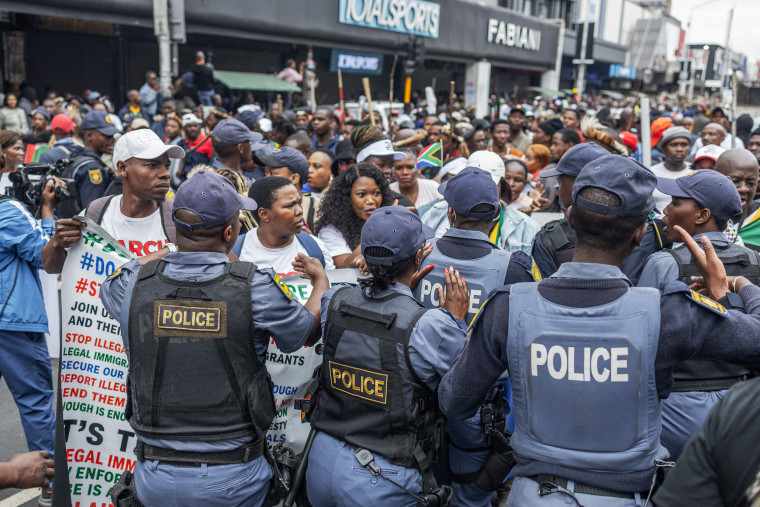 Protesters clash with police in Durban on Tuesday. Thousands of demonstrators massed across South African cities, venting anger at undocumented foreign nationals.Rajesh Jantilal / AFP via Getty Images
The rights group warned that scapegoating foreign nationals distracts from the government’s responsibility to address those underlying problems and said misinformation and xenophobia risk fueling further violence against migrants, according to a statement from Amnesty International South Africa executive director Shenilla Mohamed.
Meanwhile, thousands of migrants, primarily from neighboring Zimbabwe and Malawi, gathered at their embassies and consulates to request transport back to their countries.
There has been increased traffic over the past few days at the Beitbridge checkpoint along the Zimbabwe border as buses carrying migrants left South Africa. Thousands of Malawian nationals also have returned to their country from a temporary repatriation center in Durban.
Three groups of Nigerian migrants returned to Nigeria this month amid rising anti-immigrant tensions, including a group of 271 people who arrived in Lagos on Tuesday.
According to Nigerian officials, 632 Nigerians have been repatriated out of the more than a thousand Nigerians who have registered for the voluntary repatriation and more flights are expected in coming days.
Emmanuella Akagbosun, a 44-year-old who moved to South Africa in 2017, said she left because she feared she would be killed. She said the shop that she shared with her sister was ransacked by the anti-migrant protesters and their wares looted.
“We are not safe, so we had to leave,” Akagbosun said in Lagos.
Fintan Opara, another Nigerian national repatriated after 18 years in South Africa, said most Nigerians no longer feel welcome in the country.





















/https%3A%2F%2Fsportsmole-media-prod.s3.gra.io.cloud.ovh.net%2Fuploads%2F2026%2F06%2Fimago-xinhua-nestory-irankunda-celebrates-scoring-for-australia-in-the-world-cup-on-june-14-2026-6a2f348854d1b663111439.jpg)

/https%3A%2F%2Fsportsmole-media-prod.s3.gra.io.cloud.ovh.net%2Fuploads%2F2026%2F06%2Fjarell-quansah-2-6a405306ed40a243376273.jpg)
 Bengali (BD) ·
  English (US) ·