.png)
 1 hour ago
5
1 hour ago
5
Unreasonable leaders can lead change, but leaders with unbalanced egos can wreak havoc
Published May 15, 2026 • 3 minute read
George Bernard Shaw wrote that a “reasonable man adapts himself to the world, the unreasonable one persists in trying to adapt the world to himself. Therefore, all progress depends on the unreasonable man.”
Advertisement 2

THIS CONTENT IS RESERVED FOR SUBSCRIBERS ONLY
Subscribe now to read the latest news in your city and across Canada.
- Unlimited online access to articles from across Canada with one account.
- Get exclusive access to the Toronto Sun ePaper, an electronic replica of the print edition that you can share, download and comment on.
- Enjoy insights and behind-the-scenes analysis from our award-winning journalists.
- Support local journalists and the next generation of journalists.
- Daily puzzles including the New York Times Crossword.
SUBSCRIBE TO UNLOCK MORE ARTICLES
Subscribe now to read the latest news in your city and across Canada.
- Unlimited online access to articles from across Canada with one account.
- Get exclusive access to the Toronto Sun ePaper, an electronic replica of the print edition that you can share, download and comment on.
- Enjoy insights and behind-the-scenes analysis from our award-winning journalists.
- Support local journalists and the next generation of journalists.
- Daily puzzles including the New York Times Crossword.
REGISTER / SIGN IN TO UNLOCK MORE ARTICLES
Create an account or sign in to continue with your reading experience.
- Access articles from across Canada with one account.
- Share your thoughts and join the conversation in the comments.
- Enjoy additional articles per month.
- Get email updates from your favourite authors.
THIS ARTICLE IS FREE TO READ REGISTER TO UNLOCK.
Create an account or sign in to continue with your reading experience.
- Access articles from across Canada with one account
- Share your thoughts and join the conversation in the comments
- Enjoy additional articles per month
- Get email updates from your favourite authors
Article content
Nasser Ghaemi approached the question from a different perspective. Ghaemi is a psychiatrist, not a playwright, and his views on the reasonable man have more scientific weight than the illustrious Shaw.
Article content
Article content
Ghaemi’s book, A First-Rate Madness, published 15 years ago, is an exploration of the successes and failures of historic leaders who experienced, to various degrees, mental illness. His subjects include Abraham Lincoln, Winston Churchill, Mahatma Gandhi, Martin Luther King Jr. and John F. Kennedy.
Each of these leaders experienced mood disorders ranging from mania to depression. Ghaemi supposes that they each rose to the challenge of crisis, in part because of their difficulties.
His thesis is based on the effect of mood disorders on realism, empathy, resilience and creativity. The deep depression that Churchill described as the “black dog” apparently helps to see reality without illusion. The depressed lack the optimism that often clouds judgment (think Nevil Chamberlain vs. Winston Churchill).
By signing up you consent to receive the above newsletter from Postmedia Network Inc.
Article content
Advertisement 3
Article content
Similarly, mania provides a window to divergent thoughts that last longer than a manic episode. In times of crisis, people who suffer from mood disorders have an advantage over their “normal” rivals. But that advantage is nullified when the times call for a steady hand.
Both Shaw and Ghaemi celebrate those unusual leaders who have the capacity to overcome reason. But that, of course, begs a desperate question the entire world is seeking to answer: What happens when unreasonable leaders lose their grip on reality?
I’m not inclined (or equipped) to psychoanalyze anyone. At best, to borrow the words of Cody Jinks, I just seek out the folks who are the same kind of crazy as me. But it doesn’t take a genius to notice that a couple of the current world leaders are not exactly well-balanced.
Ghaemi’s leaders had something in common beyond mood disorders; at their best, they were selfless. They didn’t need — and often felt they didn’t deserve — personal glory.
Advertisement 4
Article content
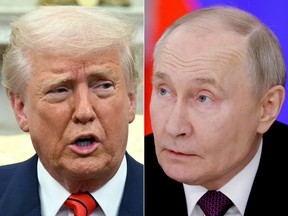
Russian President Vladimir Putin and U.S. President Donald Trump, on the other hand, have turned war into a vanity project. Putin’s vanity has bankrupted Russia and launched the longest, deadliest European war since the Second World War. The United States, on the strength of Trump’s considerable hubris, has created a global energy crisis and accidentally altered the Middle East.

We apologize, but this video has failed to load.
It isn’t the first time a couple of gunslingers have found out they may have the biggest, shiniest gun, but they aren’t the fastest draw. Putin and Trump attacked inferior nations and became mired in endless battles with entrenched and emboldened enemies. Both discovered that the leaders of the nations they attacked were a different kind of unreasonable.
Unreasonable leaders can lead change, but leaders with unbalanced egos can wreak havoc. Canada is currently paying the price for the damage left by a rock star leader, Justin Trudeau, whose considerable ego required numerous ill-advised and often expensive vanity projects. But those failures seem modest compared to the global damage inflicted by Putin and Trump.
There are reasons for nations to take up arms. Confronting the decades-old problem of a nuclear Iran is a worthy cause. But when a leader is blinded by his own image, every strategy leads inevitably to failure.
Ghaemi, who was a childhood refugee from Iran, gave the world an interesting perspective on mood disorders. Now would be a great time for some observations on the deadly nature of out-of-control egos.
Read More
-

SNOBELEN: Wars only serve to make the world a little poorer
-

SNOBELEN: Trump and America had no choice but to take over the country


Article content




























/https%3A%2F%2Fsportsmole-media-prod.s3.gra.io.cloud.ovh.net%2Fuploads%2F2026%2F05%2Fchamp-69fa166311171530187348.jpg)
 Bengali (BD) ·
  English (US) ·