.png)
 1 week ago
23
1 week ago
23
Article content
A new report proposes establishing a 350-seat Parliament in an effort to correct for imbalances in the House of Commons that have long left Ontario, Alberta and B.C. underrepresented compared with other provinces.

THIS CONTENT IS RESERVED FOR SUBSCRIBERS
Enjoy the latest local, national and international news.
- Exclusive articles by Conrad Black, Barbara Kay and others. Plus, special edition NP Platformed and First Reading newsletters and virtual events.
- Unlimited online access to National Post.
- National Post ePaper, an electronic replica of the print edition to view on any device, share and comment on.
- Daily puzzles including the New York Times Crossword.
- Support local journalism.
SUBSCRIBE FOR MORE ARTICLES
Enjoy the latest local, national and international news.
- Exclusive articles by Conrad Black, Barbara Kay and others. Plus, special edition NP Platformed and First Reading newsletters and virtual events.
- Unlimited online access to National Post.
- National Post ePaper, an electronic replica of the print edition to view on any device, share and comment on.
- Daily puzzles including the New York Times Crossword.
- Support local journalism.
REGISTER / SIGN IN TO UNLOCK MORE ARTICLES
Create an account or sign in to continue with your reading experience.
- Access articles from across Canada with one account.
- Share your thoughts and join the conversation in the comments.
- Enjoy additional articles per month.
- Get email updates from your favourite authors.
THIS ARTICLE IS FREE TO READ REGISTER TO UNLOCK.
Create an account or sign in to continue with your reading experience.
- Access articles from across Canada with one account
- Share your thoughts and join the conversation in the comments
- Enjoy additional articles per month
- Get email updates from your favourite authors
Sign In or Create an Account
or
Article content
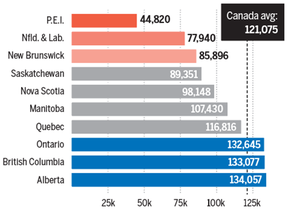
In the study, the Calgary-based Aristotle Foundation for Public Policy points out that Alberta currently has the lowest representation among provinces in the House, with one member of Parliament for every 135,057 citizens, when compared against 2025 population numbers. British Columbia has one MP per 133,077, while Ontario has one per 132,645. That is well higher than Prince Edward Island (44,820), Quebec (116,816), Saskatchewan (89,351) and other Canadian provinces.
Article content
Article content
Article content
“Political representation in Canada at present is not representative of the actual populations in each province,” it said.
Article content
Article content
The report comes as resentments over a range of issues — including a lack of federal representation in the House of Commons and Senate — has fed separatist sentiments in Alberta in particular. Alberta Premier Danielle Smith has proposed a referendum in October that will ask, among other things, whether Canada should amend the Canadian constitution to “abolish the unelected federal Senate.”
Article content
The Aristotle study, called “It’s 2026, not 1867: A 21st-century review of population and representation in the House of Commons,” compared representation in both the federal chambers over the last 50 years, and found that under-representation in Ontario, Alberta and B.C. has remained constant.
Article content

Article content
As of 2025, British Columbia was the most under-represented province in the Senate compared to its population, with 953,720 people per senator. Alberta was the next highest at 826,683. P.E.I., by comparison, had one per 44,820 people, Nova Scotia had one per 107,963 and Quebec had one senator per 379,651 people.
Article content
Article content
“One part of our rationale for change is that continued imbalances in representation will exacerbate Western alienation and feed potential separatist sentiment in Western Canada,” the authors said. “Another part of the rationale for change is that the principle of representation by population is critically necessary for legitimacy in a democracy, and Canadians deserve a House of Commons that reflects 21st-century realities, not those of 1867 or even 1982.”
Article content
Article content
The report was co-authored by Mark Milke, the head of Aristotle Foundation and former Canadian Taxpayers Federation director; Ven Venkatachalam, an economist; and Gordon Campbell, a former Canadian diplomat and premier of B.C. from 2001 to 2011.
Article content
“Canada’s House of Commons should reflect 21st-century population realities and restore a greater sense of fairness across the country,” Milke said in a statement.
Article content
The imbalance in the House of Commons or Senate is the result of a number of legal provisions, including a clause that stipulates that provinces should not have fewer MPs than they have senators. That, combined with another clause that ensures provinces have no fewer MPs than they had under a pre-set benchmark (which the Liberal government recently updated to 2019 levels), has led to “chronic underrepresentation” among some provinces, the report said.
























/https%3A%2F%2Fsportsmole-media-prod.s3.gra.io.cloud.ovh.net%2Fuploads%2F2026%2F05%2Fns-collage-background-v2-email-3-6a086d6eaa1a0057506880.jpg)
 Bengali (BD) ·
  English (US) ·