.png)
 1 hour ago
4
1 hour ago
4
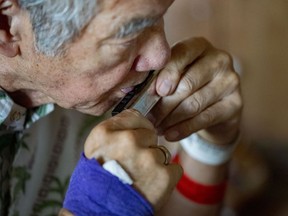
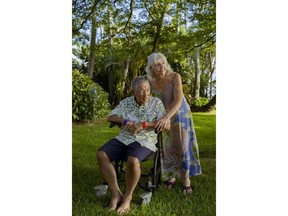
Tomita and Lippman, both 79 and longtime residents of Oahu, Hawaii, are participants in the Harmonica Parkinson’s Project, a program that teaches people with the progressive movement disorder how to play the harmonica with the goal of maintaining or improving speech.
Author of the article:

Washington Post
Meeri Kim, The Washington Post
Published Sep 14, 2026 • Last updated 7 minutes ago • 5 minute read
See more Toronto Sun on Google — save as a Preferred Source
Advertisement 2

THIS CONTENT IS RESERVED FOR SUBSCRIBERS ONLY
Subscribe now to read the latest news in your city and across Canada.
- Unlimited online access to articles from across Canada with one account.
- Get exclusive access to the Toronto Sun ePaper, an electronic replica of the print edition that you can share, download and comment on.
- Enjoy insights and behind-the-scenes analysis from our award-winning journalists.
- Support local journalists and the next generation of journalists.
- Daily puzzles including the New York Times Crossword.
SUBSCRIBE TO UNLOCK MORE ARTICLES
Subscribe now to read the latest news in your city and across Canada.
- Unlimited online access to articles from across Canada with one account.
- Get exclusive access to the Toronto Sun ePaper, an electronic replica of the print edition that you can share, download and comment on.
- Enjoy insights and behind-the-scenes analysis from our award-winning journalists.
- Support local journalists and the next generation of journalists.
- Daily puzzles including the New York Times Crossword.
REGISTER / SIGN IN TO UNLOCK MORE ARTICLES
Create an account or sign in to continue with your reading experience.
- Access articles from across Canada with one account.
- Share your thoughts and join the conversation in the comments.
- Enjoy additional articles per month.
- Get email updates from your favourite authors.
THIS ARTICLE IS FREE TO READ REGISTER TO UNLOCK.
Create an account or sign in to continue with your reading experience.
- Access articles from across Canada with one account
- Share your thoughts and join the conversation in the comments
- Enjoy additional articles per month
- Get email updates from your favourite authors
Article content
About a decade ago, Neal Tomita started to lose his voice. He has Parkinson’s, and voice and speech problems are a common issue, affecting up to 90 percent of people as the neurological disease advances.
Article content
Article content
His once-lively speech began to fade into a quiet mumble, and people struggled to understand him. He increasingly retreated into silence and became socially withdrawn, even from his wife.
“Neal and I used to have fabulous conversations about everything, and suddenly we didn’t. It got really lonely,” said Cheryl Lippman, who has been married to Tomita for 27 years. “Plus, I’m hard of hearing and wear hearing aids. It’s this cosmic joke: He speaks soft, and I can’t hear.”
Speech and voice changes are common in people with Parkinson’s disease because the same neurological factors that cause tremors and stiffness in the body also affect muscles in the face, mouth and throat. To strengthen his voice, Tomita started going to speech therapy every month and completed speech treatment programs designed specifically for Parkinson’s.
By signing up you consent to receive the above newsletter from Postmedia Network Inc.
Article content
Advertisement 3
Article content
About two years ago, Tomita and Lippman together picked up an unexpected hobby that they say has helped him speak louder, communicate more confidently and reconnect with others: playing the harmonica.
“I never imagined that a simple harmonica could make such a meaningful difference in my life,” said Tomita, who has no musical background. “It has helped me find my voice again.”
Tomita and Lippman, both 79 and longtime residents of Oahu, Hawaii, are participants in the Harmonica Parkinson’s Project, a program that teaches people with the progressive movement disorder how to play the harmonica with the goal of maintaining or improving speech.
The project is the brainchild of Kevin Lockette, a physical therapist based in Honolulu, who leads both in-person sessions and free virtual classes twice a month for anyone with Parkinson’s and their care partners. No musical background is required.
“I’ve been working with Parkinson’s for 30 years, but I’ve been playing harmonica for probably 40 years,” said Lockette, co-owner of Ohana Pacific Rehab and vice president of the Hawai‘i Parkinson Association. “People with Parkinson’s often have problems with phonation, pitch, articulation and saliva management – and ironically, those are the things that you work on when you’re playing the harmonica.”
Advertisement 4
Article content
The idea of using music – and even the harmonica – to help people with Parkinson’s isn’t new. Music therapy, which can include activities such as singing, dancing and drumming, has been linked to improvements in movement symptoms, speech, cognitive issues and mental health for people with the condition.
Singing is thought to increase vocal strength and the ability to articulate words, and humming exercises may relax tense vocal folds. Music therapists and musicians have taught harmonica to groups of people with Parkinson’s for years in an effort to increase respiratory function, lung capacity and loudness.
In the early 1990s – well before the days of Zoom – two Virginia musicians gave lessons and hundreds of free harmonicas to Parkinson’s support groups across North America. And MusicWorx, a music therapy company based in San Diego, offers a 12-week harmonica class for people with Parkinson’s and their care partners.
In May, Lockette and his colleagues presented the results of a pilot study at the World Parkinson Congress exploring harmonica lessons as a treatment for speech difficulties related to Parkinson’s. In the study, researchers randomized 22 people with Parkinson’s – including Tomita – into two groups: One joined in-person harmonica lessons twice a week for three months, and the other received traditional speech therapy.
Advertisement 5
Article content
A speech therapist and neurologist tested participants before and after the intervention to look for improvements in speech and other characteristics. Although a small sample, the harmonica group showed greater improvements in factors such as speech intelligibility and average vocal intensity than the control group.
While a larger clinical trial is needed to prove whether there’s a benefit, the study successfully demonstrated the feasibility – and joy – of group harmonica classes for Parkinson’s.
“For the first time in a long while, I saw Neal smile with confidence as he played alongside others who truly understood what he was going through,” said Lippman, one of four care partners who joined the lessons during the study. “It has not only improved Neal’s speech, but it has also enriched both of our lives.”
In traditional speech therapy for Parkinson’s, the therapist helps patients focus on speaking louder and with purposeful effort by using daily exercises that include holding musical notes and repeating phrases. Neurologist Michael Okun, who was not involved in the research, believes that playing the harmonica in addition to speech therapy may have benefits for people with Parkinson’s.
Advertisement 6
Article content
“Those musicians have to coordinate both their facial muscles and tongue movements, and that coordination can be good for diseases like Parkinsons,” said Okun, explaining that it also might help prevent aspiration pneumonia, a lung infection caused by inhaling food or liquid.
Parkinson’s has become the fastest-growing neurological disorder in the world, with the number of people living with the disease more than doubling in the past 25 years. By 2050, an estimated 25.2 million people are projected to be living with the condition worldwide.
While speech impairments are common, the vast majority of people with Parkinson’s do not receive speech therapy because of an overshadowing focus on movement-related issues, such as tremors, stiffness and slowness. And traditional speech exercises can be challenging for some to maintain on a daily basis.
“There are multiple guidelines out there saying that physical therapy, occupational therapy, and speech and swallow therapy are critical and should be used in Parkinson’s disease,” said Okun, executive director of the Norman Fixel Institute for Neurological Diseases and medical adviser for the Parkinson’s Foundation. “Only a small percentage of people actually utilize it.”
Advertisement 7
Article content
Many people with Parkinson’s and their loved ones say that communication challenges brought on by the disease is one of the hardest parts of living with it.
When Tomita was diagnosed with Parkinson’s at 55, he and Lippman tried everything to combat his symptoms and delay the progression of the disease. Exercise is known to help slow those symptoms, and as an avid cyclist, he continued to ride around Oahu for many years, even completing the epic 100-mile Honolulu Century Ride. Over the years, the couple participated in boxing, Pilates, yoga, tai chi, aikido and water aerobics. Aside from staying active, he was prescribed medication and later underwent surgery for deep brain stimulation, which initially helped improve many of his movement symptoms.
When his voice started fading, Lippman took him to a speech-language pathologist for therapy sessions, and Tomita began daily exercises at home to maintain speech improvements.
Together, the couple continues to take part in virtual harmonica lessons. Lockette also posts free on-demand video lessons on the Harmonica Parkinson’s Project’s YouTube channel.
“The lessons are open to anyone that has Parkinson’s and their caregivers – and actually, if other people want to join in, I don’t tell anybody no,” Lockette said. “Just make sure you have a harmonica in the key of C, and you’re all good.”
For more health news and content around diseases, conditions, wellness, healthy living, drugs, treatments and more, head to Healthing.ca – a member of the Postmedia Network.
Article content
























/https%3A%2F%2Fsportsmole-media-prod.s3.gra.io.cloud.ovh.net%2Fuploads%2F2026%2F09%2Ficonsport-373637-0018-6a9e6d20a27e0398293470.jpg)
 Bengali (BD) ·
  English (US) ·