.png)
 2 hours ago
9
2 hours ago
9
Article content
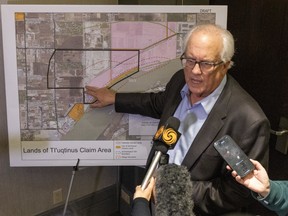
In August 2025, after one of the longest trials in Canadian history, Justice Barbara Young of the British Columbia Supreme Court issued a landmark ruling declaring that the Cowichan Tribes hold “Aboriginal title” to 800 acres of land in the Vancouver suburb of Richmond.

THIS CONTENT IS RESERVED FOR SUBSCRIBERS
Enjoy the latest local, national and international news.
- Exclusive articles by Conrad Black, Barbara Kay and others. Plus, special edition NP Platformed and First Reading newsletters and virtual events.
- Unlimited online access to National Post.
- National Post ePaper, an electronic replica of the print edition to view on any device, share and comment on.
- Daily puzzles including the New York Times Crossword.
- Support local journalism.
SUBSCRIBE FOR MORE ARTICLES
Enjoy the latest local, national and international news.
- Exclusive articles by Conrad Black, Barbara Kay and others. Plus, special edition NP Platformed and First Reading newsletters and virtual events.
- Unlimited online access to National Post.
- National Post ePaper, an electronic replica of the print edition to view on any device, share and comment on.
- Daily puzzles including the New York Times Crossword.
- Support local journalism.
REGISTER / SIGN IN TO UNLOCK MORE ARTICLES
Create an account or sign in to continue with your reading experience.
- Access articles from across Canada with one account.
- Share your thoughts and join the conversation in the comments.
- Enjoy additional articles per month.
- Get email updates from your favourite authors.
THIS ARTICLE IS FREE TO READ REGISTER TO UNLOCK.
Create an account or sign in to continue with your reading experience.
- Access articles from across Canada with one account
- Share your thoughts and join the conversation in the comments
- Enjoy additional articles per month
- Get email updates from your favourite authors
Sign In or Create an Account
or
Article content
The 800 acres includes government land and 150 “fee simple” properties, the most common form of residential land ownership in Canada. In other words, people’s homes and businesses.
Article content
Article content
Article content
The Cowichan Tribes, which are located on Vancouver Island, argued that they have a historic claim to parts of modern-day Richmond because their ancestors once visited and lived there, though as a summer fishing village.
Article content
By signing up you consent to receive the above newsletter from Postmedia Network Inc.
Article content
In court, the City of Richmond argued that Aboriginal title was extinguished because the Cowichans’ ancestors abandoned the land 150 years ago. Yet according to Richmond’s lead lawyer, lawyers for the federal and provincial governments were ”labouring under litigation directives that constrained their ability to argue extinguishment.”
Article content
Following last summer’s ruling, the provincial and federal governments appealed the decision — but they’ve been part of the problem from the start. And appeals can take years, with no guarantee of a better outcome for private property owners in Richmond.
Article content
This could have serious repercussions for the rest of the province. More than two-million fee simple titles exist in British Columbia. Homeowners and business owners who believe they own their properties may also be subject to claims made by other First Nations.
Article content
Article content
The Supreme Court of Canada’s landmark 1997 decision in Delgamuukw v. British Columbia paved the way for modern Aboriginal title claims, and because much of B.C. isn’t covered by treaties, large swaths of the province have been open to such claims.
Article content
Article content
But when a First Nation such as the Cowichan Tribes lacks a treaty with the Crown, but has been paid vast sums of money over decades by federal and provincial taxpayers, should the courts not account for that money when assessing any land claim?
Article content
For the Cowichan Tribes alone, the numbers are staggering. According to our calculations, based on 24 years of Cowichan financial statements (adjusted for inflation to 2025 dollars), the Cowichan (with approximately 5,600 members) have been paid nearly $1.3 billion since 2001 for health care, education and more.
Article content
In the 2001-02 fiscal year, the federal and provincial governments spent more than $37 million on the Cowichan, and that number tripled to $103 million (or $18,359 per band member) by 2024-25. In total, over 24 years, taxpayers paid $227,223 per band member, or over $900,000 for a Cowichan family of four.





















/https%3A%2F%2Fsportsmole-media-prod.s3.gra.io.cloud.ovh.net%2Fuploads%2F2025%2F11%2Fimago1068606686-1-69071bd01fb89577912048.jpg)
 Bengali (BD) ·
  English (US) ·