.png)
 1 hour ago
6
Throughout the 10-year anniversary of the 2016-17 Ottawa Senators — the team that came within one goal of the Stanley Cup Final — the Ottawa Citizen is releasing monthly long reads, re-telling stories of that remarkable, unforgettable season through a new lens.
Article content
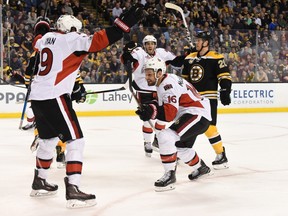
Clarke MacArthur lay on a treatment table, staring up at the locker room ceiling. For all he knew, at age 31, his hockey career had been dealt a final blow.

THIS CONTENT IS RESERVED FOR SUBSCRIBERS ONLY
Subscribe now to read the latest news in your city and across Canada.
- Unlimited digital access to the Ottawa Citizen.
- Analysis on all things Ottawa by Bruce Deachman,David Pugliese, and others, award-winning newsletters and virtual events.
- Opportunity to engage with our commenting community.
- Ottawa Citizen ePaper.
- Ottawa Citizen App.
SUBSCRIBE TO UNLOCK MORE ARTICLES
Subscribe now to read the latest news in your city and across Canada.
- Exclusive articles from David Pugliese, Andrew Duffy, Bruce Deachman and others. Plus, food reviews and event listings in the weekly newsletter, Ottawa, Out of Office.
- Unlimited online access to Ottawa Citizen and 15 news sites with one account.
- Ottawa Citizen ePaper, an electronic replica of the print edition to view on any device, share and comment on.
- Daily puzzles, including the New York Times Crossword.
- Support local journalism.
REGISTER / SIGN IN TO UNLOCK MORE ARTICLES
Create an account or sign in to continue with your reading experience.
- Access articles from across Canada with one account.
- Share your thoughts and join the conversation in the comments.
- Enjoy additional articles per month.
- Get email updates from your favourite authors.
Register to unlock this article — it’s free
Create an account or sign in to continue with your reading experience.
- Access articles from across Canada with one account
- Share your thoughts and join the conversation in the comments
- Enjoy additional articles per month
- Get email updates from your favourite authors
Sign In or Create an Account
or
Article content
Five minutes earlier, a newcomer defenceman had knocked him unconscious with an unnecessary, punishing hit at Ottawa Senators training camp in 2016, plunging an intra-squad game into awkward chaos. It was MacArthur’s fourth concussion in the span of a year and a half.
Article content
Article content
Advertisement 1
Article content
Winger Mark Stone, sidelined with a head injury of his own, broke down at his stall processing it all. He was urged to leave.
Article content
By signing up you consent to receive the above newsletter from Postmedia Network Inc.
Article content
Only MacArthur and linemate Bobby Ryan remained, as training staff walked in and out to check on them both. Seeking immediate vengeance after the collision, Ryan had broken his finger wailing on the culprit.
Article content
“That was the heaviest room I’ve ever been in,” Ryan told the Ottawa Citizen in one of over a dozen interviews conducted for a long-read series on the 2016-17 Senators. “I just remember thinking, like, Our season is done and we haven’t started yet.”
Article content
In the months that followed, MacArthur, tortured by headaches, blurry vision and false hope at every turn, wept several times a week. A failed baseline test in the new year was the nail in the coffin. With 39 games remaining in the regular season, general manager Pierre Dorion announced that MacArthur wasn’t coming back.
Article content
Utterly depressed, MacArthur fled to South Florida with wife Jessica, daughter Emery and son Gus.
Article content
He tried to let it all go. He tried to find peace.
Article content
Three months later, he would find the back of the net in overtime to send Ottawa to the second round of the Stanley Cup playoffs.
Article content
Advertisement 2
Article content
***
Article content
Article content
Dion Phaneuf had high-profile company at his New London, PEI, off-season home in the summer of 2010 — besides Hollywood actress and then-girlfriend Elisha Cuthbert.
Article content
Life was moving fast for the 25-year-old heavy-hitting, pugnacious defenceman. The Toronto Maple Leafs had plucked him from the Calgary Flames in a blockbuster January deal and slapped the ‘C’ on his chest by June.
Article content
Heading into his first full season leading one of the most-storied franchises in hockey, Phaneuf was well aware that MacArthur, a dear friend, was looking for a new National Hockey League home after the Atlanta Thrashers had bowed out of a $2.4-million arbitration award.
Article content
Phaneuf and MacArthur go way, way back. Born four days apart in April of 1985 in Alberta — Phaneuf in Edmonton; MacArthur, Lloydminster — they had their battles throughout minor hockey and in the Western Hockey League, and bonded during stints with Hockey Canada, like when they won gold at the world junior championship in 2005 on the greatest team the country has ever assembled for the tournament.
Article content
So, when Phaneuf hosted Maple Leafs general manager Brian Burke at his waterfront estate that summer, realizing the trust and pull he now had within the organization, he mentioned a speedy, tenacious little winger they could add.
Advertisement 1
Advertisement 2
Article content
“Now that the years have passed, we can talk about all this stuff,” Phaneuf said. “Burkie used to come and visit his captain every year and so we were sitting at my place in Prince Edward Island, and Clarke was a free agent. I knew what type of player Clarke was and what he could bring to a team, and I did recommend that he would be a good fit.”
Article content
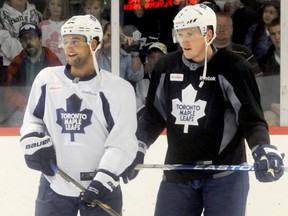
A subsequent phone call with MacArthur, enlightening him on the perks of playing in the Big Smoke, helped seal the deal. On Aug. 28, Toronto signed MacArthur to a one-year, $1.1-million contract.
Article content
“I think that if you look at the numbers that he put up in Toronto,” Phaneuf said, “he was a great player for the Toronto Maple Leafs when I was there.”
Article content
Article content
Article content
MacArthur, who had struggled to really break through offensively in the NHL until then, notched 62 points (21 goals, 41 assists) in 2010-11, two fewer than Phil Kessel for the team lead. It solidified him as one of the better second-line wingers in the league.
Article content
Six years later, when Sens general manager Bryan Murray was working on a trade that would bend the minds of both sides of the Battle of Ontario, MacArthur was offered an opportunity to return Phaneuf’s favour.
Article content
Advertisement 3
Article content
“Bryan was Bryan. He was making decisions, but he wanted Dion and asked me about him,” MacArthur said. “I didn’t think it was possible, that trade, to be honest.”
Article content
It was the worst-kept secret that Phaneuf was on the trade block in Toronto. General manager Lou Lamoriello had promised to find him a team that could win.
Article content
“I remember I was having a Super Bowl party for my teammates in Toronto,” Phaneuf said. “I got a call about Ottawa and waiving my no trade to Ottawa, and I waived it right away … I talked with Clarke quite a bit and he just loved Ottawa.
Article content
“I was all in right away.”
Article content
When Phaneuf arrived in the nation’s capital, neither he nor MacArthur had ever won a playoff series in the NHL. They were a combined 0-7. That would soon change.
Article content
“I’ll forever be grateful for him,” Phaneuf said. “He was behind me coming to Ottawa; he was behind the scenes helping bring me to the Ottawa Senators. Some of the best hockey memories I have of my life are in Ottawa.”
Article content
***
Article content
A light breeze accompanied bright, beautiful skies on the fourth day of fall 2016 in the nation’s capital, an apt setting for the measured optimism of thousands of local hockey fans attending the unofficial start of a new season.
Article content
Advertisement 4
Article content
As much as foreign media attempted to dampen expectations — just two of 20 NHL Network analysts and writers had picked the Senators to barely sneak into the post-season — the diehards flocking to Sens Fan Fest at Canadian Tire Centre knew they had a good team.
Article content
Captain Erik Karlsson was the best defenceman in the world, Craig Anderson pretty much guaranteed strong-to-immaculate goaltending and, after a bland, 85-point campaign under head coach Dave Cameron the previous year, Guy Boucher — an ultra-intelligent tactician — had taken the helm.
Article content
Up front, MacArthur’s return was rejuvenating. After missing 78 games in 2015-16 due to his third concussion in the span of eight months, he had been champing at the bit since passing a spring baseline test.
Article content
However, nobody in the hopeful crowd that day had any idea of the triumph and tears that were to come in the season ahead.
Article content
“The radio station had a booth set up outside and I went on and I chatted for a few minutes about this and that,” long-time Ottawa Citizen reporter Wayne Scanlan recalled. “And then we go in to watch this scrimmage and it’s like, ‘What the hell?’
Advertisement 2
Advertisement 3
Article content
“It was quite a wild scene.”
Article content
Eager to make a good first impression after being acquired from the Flames three months prior, Patrick Sieloff knew Boucher loved active blue liners who could aggressively stamp out breakouts and rushes along the walls. What he was unaware of — or so he would claim a month later — when he ventured deep into the offensive zone during a Red vs. White scrimmage on Sept. 25, was who he was about to pummel.
Article content
That much didn’t matter to Ryan, who saw MacArthur lying on the ice holding his head immediately following the hit. He already had dropped his gloves by the time the Sieloff had tracked back to the neutral zone.
Article content
Wrapped up by two linesmen after throwing passionate haymakers and submitting the 22-year-old defenceman, Ryan screamed as a referee tried to reason with him.
Article content
“What the f*** was that?!”
Article content
It was all so jarring. Ryan, who calls Sieloff “one of the nicest kids,” had skated with him in Detroit over the summer. Sieloff had been around the group in Ottawa for a month before the incident.
Article content
Revealed MacArthur weeks later to reporters: “I remember just kind of looking straight up at the bright lights, like I was at a KISS concert. I kind of put two and two together (about) what happened and I was upset, obviously.”
Article content
Advertisement 5
Article content
Gone nearly limp, MacArthur needed Phaneuf and Chris Neil to help him skate off the ice. He winced with each half stride, looking totally lost.
Article content
I just knew the feeling that I had. I was sick to my stomach when I saw the hit. But we'll leave it at that.
Dion Phaneuf
Article content
“I just knew the feeling that I had. I was sick to my stomach when I saw the hit,” Phaneuf said. “But we’ll leave it at that.”
Article content
Ryan was escorted out of the scrimmage, joining a shaken MacArthur in the dressing room. Stone, who had sustained a concussion of his own two days prior in a skirmish with teammate Buddy Robinson, looked on with tears streaking down his face.
Article content
“Our strength and conditioning coach is trying to tell (Stone) not to cry in front of Clarke,” Ryan recalled. “And I said the same thing. I was like, ‘Get him the f*** away from Clarke.’ Because Clarke doesn’t need anything more than what’s going on right now, right?
Article content
“I was sitting there and I was like, same thing, trying not to cry because I was like, ‘This guy’s career’s over. That’s it.’
Article content
“How do you come back from this? You just spent a year doing this anyway.”
Article content
After Neil sent his own message the following shift, Sieloff was removed from the ice for his own safety and taken out of main camp for morale’s sake. He would play the entire season with Binghamton of the American Hockey League.
Article content
Advertisement 6
Article content
***
Article content
Before setting off on yet another recovery mission, MacArthur addressed the team in hopes of wiping the slate clean.
Article content
“I just thought, as the days were going on there, it was becoming a distraction from the goals we kind of set out,” MacArthur said. “It was devastating for me and obviously a lot of teammates were upset, but it was a young kid trying to make the team, not knowing my situation, probably, or knowing who it was on the ice at the time. And things happen.”
Article content
MacArthur was candid and realistic about his road ahead. Ryan remembers his teammate, in real time, grappling with the injury’s implications on his career, everyday life and fatherhood.
Article content
Two years prior, before all the head shots, the pair had pondered legacy in Ottawa, “building something really, really good there together,” Ryan says.
Article content
MacArthur signed for five years and Ryan for seven. They had it all laid out.
Article content
“That was one of the harder parts of my career,” Ryan said, “sitting there and, like, knowing the guy that you signed on with wasn’t going to do it with you.
Article content
“When he stood in front of us and was like, I don’t know what my life’s going to look like from here on out, and I don’t know if I’m going to be able to play, I don’t know if I’m gonna be able to do all the things that I want to do as a dad, I’m just sitting there going, ‘Oh my God, man.’ Like, I’m worried about the way it’s going to look for me as a professional athlete? But he’s not. He’s thinking about the way it’s going to look for him as a dad. It was f****** awful, dude. It was awful.”
Advertisement 3
Advertisement 4
Article content
MacArthur frequented CTC in the weeks and months ahead, staying in shape as best he could while unable to skate with the team or travel on the road. Though, he was spinning his tires.
Article content
“I thought I was going to get back a few different times,” he said. “And then as I’d work out the headaches would come back and my eye was, like, blurry, and it was just kind of, you know, making progress and then going back, making progress going back.
Article content
“I had so many friends on that team. That was probably the hardest part, not being around that.”
Article content
By the time he failed a crucial baseline test on Jan. 20, MacArthur had played just four NHL games in 650 days. The Senators shut him down for the season. Doctors proposed retirement. It was the hardest day of his life.
Article content
“(Jessica) knew I was upset, so we left. We left and went to Florida,” MacArthur recalls. “I thought I was going to be able to come back and, at that point, it looked like we were done because that would have been two or three years out of the league. It was just a tough time. We kind of went to Florida and let everything go a little bit.”
Article content
Surrounded by his wife and kids in the Sunshine State, MacArthur finally began to relax. He genuinely contemplated a new beginning.
Article content
Advertisement 7
Article content
Lovely weather, an abundance of golf courses, no noise and three years of guaranteed money remaining on a $23.25 million contract — could this really be it?
Article content
That idea lasted less than one week.
Article content
***
Article content
Before January ended, MacArthur had grabbed a gym membership and was in constant communication with Sens conditioning coach Chris Schwarz. He pushed hard, he felt great.
Article content
Sensing he might have one last run in him, MacArthur flew to Ann Arbor, Mich., to visit world-renowned neurologist and concussion specialist Dr. Jeffrey Kutcher for the second time in a little over a year.
Article content
“He had a reputation of: If he puts you through his camp and you pass, you can play,” MacArthur said. “So when we went there, it wasn’t a lot of fun, that’s for sure.”
Article content
Dr. Kutcher — advisor to the NHL and NFL players’ unions, director of the NBA’s concussion program and neurologist for the U.S. Olympic Team, among many other hats — is credited with rescuing countless athletes’ careers, including hockey players Patrick Eaves and Ondrej Kase.
Article content
While the rest of the sporting world remains largely reliant on quiet, dark rooms to remedy post-concussion syndrome, the Kutcher Clinic rejects a one-size-fits-all approach.
Article content
Advertisement 8
Article content
Kutcher and his team are exceptionally meticulous in pinpointing a patient’s true ailment.
Article content
They study film of past collisions, sift through family medical history and perform numerous tests to further understand a subject’s “neurological makeup.”
Article content
They examine the eyes and spinal cord. Athletes are put through rigorous physical testing where Kutcher himself is on the field or in the gym blowing the whistle and demanding more effort.
Article content
“We’re not treating a concussion, we’re treating a person,” Dr. Kutcher said. “You cannot boil it down to somebody (having) one or two or three concussions in a year. That’s the beginning of the conversation. You need to dig much, much deeper to fully understand each scenario and do what’s best for the patient.”
Article content
What was best for MacArthur, Kutcher and his team decided, was injecting a nerve block through the skull above the left eye.
Article content
The headaches vanished.
Article content
“We use all of our tools to figure out what is the underlying cause or, more commonly, combination of causes,” Kutcher explained. “And so, looking at the peripheral nervous system — the nerves of the face, of the head, of the neck — and recognizing that they can be the problem too.
Advertisement 4
Advertisement 5
Article content
“As a matter of fact, the entire concussion symptom checklist that is commonly used in clinical practice is non-specific for concussion. You can have all those symptoms and not have a brain injury.”
Article content
Kutcher, who grew up playing hockey in Dearborn, a suburb just outside of Detroit, also skates with his patients. In MacArthur’s case, the clinic brought in players to knock him around during the final stages of his mini camp.
Article content
“That’s when I was really feeling like, ‘Wow, I can come back,’” MacArthur said.
Article content
Up until then, hope had been as dangerous as it was revitalizing. This time, it was different.
Article content
“When you find out you’ve made it through that and passed, I was quickly calling all my teammates and whoever I could to try and (alert the team),” he said. “Because you have to get clearance from the owners because it’s a liability thing. So I basically had to sign off on saying, you know, ‘Whatever happens here won’t fall back on Ottawa.’ This is my choice. Which I obviously was quick to sign.”
Article content
Upon returning to Ottawa, MacArthur passed the baseline test and was cleared by multiple doctors. He began skating with the team, ramping up the physicality in practice day by day.
Article content
Advertisement 9
Article content
Six hours before the Senators hosted the Detroit Red Wings on April 4, Boucher strolled into the locker room to write the lineup on the whiteboard. There was no morning skate — this was the second half of a home-and-home — so the coach and general manager were able to keep a secret from the rest of the team.
Article content
Ryan, out with a hand injury at the time, was the only one to witness Boucher scribble the lines. Notoriously late for games he wasn’t playing in, Ryan planned to return to the rink extra early.
Article content
“It was widely known that I don’t like cameras, so I always went into the rink the other way, outside of everything,” Ryan said. “That night though, I was like, I’m gonna be here on time. They were shooting me, thinking I was playing. I’ll actually never forget it. Like, the TSN camera is following me down the hallway and I was like, I’m not playing, but it’s gonna get even better when you guys know who is.”
Article content
Article content
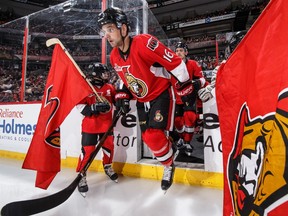
When the rest of the players arrived to see MacArthur’s name in the fourth-line left-wing slot, the room broke out into hugs and handshakes.
Article content
Shortly after puck drop, MacArthur launched himself into Detroit Red Wings defenceman Danny DeKeyser on the forecheck in his first NHL shift in 538 days.
Article content
Advertisement 10
Article content
Chosen as the game’s third star in a 2-0 win, he was so emotional that he could hardly look up at the crowd as he went for a twirl.
Article content
The trade deadline had come and gone, but MacArthur was one of the most important late-season acquisitions in franchise history.
Article content
“I didn’t know what performance I would have (in the playoffs),” he admitted, “but I knew I could help, not hurt the team.”
Article content
***
Article content
Game 2 against the Boston Bruins was a must-win. It just was.
Article content
The Senators had already given up home-ice advantage with a 2-1 loss in Game 1 and a trip to Boston loomed large. As a franchise, Ottawa had lost eight straight playoff series when down 2-0.
Article content
In Game 1, MacArthur felt the Sens offence was “banging the ketchup bottle, waiting for it to ooze out.”
Article content
A few days later, he gave that bottle a mighty whack.
Article content
Down 1-0 midway through the first, a Frank Vatrano trip on Ryan Dzingel sent the Sens to the power play. MacArthur set up shop in the bumper position on the first unit, the perfect spot for a slippery forward with a quick shot.
Article content
As Derick Brassard worked his way down the left half wall, MacArthur pointed to Ryan with the blade of his stick while drifting away from Bruins defenders Zdeno Chara and Kevan Miller in front. Brassard obliged, sending the puck down to Ryan, who one-touched a pass to MacArthur for a point-blank shot that gave Tuukka Rask’s glove hand zero time to react.
Advertisement 5
Advertisement 6
Article content
MacArthur nearly dislocated both shoulders, twice raising his arms to the sky.
Article content
“You’re just, like, dreaming about that feeling of scoring,” MacArthur said. “(If) you’ve played, you know that feeling you get for a couple seconds and you just chase it. I really wanted to get that feeling back.”
Article content
It was his first goal in two years and six days. Every soul in that arena understood the weight of the moment.
Article content
“I’ll never forget that goal, and just the feeling I had of really, like, butterflies and chills,” said Phaneuf, who would end Game 2 in overtime with a blast from the point. “Because I knew how hard he worked to come back. I knew how hard it was for him to go through what he was going through because I spoke to him almost every day.”
Article content
At the time, MacArthur believed it would be “the best moment I have in hockey.” Eight days later, another goal would rival it.
Article content
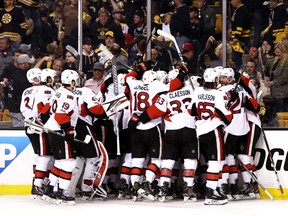
On a similar set play in overtime in Game 6 — Ryan was trying to find Mike Hoffman cross-crease this time when his pass was cut off by a lunging Rask — the puck found MacArthur at the netfront and, while falling to the ice, he banged it into an open cage.
Article content
Advertisement 11
Article content
MacArthur raced to jump on the glass as one Bruins fan flipped him the bird and his teammates mobbed him.
Article content
Article content
Article content
“I mean, it was surreal,” he reminisced. “When you sit on the plane and we’re flying back and you’re like, Wow… You’re excited, for one, that you got through the first round and onto the (New York) Rangers, who we had a good matchup against. And then, for two, to think five months ago I was in tears three times a week thinking about (how) my career’s over and, What am I going to do? It was an emotional kind of run.”
Article content
As if he hadn’t bawled enough in the previous six months, MacArthur was lovingly blindsided by a family friend post-game. Sportsnet’s Ron MacLean had something up his sleeve when he interviewed the Senators’ hero.
Article content
“Clarke MacArthur’s down in Boston. Clarke, can you hear Ron MacLean OK?”
Article content
“Yeah, I can hear ya.”
Article content
“OK, Dean and Deb in Lloydminster, can you hear Ron MacLean OK?”
Article content
“Yeah, we can, Ron.”
Article content
Wide-eyed, staring into the camera lens outside the away dressing room, MacArthur shared his triumph with his parents, just as he did 20 years ago in the warm lobbies of eastern Alberta hockey rinks.
Article content
He bashfully rubbed the back of his neck as his father lauded his effort. His mother referenced a motivational quote from his childhood.
Article content
“Thank you mum,” he softly said.
Article content
Advertisement 6





















 Bengali (BD) ·
 English (US) ·