.png)
 1 hour ago
5
1 hour ago
5
Article content
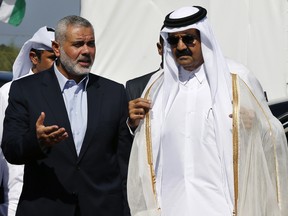
Qatar’s support for Islamist terror groups gives the small nation significant geopolitical leverage in its role as a mediator in Middle East conflicts. Its strategy of attempting to position itself as a global mediator goes beyond neutral diplomacy, as it maintains relationships with actors that fuel conflicts while presenting itself to the world as a broker capable of solving those very conflicts.

THIS CONTENT IS RESERVED FOR SUBSCRIBERS
Enjoy the latest local, national and international news.
- Exclusive articles by Conrad Black, Barbara Kay and others. Plus, special edition NP Platformed and First Reading newsletters and virtual events.
- Unlimited online access to National Post.
- National Post ePaper, an electronic replica of the print edition to view on any device, share and comment on.
- Daily puzzles including the New York Times Crossword.
- Support local journalism.
SUBSCRIBE FOR MORE ARTICLES
Enjoy the latest local, national and international news.
- Exclusive articles by Conrad Black, Barbara Kay and others. Plus, special edition NP Platformed and First Reading newsletters and virtual events.
- Unlimited online access to National Post.
- National Post ePaper, an electronic replica of the print edition to view on any device, share and comment on.
- Daily puzzles including the New York Times Crossword.
- Support local journalism.
REGISTER / SIGN IN TO UNLOCK MORE ARTICLES
Create an account or sign in to continue with your reading experience.
- Access articles from across Canada with one account.
- Share your thoughts and join the conversation in the comments.
- Enjoy additional articles per month.
- Get email updates from your favourite authors.
THIS ARTICLE IS FREE TO READ REGISTER TO UNLOCK.
Create an account or sign in to continue with your reading experience.
- Access articles from across Canada with one account
- Share your thoughts and join the conversation in the comments
- Enjoy additional articles per month
- Get email updates from your favourite authors
Sign In or Create an Account
or
Article content
Article content
To understand the wealthy Gulf state of roughly three-million people — foreign workers constitute up to 94 per cent of its workforce — it is useful to examine how the Al Thani ruling family welcomed prominent Muslim Brotherhood figures fleeing Egypt’s crackdown.
Article content
Article content
By signing up you consent to receive the above newsletter from Postmedia Network Inc.
Article content
Among them was Yusuf al-Qaradawi, a student of Hassan al-Banna, who founded the Muslim Brotherhood — a transnational Sunni Islamist organization — in 1928. In 1962, al-Qaradawi was appointed head of the Qatari Secondary Institute of Religious Studies, and went on to lead the department of Islamic studies at Qatar University.
Article content
Al-Qaradawi was granted Qatari citizenship in 1968 and became one of the Brotherhood’s most influential voices. His Al-Jazeera program, “Sharia and Life,” reached an estimated 40- to 60-million viewers worldwide. Al-Qaradawi drew international controversy for issuing several fatwas — legal rulings on matters of Islamic law — permitting and encouraging suicide bombings.
Article content
In 1999, al-Qaradawi was barred from the United States. In 2008, he was barred from Britain. And in 2012, he was prohibited from entering France by then-president Nicolas Sarkozy following the al-Qaida-inspired Toulouse attacks. When he died in 2022, his funeral in Doha was attended by a senior member of the Al Thani family, Qatari ministers, as well as two senior Hamas figures.
Article content
Article content
But Qatar’s relationship with the Brotherhood did not end with providing refuge to its exiled leaders. Doha continues to support, harbour and fund the group’s regional branches, including its offshoot Hamas, which has been designated a terrorist organization by the United States, Canada, Israel, Australia, Japan, the European Union and others.
Article content
Article content
Then came Al-Jazeera, the cable news network established in Doha in 1996. It quickly became one of the Arab world’s most-watched networks and Qatar’s most powerful soft-power tool, amplifying Islamist voices while extending Doha’s regional influence.
Article content
In 2020, the U.S. Department of Justice determined that AJ+, a subsidiary of the Al-Jazeera Media Network, should register under the Foreign Agents Registration Act, concluding that it engages in “political activities” on behalf of the Qatari government and is designed, among other things, to “influence American perceptions” of domestic and foreign policy.
Article content
How deep-rooted is this problem? The Muslim Brotherhood was designated a terrorist organization more than a decade ago by Egypt, Saudi Arabia, Bahrain, Syria and the United Arab Emirates. More recently, the United States designated its Lebanese, Jordanian and Egyptian chapters as terror groups.






















 Bengali (BD) ·
  English (US) ·