.png)
 1 hour ago
7
1 hour ago
7
American forces on Thursday carried out retaliatory strikes on Iranian military facilities that allegedly launched a series of “unprovoked” missile, drone, and small boat attacks against U.S. warships transiting the Strait of Hormuz, U.S. Central Command (CENTCOM) said. U.S. forces intercepted the Iranian attacks and no damage was done to the three U.S. Destroyers, USS Truxtun (DDG 103), USS Rafael Peralta (DDG 115), and USS Mason (DDG 87), according to CENTCOM. President Donald Trump said in a post on Truth Social that Iranian missiles and drones “dropped ever so beautifully down to the Ocean, very much like a butterfly dropping to its grave!”
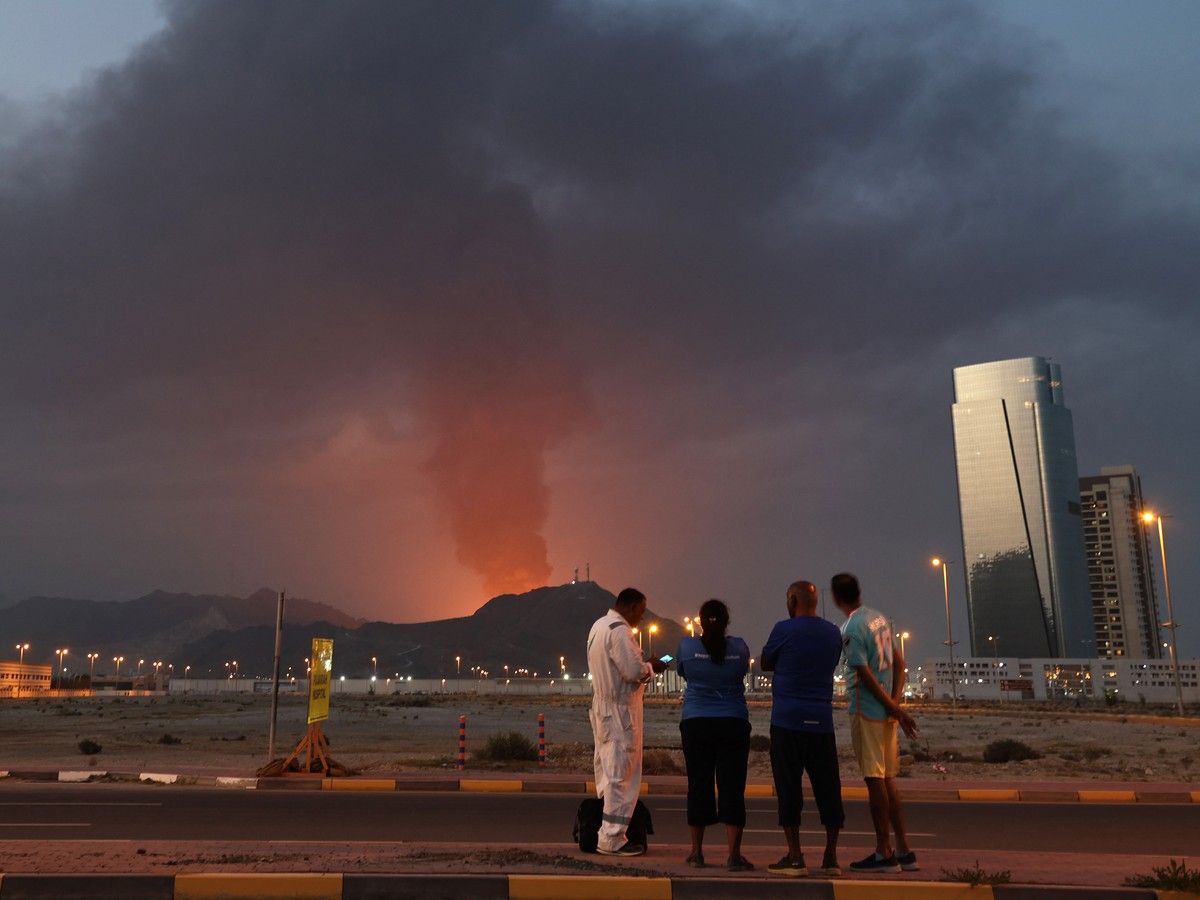
Iran responded to the airstrikes with “reciprocal action,” attacking American military vessels near the Strait, according to Iranian state media. The United Arab Emirates said early Friday that it was dealing with missile and drone attacks for the third time this week. The U.A.E., along with other Gulf states, has faced attacks from Iran in retaliation for the U.S. and Israel launching the war since late February. Iran’s military said on Thursday, “Some countries on the shores of the Persian Gulf supported U.S. in tonight’s aggression, and that has not gone unnoticed by IRAN either.”
The latest attacks came a day after U.S. forces seized an Iranian oil tanker allegedly violating the U.S. naval blockade. Iran has called both the seizure and the naval blockade violations of the U.S.-Iran cease-fire that went into effect on April 8. Iran also pushed back on the U.S. characterization of Thursday’s airstrikes, saying that the U.S. hit civilian areas, according to Iranian state media.
Trump dismissed concerns that Thursday’s hostilities meant a return to full-blown war. In a call with ABC, Trump called the U.S. strikes “just a love tap” and insisted that the cease-fire was still ongoing. But he also warned in his Thursday post, “Just like we knocked them out again today, we’ll knock them out a lot harder, and a lot more violently, in the future, if they don’t get their Deal signed, FAST!”
Trump’s threats are not out of the ordinary, but they aren’t moving the U.S. away from the negotiating table. Instead, experts tell TIME that Washington is searching for a way out of the war, but it may not emerge with a clear-cut victory.
“Trump is clearly applying pressure while hoping for a deal, and it’s clear that he needs a deal,” says William Figueroa, an assistant professor of international relations at the University of Groningen. “The war is expensive and deeply unpopular at home, is trashing [the U.S.’s] reputation abroad, and most importantly, is not achieving his stated aim of either regime change or re-opening the Strait of Hormuz. This is an existential conflict for the Iranian regime, and every day they remain in power is a victory from their perspective, and a humiliation from Trump’s.”
“What has become increasingly evident is that the Strait of Hormuz represents a knot the President has found difficult to untie,” Clemens Chay, a senior fellow for geopolitics at the U.A.E.-based Observer Research Foundation, tells TIME.
U.S. claims war over, attacks continue
Thursday’s U.S. airstrikes hit Iranian “missile and drone launch sites, command and control locations; and intelligence, surveillance and reconnaissance nodes,” according to CENTCOM. A U.S. official told CNN that the strikes were on locations including Bandar Abbas and Qeshm Island.
Iran, however, said the airstrikes hit civilian areas on the coasts of Qeshm Island, Bandar Khamir, and Sirik, according to Iranian state media. Commercial facilities at Qeshm’s Bahman Pier experienced an “explosion” during an exchange of fire between Iranian security forces and “the enemy,” Iranian state media reported.
On Wednesday, U.S. forces also disabled an Iranian-flagged oil tanker, the M/T Hasna, in the Gulf of Oman that had allegedly been sailing towards an Iranian port. Earlier this week, the U.S. and Iran traded attacks with the U.S. saying Iran had damaged a South Korean cargo vessel during “Project Freedom” and that American forces sunk seven Iranian patrol boats. Iran denied both claims.
These incidents aren’t the first time that the U.S. and Iran have come to blows even after the cease-fire began. Chairman of the Joint Chiefs of Staff Gen. Dan Caine said at a Tuesday press conference that Iran had attacked U.S. forces more than 10 times since the cease-fire took effect. But, he said, those attacks did not cross the threshold for resuming the war.
Other officials have tried to downplay the U.S. position in the Middle East. On Tuesday, Secretary of State Marco Rubio said the two-month-long “Operation Epic Fury” was over and that the U.S. is taking a defensive posture. Trump also claimed that he does not require congressional approval because the war has effectively ended. On Thursday, CENTCOM said in its statement that U.S. forces do “not seek escalation.”
The insistence of Trump and his officials that the cease-fire is intact, despite continued attacks, “signals that Washington has not abandoned its belief in a diplomatic off-ramp,” Chay says.
While Trump has issued escalatory rhetoric, Chay says his threats are part of his “self-presentation as a strongman,” which is meant to serve multiple audiences, from markets to domestic constituencies, and to act as a negotiating instrument. Earlier this week, Trump reportedly said Iran would be “blown off the face of the Earth” if it targeted U.S. ships. Trump also previously threatened to wipe out “a whole civilization” if Iran did not agree to a cease-fire and re-open the Strait of Hormuz.
“Pressure and diplomacy are being deployed in tandem, with the balance shifting depending on the moment and the audience being addressed,” Chay tells TIME.
Doing so has left observers questioning the parameters of the U.S.-Iran cease-fire, especially since Iran asserted that U.S. actions are violations. When asked what lines Iran would have to cross to be considered cease-fire violations, Trump on Tuesday said only, “they know what not to do.”
On Thursday, he called Iranian attacks “a trifle.”
Figueroa tells TIME the cease-fire is intact in the way that “matters the most to ordinary Iranians: there is no longer an aerial bombardment campaign of major cities.”
But even that peace appears fragile.
“You won’t have to know if there’s no ceasefire,” Trump told reporters on Thursday. “You’ll just have to look at one big glow coming out of Iran.”
Prospects for a deal
Thursday’s flare-up in hostilities has created more uncertainty around reported progress towards a deal between the U.S. and Iran. When asked about the possibility of a deal, Trump said it “might not happen, but it could happen any day.”
Iran said it is reviewing a proposal for a memorandum of understanding (MOU) to end the war.
Trump said Thursday that the proposal is “more than a one-page offer,” as had been previously reported. “It’s an offer that basically said they will not have nuclear weapons, they are going to hand us the nuclear dust and many other things that we want.”
The framework reportedly involves three stages, beginning with an end to the war, followed by the lifting of both U.S. and Iranian restrictions in the Strait, and finally hammering out other demands over a 30-day period once the MOU is signed. American demands reportedly include a moratorium on Iranian nuclear enrichment, while Iran is reportedly seeking the lifting of U.S. sanctions.
The Iranians “have agreed,” Trump said, but added, “When they agree it doesn’t mean much because the next day they forgot they agreed.”
The U.S. and Iran have exchanged proposals several times since before the cease-fire began, but sticking points have remained largely over the Strait of Hormuz and Iran’s nuclear program. A first round of marathon talks collapsed, and a second in-person meeting is yet to take place, although direct and indirect negotiations are ongoing. Several Iranian officials expressed pessimism around an imminent deal this week, and the Iranians previously said trust was broken after U.S.-Iran nuclear negotiations stalled and ultimately collapsed when the U.S. and Israel attacked Iran in February.
Chay says the two parties are engaged in an “ongoing, if turbulent, negotiating process.”
“Even as both parties have publicly adopted hardline, at times zero-sum postures,” Chay says, “the reality is almost certainly one of quiet concession-making: both sides seeking a formula that allows each to claim a meaningful victory for their respective domestic audiences while offering the other a face-saving climbdown.”
Some observers are less optimistic about a deal in the near term, however. Both sides want to avoid outright conflict, but they don’t appear ready to meet halfway in order to resolve it, Andrea Ghiselli, a lecturer in international politics at the University of Exeter and head of research at the ChinaMed Project, tells TIME.
Liu Jia, a research fellow at the Middle East Institute at the National University of Singapore, tells TIME that current squabbles are a kind of “pressure test, with each side trying to measure the effectiveness of the other’s leverage in order to extract greater concessions.”
Trump may have even more political capital to lose than Iran’s leadership, Liu says. With an already faltering economy before the war, thousands of civilians killed during the war, and severe blows to its leadership ranks from U.S.-Israeli strikes early on, barring an existential threat like suffering a nuclear attack, which is highly unlikely, Iran’s Islamic Revolutionary Guard Corps, she adds, “has already suffered the worst and there is limited additional losses to fear.”
Trump, on the other hand, risks dragging the U.S. into a prolonged, costly war that could hurt Republican prospects in the midterm elections, while experts have warned that persistent disruptions in the Strait of Hormuz could lead to a global recession. “Trump needs to show that the war achieved something,” Ghiselli says, “and that the cost that American voters and the world are paying was not paid in vain.”
And, Liu adds, “a prolonged U.S. military focus on the region could create strategic opportunities for China and other Global South states to expand their influence, weakening America’s position as the world hegemon and reshape the global order.”
























 Bengali (BD) ·
  English (US) ·