.png)
 2 hours ago
10
2 hours ago
10
Article content
On the 44th anniversary of the Charter, the Nova Scotia Supreme Court vindicated Jeffrey Evely, who asserted his Charter right to move freely in the woods of Nova Scotia. The government had prohibited all activities — including hiking, picnicking, fishing, swimming, camping, and birdwatching — in a near-province-wide ban in August 2025, on the pretext of preventing forest fires.

THIS CONTENT IS RESERVED FOR SUBSCRIBERS
Enjoy the latest local, national and international news.
- Exclusive articles by Conrad Black, Barbara Kay and others. Plus, special edition NP Platformed and First Reading newsletters and virtual events.
- Unlimited online access to National Post.
- National Post ePaper, an electronic replica of the print edition to view on any device, share and comment on.
- Daily puzzles including the New York Times Crossword.
- Support local journalism.
SUBSCRIBE FOR MORE ARTICLES
Enjoy the latest local, national and international news.
- Exclusive articles by Conrad Black, Barbara Kay and others. Plus, special edition NP Platformed and First Reading newsletters and virtual events.
- Unlimited online access to National Post.
- National Post ePaper, an electronic replica of the print edition to view on any device, share and comment on.
- Daily puzzles including the New York Times Crossword.
- Support local journalism.
REGISTER / SIGN IN TO UNLOCK MORE ARTICLES
Create an account or sign in to continue with your reading experience.
- Access articles from across Canada with one account.
- Share your thoughts and join the conversation in the comments.
- Enjoy additional articles per month.
- Get email updates from your favourite authors.
THIS ARTICLE IS FREE TO READ REGISTER TO UNLOCK.
Create an account or sign in to continue with your reading experience.
- Access articles from across Canada with one account
- Share your thoughts and join the conversation in the comments
- Enjoy additional articles per month
- Get email updates from your favourite authors
Sign In or Create an Account
or
Article content
Article content
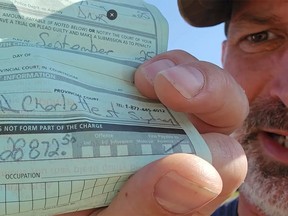
Retired master warrant officer Jeffrey Evely, who served in Afghanistan and Iraq, received a $28,872.50 fine (including taxes, fees, and surcharges) for simply walking in the woods. He filed a Charter challenge to the government’s irrational and draconian ban, receiving a favourable ruling on April 17, 2026.
Article content
Article content
By signing up you consent to receive the above newsletter from Postmedia Network Inc.
Article content
Nova Scotia’s law targeted people, rather than potentially dangerous activities like smoking, campfires and cooking. Mr. Evely saw the August 2025 ban as Orwellian, punishing ordinary people rather than targeting the actions most likely to cause fires. He stated: “It’s about human dignity … I find the cavalier attitude with which these freedoms have been impaired to be a gross indignity to our fallen soldiers, and a moral injury to those of us still here. This moral injury serves to exacerbate my PTSD symptoms, which I have been managing with therapy, medication, and daily outdoor activity, which I normally conduct in the woods.”
Article content
In Evely v. Nova Scotia (Minister), 2026 NSSC 118, the court ruled that Nova Scotia’s decree affected mobility rights: “people could no longer go where they had once gone.” This was not a fleeting or insignificant restriction, ruled the court, but one that “substantially affected peoples’ lives.”
Article content
Article content
The court cited a recent Supreme Court of Canada ruling (Taylor v. Newfoundland and Labrador, 2026 SCC 5), which stated that Charter section 6 mobility rights “sit at the heart of what it means to be a free person” and “protect a broad interest in human mobility.” This basic human right to move freely was already described as “ancient” in 1215 in the Magna Carta, and has always been part of Canada’s heritage.
Article content
Article content
In the Evely case, the court found no evidence that government officials even considered the Charter. The documents placed before the minister (before he made the decision to ban walking in the woods) made no reference to the Charter at all, contrary to what the Supreme Court of Canada requires.
Article content
The court also noted that the term “woods” in the Forests Act was unacceptably vague, by including bog (wet muddy ground), muskeg (swamp water with partly dead vegetation), “rock barren,” and land without trees but with “surface evidence of past forest occupancy.” The court found that Nova Scotians seeking to avoid the $28,872 fine (and jail terms up to six months) were left in an “interpretative quandary” because “the woods are not the forest, but the forests are part of the woods. The woods do not mean that trees are present. The trees could have been removed. But if trees are present, that could be the woods, though it was not clear how many trees were required… And one might reasonably ask what staying out of a wet bog has to do with the mitigation of fire risk.”




























/https%3A%2F%2Fsportsmole-media-prod.s3.gra.io.cloud.ovh.net%2Fuploads%2F2025%2F11%2Fimago1068606686-1-69071bd01fb89577912048.jpg)
 Bengali (BD) ·
  English (US) ·