.png)
 9 hours ago
8
9 hours ago
8
Article content
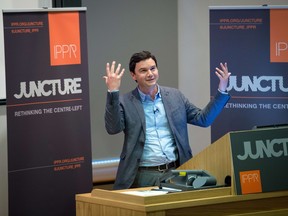
Celebrity economist Thomas Piketty won fame with a claim that, in market economies, capital accumulates in the hands of the already wealthy, leading to increased inequality. The message found a receptive audience among people eager to believe economic success isn’t earned. Canada’s Prime Minister Mark Carney cited Piketty in his own 2021 book-length argument that economic activity should be managed by people like Carney.

THIS CONTENT IS RESERVED FOR SUBSCRIBERS
Enjoy the latest local, national and international news.
- Exclusive articles by Conrad Black, Barbara Kay and others. Plus, special edition NP Platformed and First Reading newsletters and virtual events.
- Unlimited online access to National Post.
- National Post ePaper, an electronic replica of the print edition to view on any device, share and comment on.
- Daily puzzles including the New York Times Crossword.
- Support local journalism.
SUBSCRIBE FOR MORE ARTICLES
Enjoy the latest local, national and international news.
- Exclusive articles by Conrad Black, Barbara Kay and others. Plus, special edition NP Platformed and First Reading newsletters and virtual events.
- Unlimited online access to National Post.
- National Post ePaper, an electronic replica of the print edition to view on any device, share and comment on.
- Daily puzzles including the New York Times Crossword.
- Support local journalism.
REGISTER / SIGN IN TO UNLOCK MORE ARTICLES
Create an account or sign in to continue with your reading experience.
- Access articles from across Canada with one account.
- Share your thoughts and join the conversation in the comments.
- Enjoy additional articles per month.
- Get email updates from your favourite authors.
THIS ARTICLE IS FREE TO READ REGISTER TO UNLOCK.
Create an account or sign in to continue with your reading experience.
- Access articles from across Canada with one account
- Share your thoughts and join the conversation in the comments
- Enjoy additional articles per month
- Get email updates from your favourite authors
Sign In or Create an Account
or
Article content
Article content
And now Piketty is back seeking new fans with a scheme for top-down central planning of the world’s economy. He is the co-director of the new Global Justice Report from the World Inequality Lab.
Article content
Article content
By signing up you consent to receive the above newsletter from Postmedia Network Inc.
Article content
Introducing the project, Piketty posted on X, “The world today is characterized by large-scale inequalities. And a climate crisis is looming over us. We urgently need a new vision for global progress in the 21st Century. One that grounds human development and equality in planetary habitability.”
Article content
Piketty shoehorns an impressive number of buzz phrases into a few lines. He includes concerns about equality and inequality, climate change and progress that should send thrills through college campuses. But Piketty has a talent for tapping into the moment. In this case, at a time when Freedom House’s annual report finds that “Global freedom declined for the 20th consecutive year in 2025,” the economist and his colleagues propose authoritarian policies for shaping the entire planet to their liking.
Article content
In his post, Piketty asks, “What would it take to achieve high prosperity and equality while remaining within planetary boundaries?” He answers that “energy transition” (meaning moving away from power sources that produce carbon) is necessary, as well as “labour hour reductions, growth caps in rich countries, less material consumption, and changes in food habits.”
Article content
Article content
The report itself asserts, “The compression of global inequality is not only compatible with deep decarbonization; it is a necessary condition for shared prosperity on a finite planet.”
Article content
To fight climate change and battle inequality, Piketty and company want “full income convergence across countries by 2100.” This requires, in part, limiting growth to “around 0-0.5% in today’s richest regions (North America/Oceania, Europe).” They argue that near-zero growth in rich countries “does not mean that their living standards stagnate” because people will benefit from flattened incomes.
Article content
“Accounting for the value of additional leisure time and the avoided costs of climate damage relative to high-growth and high-warming scenarios, even today’s richest countries will enjoy a substantial rise in comprehensive well-being indicators,” they conclude.
Article content
In other words, people will learn to like what Piketty and company think they should like.
Article content
Restricting economic growth in developed countries would require an enormous amount of government intervention, but the report isn’t shy about calling for just that. It proposes limiting the power of individual shareholders in companies with more than 100 employees.



























 Bengali (BD) ·
  English (US) ·