.png)
 2 hours ago
10
While some like Rezaei took credit for Trump’s “POLITICAL DEFEAT,” other Iranian leaders cast the midterm results as a repudiation of his war by Americans.
Iran’s Parliament Speaker Mohammed-Baqer Qalibaf, the country’s chief negotiator, posted, “Conscience or the cost of living, Americans said NO TO WAR, and we endorse this message.” He characterized potential further attacks on Iran as a betrayal of the American public.
Esmaeil Baqaei, the spokesperson for the Iranian Foreign Ministry, addressed Trump directly on Wednesday, accusing him of dragging the U.S. into “an unlawful and atrocious war against Iran.”
“Your calculations failed, your assumptions collapsed, and your strategic misjudgments became painfully evident,” he wrote.
“The American people have now sent you a clear message,” Baqaei continued. “Yet, if you continue to disregard reality, dismiss the lessons of history, and persist in this dangerous course, the consequences of this grave miscalculation will extend far beyond what you have already witnessed.”
Republicans blame war for losses
The sweeping Republican defeat has sharpened divisions over the Iran War.
Some lawmakers reportedly want to impeach Defense Secretary Pete Hegseth, who was an early advocate for the war. Rep. Thomas Massie (R, Ky.) told CNN that he intends to force a vote when Congress returns next week on his effort to impeach Hegseth. Massie has been a vocal intraparty critic of Trump and his Administration and lost his GOP primary race in May.
“There are Republicans who would support impeaching Hegseth who might not support doing it to Trump,” Rep. Adam Smith, the top Democrat on the House Armed Services Committee, told TIME last week.
“If the President is serious about anyone taking responsibility for [the midterm losses], it’s Pete Hegseth,” a Republican close to the White House told CNN. “Pete has been either dishonest or incorrect—neither of which are acceptable—about [Iran War] timelines, goals and objectives since the beginning.”
Hegseth, however, may be forced out of his job before Congress steps in. Trump has reportedly spoken to advisers about whether the Defense Secretary should be replaced, CBS reported on Wednesday, citing multiple sources. Florida Gov. Ron DeSantis, a Republican whose gubernatorial term expires Jan. 5, has been floated as a possible replacement for Hegseth, one source told CBS.
Trump told reporters on Wednesday afternoon that Hegseth would be “very popular” if he was appointed to fill the seat that will be vacated by Tennessee Sen. Marsha Blackburn, who will take office as the state’s governor, although he said he had not heard any talk of the idea from others “at all.”
Still, Trump has publicly backed the Pentagon’s top official, who has been discussed as a possible 2028 Republican presidential candidate, and denied plans to fire him.
“I think he’s doing a very good job,” Trump told reporters on Wednesday.
Where the war could go from here
Democratic leaders have vowed to push for an end to the war following their midterm victory.
“We are going to end the war,” Senate Democratic Leader Chuck Schumer said at a news conference in Washington on Wednesday, citing Congress’s power over federal spending. House Democratic leader Hakeem Jeffries urged Trump to end the war before the new Congress convenes, describing the electoral outcome as a message from Americans that they are opposed to the war.
Their majorities in Congress will give Democrats greater leverage to restrict military spending on Iran and the ability to advance legislation directing an end to hostilities, although they would still need substantial Republican support in the Senate to override a Trump veto. Democrats could also withhold new funding, and put further pressure on the Administration through congressional investigations and hearings scrutinizing the Pentagon’s strategy, spending, and conduct of the war. White House spokesperson Lauren Bis described the potential Democratic approach as “sham investigations and radical left policies” in a statement to CNN.
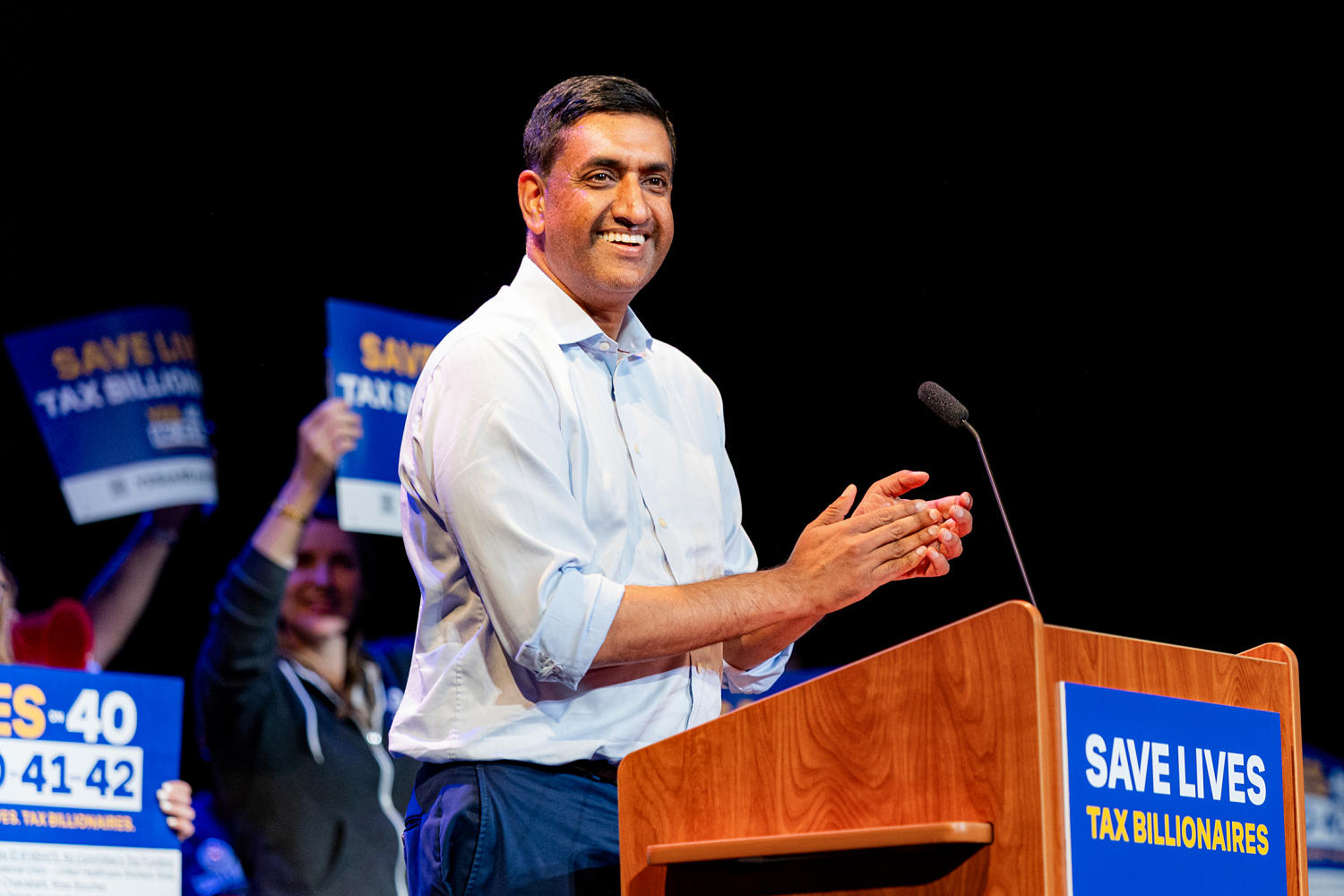
Some Democrats are also seeking to reduce U.S. military aid to Israel. Abdul El-Sayed, who was elected as Michigan’s senator, said in his victory speech, “We don’t want our money sent to do apartheid, or genocide, or war.” In July, 103 House Democrats supported an unsuccessful amendment by Massie to eliminate $3.3 billion in military aid to Israel. Separately, Rep. Ro Khanna (D, Calif.) and Massie sought to strip a provision from the annual defense authorization bill that would deepen U.S.-Israeli cooperation on military technology, research, and weapons production, although the House ultimately passed the bill with the provision intact.
But the midterm results do not offer a guarantee of a quick resolution to the war.
Iran may harden its stance in negotiations and press for U.S. concessions. “If there are still those who entertain the slightest hope that the hegemonic system may change behavior or shifts in its political parties may bring about change, or that by making concessions to the US, they can persuade it to abandon its hostility, they’re gravely mistaken,” Khamenei wrote in another post on Wednesday.
This week, Iran unveiled a massive billboard in Tehran’s Enqelab Square depicting the U.S. President behind bars, with the words “We Will Kill Trump.” A crowd gathered in the square on Wednesday, as U.S. election results came in, for a rally marking the anniversary of the 1979 takeover of the U.S. embassy. Rallygoers held up signs with the same words and set fire to a poster depicting Trump, Vance, and Israeli Prime Minister Benjamin Netanyahu.
William Figueroa, an assistant professor of international relations at the University of Groningen, tells TIME that “the Iranian government has far more reason to seek [nuclear] deterrence and far less reason to trust negotiations” due to the war, which has further “entrenched” the theocratic government by damaging the country’s opposition movement and wrecking its economy.
Although Trump has repeatedly said he expects the war to end shortly after the midterms, the President has also left open the possibility of renewed military action. Last month, Trump said he was considering additional military action against Iran, including a strike on its Pickaxe Mountain nuclear facility, while Hegseth reportedly met with Netanyahu to discuss the possibility of attacking Iran. Despite Trump’s October pledge not to attack Iran before the midterms, U.S. forces struck Qeshm Island on Monday. American officials described the operation as a limited defensive response to Iranian forces firing at a U.S. aircraft.
“Trump has accepted the criticism of the cost,” says Figueroa. “But not the premise.” Figueroa adds that the U.S. President “has little else to lose should he decide to pursue another escalation.”
Israel’s ongoing coalition negotiations add further uncertainty after Netanyahu’s Likud party lost its parliamentary majority in Israel’s Oct. 27 election.
On Wednesday, Trump defended his decision to go to war despite its political cost: “If I had to do it again, I’d have to do it again.”























 Bengali (BD) ·
 English (US) ·