.png)
 2 hours ago
9
2 hours ago
9
Negotiations deadlocked and a ceasefire on a precipice.
Subscribe to read this story ad-free
Get unlimited access to ad-free articles and exclusive content.

That appeared to be the situation Monday between the United States and Iran, with both sides labeling each other’s peace proposals unacceptable after exchanging fire over the weekend.
That impasse raised the threat of renewed conflict and left the global economy imperiled by the standoff over the Strait of Hormuz, a tense backdrop for President Donald Trump’s state visit this week to China.
Oil prices rose early Monday, with the Brent Crude international benchmark above $103 a barrel, as Tehran insisted its latest offer was “reasonable and generous” hours after Trump dismissed it as “totally unacceptable.”
 A woman holds the Iranian flag as she stands in front of an anti-U.S. billboard on a building at Valiasr Square in Tehran on Sunday.Atta Kenare / AFP via Getty Images
The Iranian Foreign Ministry accused the U.S. of “one-sided views” and “making unreasonable” and “excessive demands,” spokesman Esmail Baghaei told a news conference. “Everything we proposed,” he said, was “reasonable and generous not only for Iran’s national interests, but also for the good and well-being of the region and the world.”
That came after Trump’s assessment on Sunday that the response was “TOTALLY UNACCEPTABLE!”
“I have just read the response from Iran’s so-called ‘Representatives,’” Trump posted on Truth Social. “I don’t like it.”
Trump did not give details of the proposal.
Baghaei said that Iran’s offer included stopping “maritime piracy against Iranian ships” — a reference to Washington blockading Iranian ports. He also called for releasing “assets belonging to the Iranian people which have been unjustly frozen for years in foreign banks due to American pressure.”
And he said that Iran wanted “safe passage through the Strait of Hormuz” and “establishing security and peace throughout the region, including Lebanon,” where Israel has continued attacks it says are targeting militant group Hezbollah despite a ceasefire.
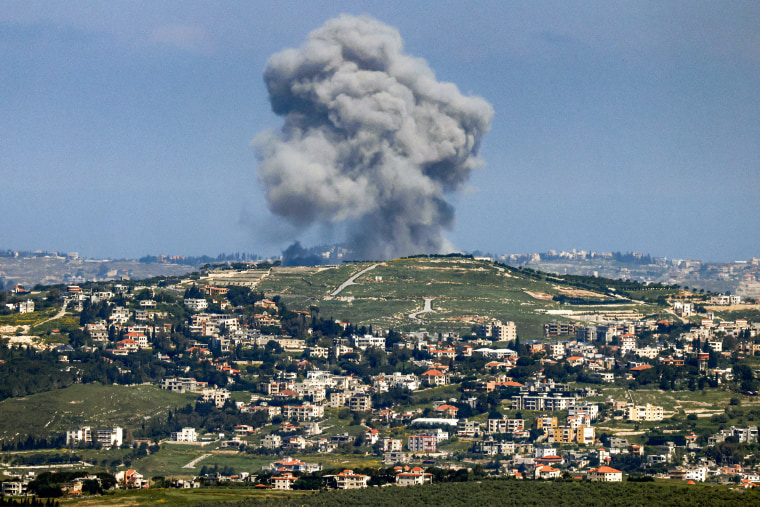 Smoke rises following Israeli bombardment in southern Lebanon on Thursday.Jalaa Marey / AFP via Getty Images
Trump last week abandoned a short-lived plan for military vessels to escort merchant ships through the Strait of Hormuz, known as “Project Freedom.”
The two sides traded fire repeatedly in the following days, with the U.S. saying its destroyers launched “self-defense strikes” after they came under attack.
The U.S. has insisted those exchanges do not mean an end to the ceasefire, more than a month after the temporary deal that was initially intended to reopen the Strait of Hormuz.
In a phone interview Friday with NBC News, Trump said “No” when asked if the conflict with Iran was over. That was echoed by Israeli Prime Minister Benjamin Netanyahu, who told CBS News’ “60 Minutes” on Sunday that the conflict was “not over,” and if negotiations were not successful in extracting nuclear material from Iran then “we can reengage them militarily.”
That speaks to a key sticking point in the talks: the U.S.-Israeli demand that Iran’s stockpile of highly enriched uranium be removed from the country.
Though Iran has always denied wanting to build a bomb, it has enriched the material beyond civilian needs, accelerating those efforts after Trump tore up the previous nuclear agreement.
The U.S. has meanwhile continued its own blockade of Iran’s ports, but the Iranian regime could likely withstand a naval blockade for months, energy industry analysts and two Western officials familiar with intelligence assessments told NBC News.


























 Bengali (BD) ·
  English (US) ·