.png)
 1 hour ago
7
1 hour ago
7
José Gregorio González is inside an immigration detention center almost a year after he donated his kidney to save the life of his brother, who has end-stage renal disease.
The Venezuelan man was taken into ICE custody July 21 during a routine check-in appointment with immigration authorities in Chicago.
González had been reporting to Immigration and Customs Enforcement since April on a weekly basis, sometimes more than once. The agency had placed him in an intensive supervision program to monitor his whereabouts after his yearlong humanitarian parole expired, according to his lawyer and brother.
“I don’t really see a need to necessarily detain him,” said Peter Meinecke, an attorney handling his immigration case and the managing attorney at Resurrection Project, a nonprofit group in Chicago.
“He has no criminal record and has been dutifully complying with supervision,” Meinecke told NBC News.
José Alfredo Pacheco, González’s younger brother and the recipient of his kidney, had just finished a follow-up medical appointment to monitor his recovery from the transplant he received last August. He texted González to let him know he was on his way to pick him up from his ICE check-in.
“Three minutes later, he replied, ‘Brother, I love you. They’re about to deport me.’ That was the only thing he wrote to me,” Pacheco told Noticias Telemundo in Spanish on Wednesday.
“My world came crashing down,” he said, noting that González is his sole caregiver. “My biggest fear is being left alone here.”
González’s story first made headlines in March 2025, when ICE detained him before he could donate his kidney to Pacheco. Community members in the Chicago area rallied in support of the brothers and advocated for González’s release under humanitarian parole. The brothers share the same mother.
González was temporarily released from ICE detention that April, and the brothers successfully underwent a lifesaving kidney transplant surgery in August.
“Someone who’s committed a very selfless act, like donating a kidney, is still being treated like they’re a threat to this country,” Meinecke said. “It’s an alarming precedent to be setting in terms of how we’re treating immigrants in this country.”
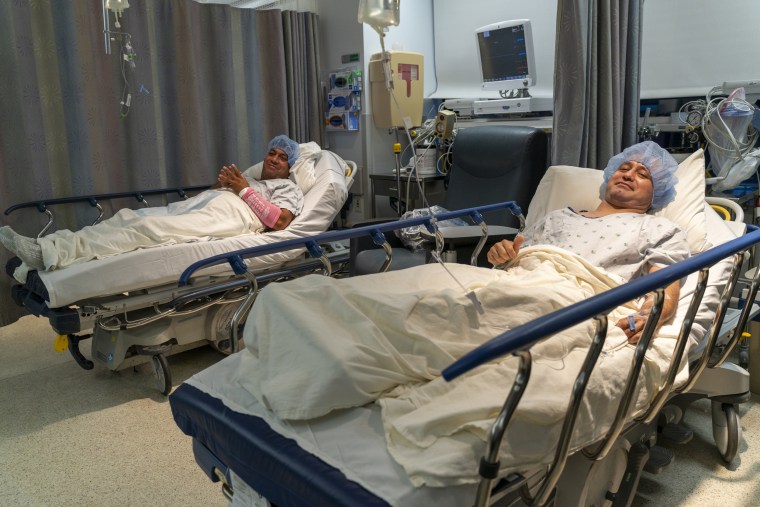 José Alfredo Pacheco, left, and José Gregorio González prepare for a living kidney transplant on Aug. 14, 2025, at University of Illinois Hospital.Hoss Fatemi / UI Health Marketing
According to the Department of Homeland Security, González first attempted to enter the U.S. in June 2023, but Border Patrol arrested him and removed him from the country.
In December 2023, Pacheco was diagnosed with end-stage renal disease. González returned to the U.S. a month later, in January 2024, to care for his brother, who at the time needed four-hour dialysis sessions three times a week.
“In violation of our nation’s laws, he illegally re-entered the country,” a DHS spokesperson said about González’s January 2024 entry into the U.S.
González sought asylum but did not pass an initial credible fear interview, so immigration authorities placed a deportation order on him. Still, he was allowed to remain in the country under ICE supervision and with an ankle monitor to track him, which is not uncommon.
Before González’s humanitarian parole was set to expire in April, Meinecke said he filed a request to temporarily stop the government from enforcing the deportation order against his client.
That application was still pending when ICE detained González last week, Meinecke said.
According to the DHS spokesperson, González overstayed his parole in “violation of our nation’s laws.”
Meinecke said they intend to try to request another humanitarian parole for release from detention.
“While his health has more or less progressed the way you would hope following a surgery,” the attorney said about González, “his brother’s hasn’t been as straightforward.”
Pacheco said he has had two setbacks on the delicate journey to recovery from his kidney transplant. The worse one, a severe blood infection, landed him in the hospital in January. When he felt like he almost didn’t make it, Pacheco said his brother “was the only one who was with me.”
As a living organ donor, González is also under structured medical supervision to ensure his remaining kidney adapts well, Pacheco said. “He still has to attend his medical appointments, and there is no health care in Venezuela,” he said.
Venezuela’s fragile health care system had been deteriorating for years before two powerful earthquakes rattled the South American nation last month, killing more than 5,000 people and further exacerbating its ongoing health crisis.
The DHS spokesperson said González will “remain in ICE custody pending removal proceedings” to Venezuela.
On Sunday, Pacheco spoke to González, who called him from an immigration detention center in Missouri, where he is being held. Pacheco said his older brother never complained about the situation and instead insisted he not worry about him.
“It’s very hard when we siblings are so close,” Pacheco said with emotion. “We would give our lives for one another. … He is the best of us all.”






















/https%3A%2F%2Fsportsmole-media-prod.s3.gra.io.cloud.ovh.net%2Fuploads%2F2026%2F07%2Fwc26-stencil-generic-1-player-email-6a5efced3be22784676779.jpg)
 Bengali (BD) ·
  English (US) ·