.png)
 1 day ago
12
1 day ago
12
Here's how to manage three of the most common foot concerns I see in adults in midlife and beyond.
Author of the article:

Washington Post
Paul Langer, DPM
Published Aug 25, 2026 • Last updated 8 minutes ago • 6 minute read
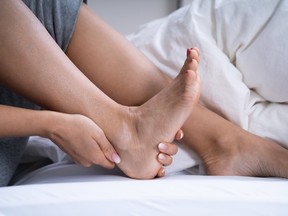
It seems like my feet develop new aches and pains every year. What can I do to reduce the discomfort and avoid more foot issues as I get older?
Advertisement 2

THIS CONTENT IS RESERVED FOR SUBSCRIBERS ONLY
Subscribe now to read the latest news in your city and across Canada.
- Unlimited online access to articles from across Canada with one account.
- Get exclusive access to the Toronto Sun ePaper, an electronic replica of the print edition that you can share, download and comment on.
- Enjoy insights and behind-the-scenes analysis from our award-winning journalists.
- Support local journalists and the next generation of journalists.
- Daily puzzles including the New York Times Crossword.
SUBSCRIBE TO UNLOCK MORE ARTICLES
Subscribe now to read the latest news in your city and across Canada.
- Unlimited online access to articles from across Canada with one account.
- Get exclusive access to the Toronto Sun ePaper, an electronic replica of the print edition that you can share, download and comment on.
- Enjoy insights and behind-the-scenes analysis from our award-winning journalists.
- Support local journalists and the next generation of journalists.
- Daily puzzles including the New York Times Crossword.
REGISTER / SIGN IN TO UNLOCK MORE ARTICLES
Create an account or sign in to continue with your reading experience.
- Access articles from across Canada with one account.
- Share your thoughts and join the conversation in the comments.
- Enjoy additional articles per month.
- Get email updates from your favourite authors.
THIS ARTICLE IS FREE TO READ REGISTER TO UNLOCK.
Create an account or sign in to continue with your reading experience.
- Access articles from across Canada with one account
- Share your thoughts and join the conversation in the comments
- Enjoy additional articles per month
- Get email updates from your favourite authors
Article content
Every day, your feet carry you over thousands of steps and are subjected to tons of walking impact. It is easy to take this for granted until foot pain turns normal daily activities and fitness routines into painful ordeals.
Article content
Article content
Common, highly treatable foot conditions not only have the potential to sideline you from the physical activities you love, but they can also begin to dictate daily choices, transforming something as simple as selecting a shoe into a stressful negotiation between fashion, comfort and pain.
Like other parts of the body, feet change over time. With age, the foot may lose some range of motion and tactile sensation and strength, and conditions such as bunions, plantar fasciitis, hammertoes and changes in the arch or forefoot can become more common. These all may alter how shoes fit and can contribute to pain.
As a podiatrist, I see patients every day who feel defeated by their foot pain, but keeping your feet healthy and active doesn’t always require a trip to the doctor’s office. Often, the most powerful relief comes from a few simple, consistent adjustments to your daily routine and a thoughtful approach to the shoes you wear.
Advertisement 3
Article content
Here’s how to manage three of the most common foot concerns I see in adults in midlife and beyond.
Heel pain, often caused by plantar fasciitis, which is inflammation and degeneration of the plantar fascia (a band of tissue that runs along the bottom of the foot and supports the arch), usually appears as pain on the bottom of the heel and may radiate into the arch. Reduced ankle and big-toe range of motion, decreased foot strength and weight gain have all been implicated as contributing factors.
Some studies suggest that plantar fasciitis may resolve on its own over time. If it doesn’t, comfortably supporting the arch, doing targeted stretching exercises and reducing high impact activities can reduce pain.
Many people instinctively try to cushion the heel, but a better starting strategy is often to support the arch firmly with an off-the-shelf insole. Insoles should be selected much like shoes: Try them on and choose the option that feels best. Better-quality insoles typically cost between $30 and $70. Some sandals also have firm arch support that can help with heel pain.
By signing up you consent to receive the above newsletter from Postmedia Network Inc.
Article content
Advertisement 4
Article content
Gently stretching the Achilles tendon as well as the plantar fascia multiple times each day has been shown to relieve pain for up to 70 percent of people.
In the short term, it is best to minimize going barefoot and wear shoes as often as possible, even indoors, until the pain resolves. In terms of staying active, one of the merciful things about plantar fasciitis is that it usually causes little or no pain during activity and only becomes more painful after sitting, sleeping or as the day goes on. I tell my patients that it is okay to stay as active as they can tolerate during this time as long as the pain does not worsen.
The most common toe changes I see include hammertoes and bunions. One study found that 36 percent of women over age 65 had bunions, a bony protrusion at the base of the big toe joint caused by alignment changes. Another study found that more than 60 percent of older adults had toe deformities, like hammertoes, which are structural changes that cause one of the small toes to start to curl in a downward direction. In both cases, the prevalence increases with age.
Advertisement 5
Article content
These conditions often begin with joint and muscle imbalances in the foot and may progress to stiff, contracted toes that gradually become painful. This then leads to toe alignment changes, which can alter shoe fit and forefoot pressure during walking, leading to more pain and misalignment in the toes themselves, pain in other areas such as the metatarsals (the long bones of the midfoot) and an increased risk of falling.
Many of my patients have already tried toe spacers and digital pads (bandage-like toe wraps that protect from friction) before their office visit but these are doomed to fail if the shoe does not have adequate space to accommodate them. There is some research that shows that changing footwear and starting physical therapy may be able to slow bunion progression if it’s recognized and started early enough. Once a bunion or hammertoe becomes stiff and painful, however, conservative measures are often aimed at reducing pressure and improving comfort; at this point, surgery is the only real fix.
Advertisement 6
Article content
Before considering surgery, I advise patients to accommodate their foot shape with shoes that have a less tapered toe box and adequate width. A common misconception is that a wide shoe size alone should reduce forefoot pain. Many wide shoes still have a tapered toe box, which may provide enough room at the ball of the foot but not enough room for the toes.
Calluses are the skin’s response to pressure or friction. Over time, repeated friction causes the skin to become thicker to protect the soft tissue and bone. A corn is a type of a callus generally described as having a hard center or being located on the toes, but it does not have a separate medical definition and is treated the same, so I will use the term callus to discuss both.
It is not a coincidence that calluses are common on the toes and the bottom of the forefoot, where the mismatch between foot shape and shoe shape is often most pronounced. Unless the pressure causing the thickened skin is addressed, the callus will usually return, even if you see a podiatrist to have it removed.
Advertisement 7
Article content
Calluses between the toes are commonly caused by a stiff, contracted toe pressing against the neighboring toe, shoes that squeeze the toes together, or both. Calluses on the ball of the foot are typically related to thinning of the plantar fat pad (which provides cushioning under the ball of the foot and can thin over time), and abnormal pressure under the metatarsal heads.
Calluses on the toes can often be managed by choosing shoes that better accommodate the shape of the foot and by using silicone toe sleeves to cushion the bony spots. Calluses under the ball of the foot may improve with cushioned insoles and metatarsal pads that shift pressure away from the painful area. (You can buy all of these items at your local drugstore or online.)
Once you relieve the pressure, skin care can help: a daily exfoliating lotion, such as 40 percent urea, and gentle use of a pumice stone after a bath or shower once or twice a week can reduce thickened skin.
Small, consistent habits can go a long way toward keeping feet healthy and comfortable. For each of the conditions described above, footwear can contribute to the problem or become part of the treatment. The right shoe is not the same for everyone, but fit is the best starting point: The shoe should match the shape of the foot rather than forcing the foot to match the shape of the shoe.
Advertisement 8
Article content
I often reassure patients that needing supportive footwear for a painful condition does not mean they can never wear stylish shoes. A practical goal is to spend most of the day in shoes that fit well and accommodate the shape of the foot. If you can do that 80 to 90 percent of the time, you’ll generally be much less likely to develop or aggravate foot pain.
Paul Langer, DPM, is a sports medicine podiatrist practicing with Twin Cities Orthopedics in Minnesota and an adjunct clinical faculty member at the University of Minnesota Medical School. He is also the author of ” Great Feet for Life .”
08-20-2026 02:25PM
For more health news and content around diseases, conditions, wellness, healthy living, drugs, treatments and more, head to Healthing.ca – a member of the Postmedia Network.
Article content


























/https%3A%2F%2Fsportsmole-media-prod.s3.gra.io.cloud.ovh.net%2Fuploads%2F2026%2F07%2Fimago1075669211-6a5fb6068a84b779278224.jpg)
/https%3A%2F%2Fsportsmole-media-prod.s3.gra.io.cloud.ovh.net%2Fuploads%2F2026%2F08%2Fimago1080705836-6a733ed0dad41130296964.jpg)
 Bengali (BD) ·
  English (US) ·