.png)
 1 hour ago
7
1 hour ago
7
Article content
Based on the season series, the odds may seem stacked against Ottawa, but this Charge team has built its identity on grit, resilience and refusing to quit, and those qualities have already gotten the team this far.
Article content
So what’s three more wins?
Article content
Here are a few keys to success for the Charge in the all-Canadian Walter Cup final.
Article content
Battle of the goaltenders (part 2)
Article content
This series will see some of the best goaltenders in the world go head-to-head.
Article content
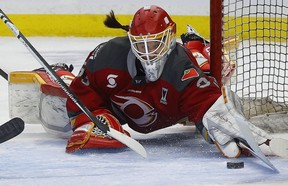
No matter who ends up winning this final, there’s little doubt that Ottawa’s Gwyneth Philips will again be part of the playoff MVP conversation.
Article content
The Charge goaltender has easily been Ottawa’s best player through the postseason and is a major reason why this team has a reputation of being difficult to score against.
Article content
She’s kept the puck out of the net with her paddle or with the toe of her skate in highlight-reel fashion, confidently giving her team the chance to win games even when the opposition controls most of the play.
Article content
Article content
Against Boston, Philips averaged 34 saves a game and faced 142 shots over the four-game semifinal. It was an enormous workload, even for an elite goaltender.
Article content
Article content
But, at the other end, Desbiens has also proven she can steal playoff games, and she has already done exactly that this postseason.
Article content
Take Game 5 of the semifinal as an example. Montreal was outshot 13-5 through the first period, yet Montreal still found a way to win. Sound familiar, Charge fans?
Article content
Statistically, Desbiens also enters this series with the top numbers of any goalie in the postseason. Through five games, she has a 1.56 goals-against average and a .940 save percentage, narrowly edging Philips in both categories.
Article content
Still, Ottawa has already shown it can adapt against elite goaltending, as it did against Boston’s Aerin Frankel.
Article content
So, Jenner said, the game plan doesn’t really change.
Article content
“In this league, we face a lot of elite goaltending,” she said. “I think (Desbiens) is at the top, and the recipe doesn’t really change. It’s how hard you’re going to work to get in front of her, to get in on those loose pucks around the net and just make life as difficult as possible because we know she’s a great player.”
Article content
Shut down Montreal’s top line
Article content
The Victoire’s top line of Marie-Philip Poulin, Laura Stacey and Abby Roque has been a force throughout the postseason, combining for 12 points in five games.
Article content
Article content
Their speed, chemistry and nose for the net have been key ingredients for Montreal’s success, including Stacey’s hat-trick performance in Game 2.
Article content
In Game 5, head coach Kori Cheverie made a tweak by swapping Roque with Catherine Dubois, which immediately paid dividends as Dubois scored her first goal of the postseason.
Article content
In short, no matter who lines up beside Poulin and Stacey, that top unit is loaded with talent, and the Charge will need to find ways to shut them down and stifle their strong forecheck.
Article content
But Charge head coach Carla MacLeod was quick to remind everyone that the Charge had plenty of star power, too. Just look at Fanuza Kadirova, who is tied with Poulin for most postseason points with five.
Article content
“Good news, there’s a lot of star power on our roster as well,” MacLeod said. “So, at the end of the day, you get to this point in the season because you’ve got two good teams that are going to go at each other.”
Article content
When Ottawa had the benefit of last change in Games 3 and 4 against Boston, the coaching staff often matched its second line of Emily Clark, Gabbie Hughes and Peyton Hemp against Boston’s top guns.


























/https%3A%2F%2Fsportsmole-media-prod.s3.gra.io.cloud.ovh.net%2Fuploads%2F2026%2F05%2Fchamp-69fa166311171530187348.jpg)
 Bengali (BD) ·
  English (US) ·