.png)
 5 days ago
27
Canadian energy policies should not be influenced, determined or implemented at the behest of the UN's byzantine climate bureaucracy
Published Nov 14, 2026 • Last updated 5 minutes ago • 4 minute read
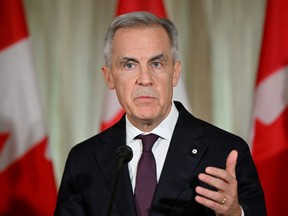
In the name of Canadian sovereignty, it’s time for Prime Minister Mark Carney to withdraw Canada from the United Nations Framework Convention on Climate Change and the UN’s Paris climate treaty.
Advertisement 2

THIS CONTENT IS RESERVED FOR SUBSCRIBERS ONLY
Subscribe now to read the latest news in your city and across Canada.
- Unlimited online access to articles from across Canada with one account.
- Get exclusive access to the Toronto Sun ePaper, an electronic replica of the print edition that you can share, download and comment on.
- Enjoy insights and behind-the-scenes analysis from our award-winning journalists.
- Support local journalists and the next generation of journalists.
- Daily puzzles including the New York Times Crossword.
SUBSCRIBE TO UNLOCK MORE ARTICLES
Subscribe now to read the latest news in your city and across Canada.
- Unlimited online access to articles from across Canada with one account.
- Get exclusive access to the Toronto Sun ePaper, an electronic replica of the print edition that you can share, download and comment on.
- Enjoy insights and behind-the-scenes analysis from our award-winning journalists.
- Support local journalists and the next generation of journalists.
- Daily puzzles including the New York Times Crossword.
REGISTER / SIGN IN TO UNLOCK MORE ARTICLES
Create an account or sign in to continue with your reading experience.
- Access articles from across Canada with one account.
- Share your thoughts and join the conversation in the comments.
- Enjoy additional articles per month.
- Get email updates from your favourite authors.
THIS ARTICLE IS FREE TO READ REGISTER TO UNLOCK.
Create an account or sign in to continue with your reading experience.
- Access articles from across Canada with one account
- Share your thoughts and join the conversation in the comments
- Enjoy additional articles per month
- Get email updates from your favourite authors
Article content
Canadian energy policies should not be influenced, determined or implemented at the behest of the UN’s byzantine climate bureaucracy.
Article content
Article content
To borrow a phrase from the federal budget, let us be “masters of our destiny” on energy.
The ideal time for Canada to declare its independence – even though it won’t happen – would be at the annual UN global gabfest on climate change currently being held in Antalya, Turkiye from Nov. 9 to 20.
This is the 31st annual meeting of the UN’s Conference of the Parties – known as COP 31 – where global elites fly in on private jets and urge everyone else to lower their industrial greenhouse gas emissions, and thus their standard of living, while global emissions keep rising and in 2025, were at their highest level ever.
Read More
-

GOLDSTEIN: Canada’s bottomless climate change money pit
-

GOLDSTEIN: Trudeau’s failed climate policies left us captives to the U.S. oil market
-

GOLDSTEIN: Claims Canada's crime rate is down aren’t reporting the real story
-

GOLDSTEIN: Canada still reeling from lost decade of economic opportunity under Trudeau


By signing up you consent to receive the above newsletter from Postmedia Network Inc.
Article content
Advertisement 3
Article content
Canada will not meet 2030 and 2035 targets
Carney has acknowledged Canada will not meet the unrealistic 2030 and 2035 targets the previous Justin Trudeau government agreed to under the 2015 UN Paris climate treaty to reduce our emissions to at least 40% below 2005 levels by 2030 and at least 45% by 2035.
There is no logical reason for our government to maintain a bureaucracy devoted to implementing a treaty whose emission targets we are ignoring.
None of this is surprising since no Canadian government, Liberal or Conservative, has ever met a single one of the nine emission targets they have set since 1988.
Under Carney, Canada, in theory, remains committed to achieving the Paris treaty goal of net-zero emissions by 2050.
But given that it took 20 years to reduce our emissions to 9.5% below 2005 levels in 2025, according to a report last month by the federally-funded Canadian Climate Institute, the idea we’ll achieve net zero 24 years from now, is absurd.
Advertisement 4
Article content
The CCI says Canada’s emissions increased by 1% last year to 691 million tonnes compared to 685 million tonnes in 2024, that Canada won’t achieve its 2030 target until 2050 and in 2050 will be 460 million tonnes above net zero.

The latest farce is the hypocrisy of Trudeau-era environment ministers Catherine McKenna and Steven Guilbault posting on social media while attending COP 31 that Carney’s environment minister, Julie Dabrusin, misled the public by telling The Canadian Press before leaving for the UN conference that Canada remains “absolutely committed” to achieving net zero emissions by 2050.
Of course Dabrusin is misleading the public, but that’s no different from how McKenna and Guilbault misled the public when they claimed the Trudeau government was on track to meet its emission targets.

Costing Canadian taxpayers a fortune
The failed attempt to reach those targets under the UN Paris treaty has cost Canadian taxpayers a fortune.
There are no financial, legal, or punitive penalties under the Paris treaty for a country that fails to reach its emission targets.
Advertisement 5
Article content
But there are costs that go far beyond the $14.3 billion Canada has sent to developing countries, ostensibly to help lower their emissions, since the Trudeau government came to power in 2015.
Overall, the federal government under Trudeau committed more than $200 billion of taxpayers’ money to 149 programs administered by 13 government agencies, in a failed attempt to meet the Paris treaty targets.
Add in $303 billion in estimated provincial and territorial spending on climate change, administered through 364 government programs and the total comes to $503 billion, or $12,000 for every Canadian, which doesn’t include municipal government spending on climate change.
RECOMMENDED VIDEO

We apologize, but this video has failed to load.
Carney abandoned Trudeau government’s unrealistic targets
Carney abandoned Canada’s 2030 and 2035 unrealistic targets set by the Trudeau government because his goal of making Canada an energy superpower will require emissions to go up.
That alone refutes the nonsense we’ve been told by Liberal governments since 2015 that efforts to reach the Paris treaty targets would have no negative impact on the Canadian economy.
Advertisement 6
Article content
Carney’s decision to cancel the consumer carbon tax, increase Canada’s oil and natural gas exports, remove the cap on emissions in the energy sector, fast-track major infrastructure projects, including the Pacific Link pipeline from Alberta to B.C., and scrapping electrical vehicle mandates will all increase Canada’s emissions.
Withdrawing from the Paris treaty would not mean Canada could not pursue the Carney government’s agenda of lowering emissions over time, nor would it be unprecedented.
The Stephen Harper Conservative government withdrew from the UN’s Kyoto accord – the predecessor of the Paris treaty – in 2011.
It simply means Canada would set its own energy policies, independent of the latest climate nonsense coming out of the UN.
Article content


























 Bengali (BD) ·
 English (US) ·