.png)
 4 hours ago
14
4 hours ago
14
Article content
“Students call out ‘Stop!’ when they want you to cease reading. They must then identify the sexist incident before you can proceed with the story,” it reads.
Article content
The lesson plan then calls for teachers to read through King and King, a book about a gay-married monarch, and “debrief student reactions to the book.”
Article content

Article content
Tell children that changing sex is akin to a new hairstyle
Article content
This lesson plan is also targeted at the kindergarten to Grade 3 cohort.
Article content
It surrounds the children’s book Teddy, A Gentle Story, about a male teddy bear who transitions to a female teddy bear. The book’s protagonist is Errol, a “good friend” who affirms the teddy bear’s gender transition.
Article content
The lesson plan instructs teachers to frame gender transitions as a change no different than a new hairstyle or a sunburn.
Article content
“I talked about how sometimes they might see me and one day I might have a full beard. On other days, I would have no beard,” wrote the lesson’s author, adding “regardless of physical appearance, I am still the same person.”
Article content
The lesson plan then stresses that the way to be a “good friend” is to accept “non-binary understandings of gender” and affirm it in others.
Article content
Advertisement 3
Article content
“When someone shares their name, it is respectful for us to use the name they ask us to use,” it states.
Article content
Correct elementary schoolers whenever they identify an adult as a man or a woman
Article content
SOGI 123 materials are consistent in their view that there is no minimum age for discussions about gender or sexual identity.
Article content
How Young Can SOGI Go?, a 2019 article included in SOGI 123 materials, says that children can be gay or transgender as soon as they enter kindergarten, typically around age 5.
Article content
“Some students enter our Kindergarten classes already asserting their gender identity. Some students have some awareness of their own same-sex attraction,” reads the article, written by elementary schoolteacher Bryan Gidinski.
Article content
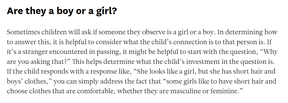
The article also stresses that children should be told from an early age that it is wrong to assume the gender of peers or even authority figures. If a child asks if someone is a boy or a girl, the appropriate response is to tell them “I’m not sure. Does it matter?” or “why are you asking that?”
Article content
Article content
Facilitate children adopting new sexual identities, and conceal the information from parents
Article content
Advertisement 4
Article content
This policy has been the most controversial flashpoint of SOGI curricula across Canada, and is already banned in Alberta. In 2024, the government of Alberta Premier Danielle Smith required school authorities to “notify parents where a student requests that teachers, principals and other school staff refer to them by a new preferred name or pronouns.”
Article content
But the standing policy of the B.C. Ministry of Education is that if a child of any age states that they want to adopt a new gender identity, the only appropriate response is to “affirm” the decision and mandate that students and school staff do so as well.
Article content
What’s more, the details of this affirmation may be concealed from the child’s parents if it is determined this is something they might find objectionable.
Article content
There’s an entire SOGI 123 unit on how to handle this process entitled Hello, My Name is Changing. School staff are to record the child’s new name and develop a strategy that will both alert other staff members to the social transition while potentially concealing it from family. “Make note of who will see what, including parents, teachers, other students, and administrative staff,” it reads.





























/https%3A%2F%2Fsportsmole-media-prod.s3.gra.io.cloud.ovh.net%2Fuploads%2F2026%2F09%2Fmikel-arteta-21-6ab9a6087b35f019707296.jpg)
 Bengali (BD) ·
  English (US) ·