.png)
 2 weeks ago
17
2 weeks ago
17
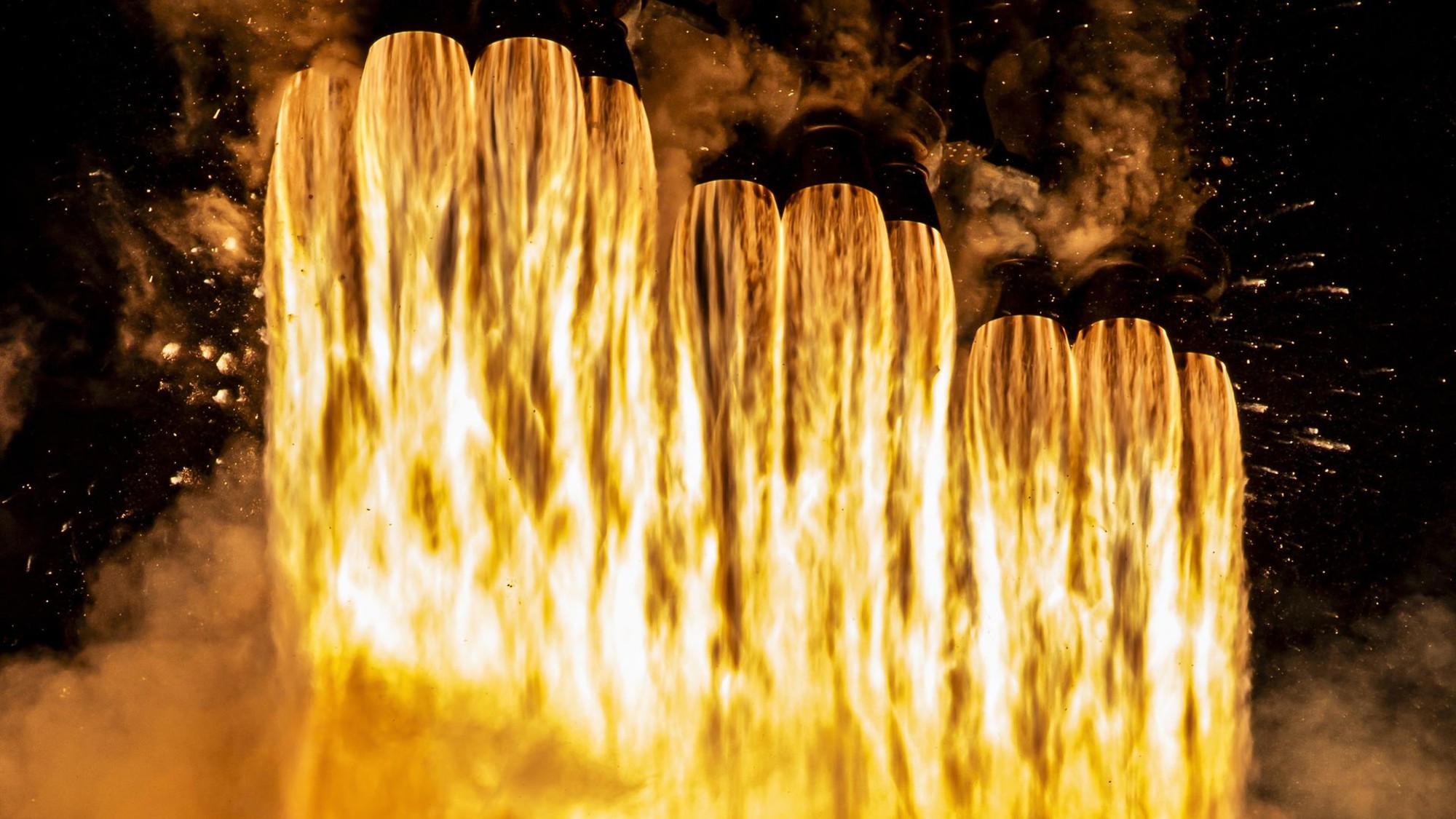
SpaceX's Falcon Heavy rocket can generate some serious thrust, leading to incredible displays of fireworks as seen in the photo above.
What is it?
In this photo, the 27 Merlin engines of a SpaceX Falcon Heavy rocket spew fire as they generate the thrust that sent NASA's revolutionary Nancy Grace Roman Space Telescope to orbit on a picture-perfect morning launch on Sunday, Aug. 30, 2026.
Falcon Heavy sent Roman to a gravitationally stable parking spot known as Lagrange Point 2, located 1 million miles away (1.5 million kilometers) between Earth and Mars, where the gravitational pulls of the sun and Earth equal out.
Once there, the Roman Space Telescope will spend a few months coming online before it begins conducting groundbreaking science, searching the universe for signs of dark energy and dark matter and hunting for distant exoplanets.
Why is it incredible?
SpaceX only pulls out Falcon Heavy when it needs incredible heavy-lift capability. The rocket essentially consists of three Falcon 9 rocket boosters attached to one another, whose combined 27 Merlin engines can generate over 5 million pounds (2.27 million kilograms) of thrust. That lift power enables Falcon Heavy to send large payloads to distant destinations.
Aside from Roman, other notable Falcon Heavy missions include the 2024 launch of the Europa Clipper mission to Jupiter's icy moon, the Psyche probe that will investigate a metal-rich asteroid in the main belt between Mars and Jupiter, and most famously, a Tesla Roadster convertible featuring a mannequin 'driver'.



























 Bengali (BD) ·
  English (US) ·