.png)
 4 days ago
14
Article content
Second in a three-part series

THIS CONTENT IS RESERVED FOR SUBSCRIBERS ONLY
Subscribe now to read the latest news in your city and across Canada.
- Unlimited online access to articles from across Canada with one account.
- Get exclusive access to the Vancouver Sun ePaper, an electronic replica of the print edition that you can share, download and comment on.
- Enjoy insights and behind-the-scenes analysis from our award-winning journalists.
- Support local journalists and the next generation of journalists.
- Daily puzzles including the New York Times Crossword.
SUBSCRIBE TO UNLOCK MORE ARTICLES
Subscribe now to read the latest news in your city and across Canada.
- Unlimited online access to articles from across Canada with one account.
- Get exclusive access to the Vancouver Sun ePaper, an electronic replica of the print edition that you can share, download and comment on.
- Enjoy insights and behind-the-scenes analysis from our award-winning journalists.
- Support local journalists and the next generation of journalists.
- Daily puzzles including the New York Times Crossword.
REGISTER / SIGN IN TO UNLOCK MORE ARTICLES
Create an account or sign in to continue with your reading experience.
- Access articles from across Canada with one account.
- Share your thoughts and join the conversation in the comments.
- Enjoy additional articles per month.
- Get email updates from your favourite authors.
THIS ARTICLE IS FREE TO READ REGISTER TO UNLOCK.
Create an account or sign in to continue with your reading experience.
- Access articles from across Canada with one account
- Share your thoughts and join the conversation in the comments
- Enjoy additional articles per month
- Get email updates from your favourite authors
Sign In or Create an Account
or
Article content
WILLIAMS LAKE — “This whole province has been run by the south,” says Eli Bergen, who runs a concrete business in this city, a seven-hour drive north of Metro Vancouver.
Article content
Article content
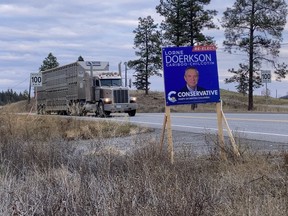
Wearing a black baseball cap, Bergen, a Cariboo-Chilcotin native, used rough language to describe how little he believes politicians in Victoria have cared about the immense B.C. Interior, including this home riding won by Lorne Doerkson, who will become premier this week.
Article content
Advertisement 1
Article content
That perceived negligence should change fast under Doerkson, who Bergen believes will be “awesome” for invigorating the province’s Interior economy. While the Conservatives made inroads in urban southwestern B.C. on Oct. 24, they won almost all the ridings northwest of Vancouver on the Mainland, from Abbotsford to Dawson Creek.
Article content
Article content
It is hard to convey the vastness of B.C.’s Interior. Doerkson’s riding alone is big enough to contain 20 Metro Vancouvers. The B.C. Conservatives now dominate most electoral districts heavily populated by blue-collar workers — loggers, miners, hunters, farmers, industrial labourers, highway crews, ranchers, and oil-and-gas workers.
Article content
Meanwhile, the B.C. NDP has, generally speaking, lost some of its traditional ties to voters who work outdoors or with their hands. It’s become largely the party of educated urban residents and white-collar employees in the public service.
Article content
Let’s look at how some key provincial policies are likely to be changed by Doerkson and much of his caucus hailing from outside B.C.’s congested, cosmopolitan urban cores.
Article content
Advertisement 2
Article content
Article content
Resource industries
Article content
“We used to see a lot more logging trucks on the road,” said Paul Cornwallis, sitting in the PV Cuisine restaurant at 100 Mile House, which calls itself “The Log Home Building Capital of North America.”
Article content
The pleasant restaurant, with a burning woodstove, is constructed of handcrafted logs. The city’s tourist information centre and main real-estate outlet are also among the region’s plethora of offices, lodges, motels and houses made of logs.
Article content
Nevertheless, despite the local pride in logging, B.C.’s forestry sector is struggling. The Council of Forest Industries has tracked 21 permanent or indefinite mill closures in B.C. since 2023, resulting in roughly 15,000 job losses.
Article content
What remains of the industry survives in different forms in the Cariboo-Chilcotin. Williams Lake itself encompasses several sprawling sawmills and other wood-products operations. The lumberyards of West Timber, Tolco, Sigurdson and others cannot be missed by people passing through.
Article content
Another sign of the prevalence of extractive industries comes almost every morning in Williams Lake, when buses arrive to pick up hundreds of workers to transport them on highway and gravel roads to the Gibraltar Mine, Mount Polley Mine, and other underground operations producing copper, gold and molybdenum.

























 Bengali (BD) ·
 English (US) ·