.png)
 2 hours ago
7
2 hours ago
7
She spent the winter struggling to protect her six young children from the biting cold and driving rain. Now the weather in Gaza has improved but Ezyia Abu Hayya is facing a new, more wretched problem: rats who devour her family’s scarce food and even their few remaining clothes.
Subscribe to read this story ad-free
Get unlimited access to ad-free articles and exclusive content.

“In the winter, the water surrounds us, and in the summer, we suffer from rats because our tent is low,” the 34-year-old said, squatting inside her tiny dwelling in the city of Khan Younis in southern Gaza. “The rats eat everything, leaving us with nothing.”
It’s been more than six months since a ceasefire halted the heaviest fighting in the Gaza Strip, but the changing seasons still bring fresh miseries for Abu Hayya and her children.
Gaza’s most dire conditions — the lack of food and medicine, continuing Israeli attacks, destroyed hospitals, schools and residential buildings, homelessness and overcrowding — now include rodents, climbing temperatures and open-air sewage.
Meanwhile, talks over Gaza’s future between Hamas, mediating countries and representatives from President Donald Trump’s Board of Peace have barely progressed, three officials close to the process told NBC News.
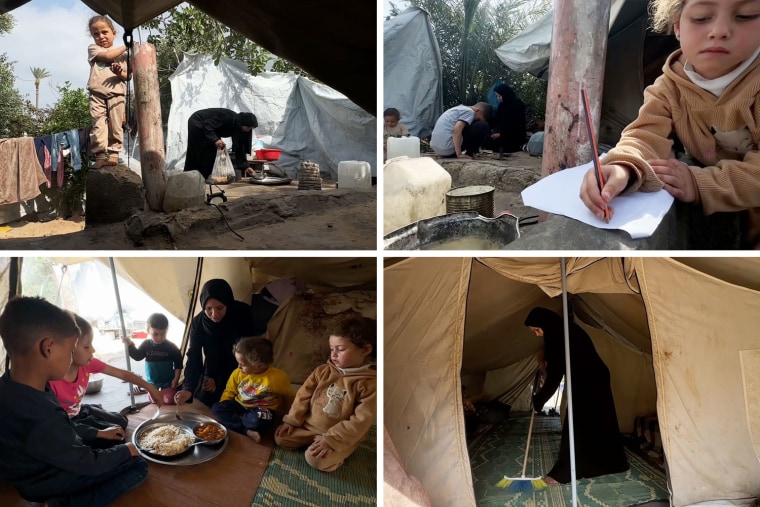 Widowed Ezyia Abu Hayya looks after her six children in a tent camp in southern Gaza after her husband was killed in 2025. NBC News
Optimistic plans to improve the enclave’s security, provide reconstruction and humanitarian relief, and institute a more permanent governance structure in Gaza are gridlocked by diplomatic disagreements over Hamas’ disarmament and an increasingly distracted Trump administration, the diplomats say.
“Once the war ended and Hamas agreed to the ceasefire and the hostages were released, that was the priority of the U.S. administration,” said Bishara Bahbah, a Palestinian American businessman who is close to the Trump administration and is regularly briefed on the negotiations. “Then the Iran war came and nobody talks about Gaza as a result.”
An official with the board acknowledged that “life remains very challenging in Gaza and more needs to be done to meet urgent civilian needs.” The official disputed that negotiations had not progressed, and that “distraction among our key member states is hampering our work.”
The official, who spoke on behalf of the board on condition of anonymity, did not specify what progress had been made in talks.
“We are pressing for quick agreement of the full and sequenced implementation of the roadmap for the decommissioning of weapons in Gaza, the deployment of the International Stabilization Force, the transition of authority to the National Committee for the Administration of Gaza, and the withdrawal of Israeli forces,” the official added.


Inside the Israeli movement pushing for resettlement in Gaza
A State Department official told NBC News on Friday that American leadership and “targeted negotiations” had improved humanitarian “access” in Gaza.
Reconstruction, however, was contingent on Hamas laying down its weapons, as specified under Trump’s 20-point plan, which the group agreed to as part of the ceasefire.
“Anything short of full demilitarization undermines Gaza’s recovery, Israel’s security and regional stability,” the official added.
Aid agencies agree the situation in Gaza has improved since the ceasefire: Deaths and injuries from Israeli attacks and reports of famine conditions have decreased, but both still stalk the Gaza Strip’s more than 2 million residents, most of whom are now homeless.
The Palestinian Health Ministry in Gaza, parts of which are still controlled by Hamas, said 784 people have been killed by Israeli attacks since the ceasefire came into effect in October. The International Rescue Committee reported this week that around 77% of Gaza’s population is expected to face acute food insecurity this year.
Aid agencies say Israeli security restrictions have tied their hands, creating difficult security barriers that have limited the influx of aid.
“We’re not getting beyond the immediate basic humanitarian needs,” said Sam Rose, the acting director of UNRWA Affairs in Gaza. “People are living in absolute squalor in fetid, rancid conditions on the side of the beach on barren land, in a completely undignified manner.”
COGAT, the Israeli military unit in charge of humanitarian coordination in the Palestinian territories, said claims about the continuing squalor in Gaza are biased and “promoted by interested parties seeking to create a false impression of a crisis in the Gaza Strip as part of an effort to discredit Israel.”
UNRWA, the United Nations Relief and Works Agency, is the main U.N. body in charge of providing services and aid to Palestinians throughout the Middle East. Israel accused hundreds of UNRWA employees in Gaza of working with terrorist groups and banned the organization from operating in Israel in 2024, effectively blocking its foreign staff and aid from entering the enclave.
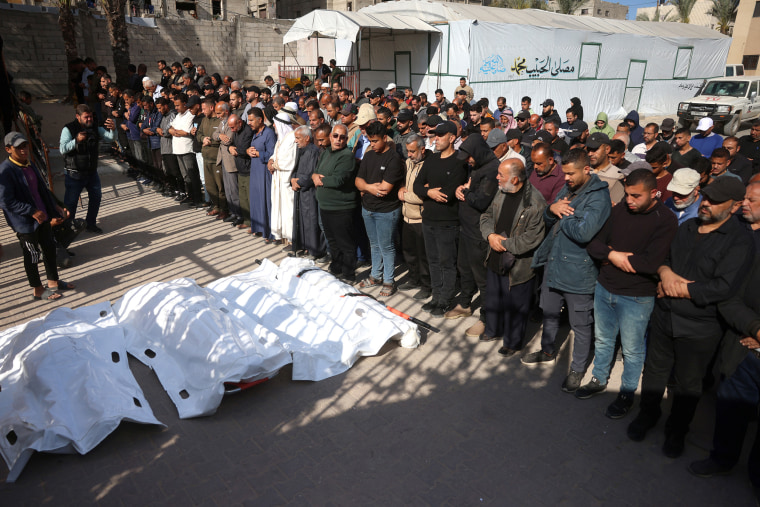 Palestinians pray over the bodies of people killed in an Israeli airstrike in the city of Khan Younis, southern Gaza on April 21, 2026. Bashar Taleb / AFP via Getty Images
UNRWA fired nine of its employees over their potential involvement in the Oct. 7, 2023, terror attacks but denied its employees were involved on a wider scale.
The incident prompted Israel to withdraw official registration for dozens of aid agencies to access Gaza after they refused to provide detailed lists of their employees. The aid agencies said revealing this information could put them at risk of Israeli attack.
“We’re in a stalemate as a community,” one high-ranking aid agency official said of the humanitarian groups trying to get into Gaza, speaking on condition of anonymity because the person was not authorized to speak to the media. “Even those of us trying to move the ball forward have been unsuccessful in getting registered.”
The official blamed the lack of trucks entering Gaza on the nearly impossible registration process for aid organizations that are expected to pick up where UNRWA left off.
Since Israel began its military assault on Gaza, aid agencies have disputed the amount of aid that Israel says it has allowed to enter the strip.
The U.N. and other agencies say only about 100 to 200 trucks are entering Gaza each day — far below the 600 stipulated in the ceasefire agreement.
The Gaza Border Crossings Authority told NBC News that Israel has allowed in an average of 129 trucks each day so far this week.
COGAT said there are no restrictions on aid entering Gaza and that it has been allowing 600 trucks each day, but that for safety reasons, the number of trucks were limited to 250 per day during the Israeli and American war with Iran. That number increased back to 600 per day three weeks ago, said Shimi Zuaretz, a COGAT spokesperson.
Most of the incoming aid is food, the U.N, reported, a welcome improvement from the famine conditions before the ceasefire.
But Palestinians like Abu Hayya and her family also need more building materials to at least improve their shelters. Advocacy groups say Israel categorizes almost all useful building materials and tools as “dual use” items — imports it has blocked from entering because it says they could function as weapons.
That means the vast majority of Palestinians in Gaza live either in rickety tents or partially destroyed buildings. Satellite images examined by the U.N. shortly after the ceasefire found that more than 80% of buildings in Gaza were at least partially damaged.
As spring turns to summer, Abu Hayya’s rat problem is both a cause and symptom of escalating health concerns in Gaza.
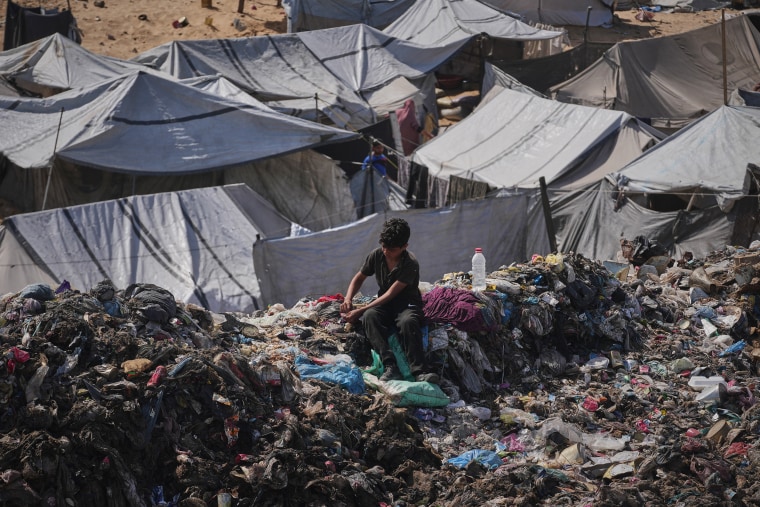 A child searches for reusable items at a landfill site beside a displacement camp in Deir al-Balah, central Gaza on April 16.Abdel Kareem Hana / AP
The U.N. reported earlier this month that 80% of the displaced people’s sites it visited in March had “frequent and visible rodent and pest presence, while skin diseases are widespread in 48 percent of the sites.”
Aid groups expect the problem to worsen as temperatures soar in the coming months, particularly amid the streams of untreated sewage flowing through the strip’s tent cities housing the displaced.
Any outbreak will face a battered health care system — fewer than half of hospitals and primary healthcare centers have remained at least partially functional through two years of Israeli strikes, according to a joint U.N.-European Union report on Gaza published Tuesday.
“Summer will carry a lot of problems for the Palestinians, and we have concerns regarding the contagious diseases,” said Amjad Al Showa, a prominent Palestinian humanitarian and human rights advocate who lives in Gaza. “Shortage of hygiene and sanitation will lead to more catastrophic conditions.”
Solutions to Gaza’s continuing crisis are waiting on negotiations between Hamas and intermediaries in Cairo that have so far failed to reach a final deal, though one person involved in the talks said they were progressing.
The main sticking point remains Hamas’ disarmament. The group cites the enduring lack of humanitarian assistance as one of its reasons for refusing to give up its weapons.
A Hamas spokesperson in Gaza said the group needs its weapons as long as Israel continues attacking Palestinians and keeps its forces at the “yellow line,” the limit of Israel’s zone of control under October’s ceasefire that gives it control over more than half of the enclave.
“The danger remains constant,” Hazim Qassem said. “Even with the presence of arms; the lack of weapons would likely encourage the occupation to commit even more crimes.”
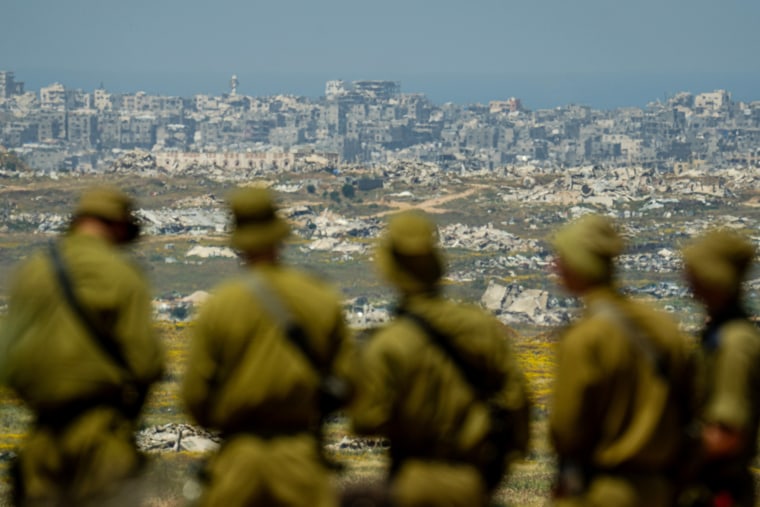 Israeli soldiers looking at the destroyed city of Jabalia in Gaza from southern Israel on Wednesday.Erik Marmor / Getty Images
But diplomats close to the negotiations said the Israeli side will not proceed to next steps until Hamas surrenders all its weapons.
“Not disarming and not demilitarizing is a violation of the ceasefire agreement and the U.N. Security Council resolution by Hamas,” said an Israeli official close to the negotiations who spoke on condition of anonymity because the person was not authorized to speak to the media. “It’s the job of the mediators and the Board of Peace and everybody else to ensure that they disarm. That’s the key thing. And the time for that has already passed.”
Trump first proposed the Board of Peace to oversee the next phase of his peace plan for Gaza, but it then morphed into a body billed as part of the solution to a series of global conflicts.
The past few weeks of talks in the Egyptian capital have begun to look like the opening stages in a longer set of discussions, people close to the negotiations said, rather than an imminent source of relief for people in Gaza.
Hamas has said it will accept the authority of a 15-member panel of Palestinian technocrats chosen by the U.S.-led board to administer Gaza if Israel meets the treaty’s other conditions, such as halting attacks on Palestinians and withdrawing further toward the borders. But three diplomats close to the process said the officials have not entered Gaza since the ceasefire was agreed to.
The Palestinian technocrats fear for their lives if they travel to Gaza, two of the three officials said, and they are worried that returning without any power to effect any consequential change will immediately discredit them, casting them as Israeli puppets rather than legitimate leaders.
The technocrats, many of whom are career officials from the Palestinian Authority that governs parts of the occupied West Bank, have instead spent their time in meetings, making policy plans for their eventual return to the Gaza Strip and its mounting humanitarian challenges.
For many in Gaza like Abu Hayya, even the signal of a permanent end to the fighting would come as a huge relief.
“At least we won’t be living in fear anymore. We will finally know our fate, that the war has ended — thank God,” she said.
But Abu Hayya said she doubts Hamas will ever give up its weapons, which will prolong the uncertainty even if the guns stay silent.
“With Hamas in control, I fear the fighting could return,” she said. “I’m worried for my children — where would we go?”


























/https%3A%2F%2Fsportsmole-media-prod.s3.gra.io.cloud.ovh.net%2Fuploads%2F2025%2F11%2Fimago1068606686-1-69071bd01fb89577912048.jpg)

 Bengali (BD) ·
  English (US) ·