.png)
 1 hour ago
10
1 hour ago
10
Article content
This interview has been edited for length and clarity.

THIS CONTENT IS RESERVED FOR SUBSCRIBERS
Enjoy the latest local, national and international news.
- Exclusive articles by Conrad Black, Barbara Kay and others. Plus, special edition NP Platformed and First Reading newsletters and virtual events.
- Unlimited online access to National Post.
- National Post ePaper, an electronic replica of the print edition to view on any device, share and comment on.
- Daily puzzles including the New York Times Crossword.
- Support local journalism.
SUBSCRIBE FOR MORE ARTICLES
Enjoy the latest local, national and international news.
- Exclusive articles by Conrad Black, Barbara Kay and others. Plus, special edition NP Platformed and First Reading newsletters and virtual events.
- Unlimited online access to National Post.
- National Post ePaper, an electronic replica of the print edition to view on any device, share and comment on.
- Daily puzzles including the New York Times Crossword.
- Support local journalism.
REGISTER / SIGN IN TO UNLOCK MORE ARTICLES
Create an account or sign in to continue with your reading experience.
- Access articles from across Canada with one account.
- Share your thoughts and join the conversation in the comments.
- Enjoy additional articles per month.
- Get email updates from your favourite authors.
THIS ARTICLE IS FREE TO READ REGISTER TO UNLOCK.
Create an account or sign in to continue with your reading experience.
- Access articles from across Canada with one account
- Share your thoughts and join the conversation in the comments
- Enjoy additional articles per month
- Get email updates from your favourite authors
Sign In or Create an Account
or
Article content
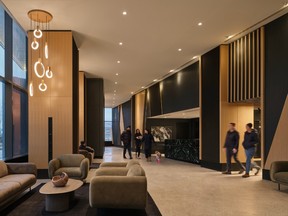
Once treated largely as pass-through spaces, condo lobbies are now being asked to do more than provide handsome first impressions. Marcella Au, senior associate and retail and interiors lead at BDP Quadrangle — the Toronto-based architecture firm behind CG Tower in Vaughan, Westbend Residences near High Park and Gallery Towers in Markham among others — explains how lobby design is changing, why concierge desks still matter, and how developers and designers can create spaces that are both practical and eye-catching.
Article content
Article content
Article content
Q What are the most important uses of a condo lobby today?
Article content
A They can become real community spaces. It’s where kids might go trick-or-treating, residents gather for meet-and-greets or people wait for friends to chat. It can help residents feel connected to the building and to one another, rather than simply moving through a shared entrance. Then there is the logistics role: deliveries, move-ins, package management and concierge coordination.
Article content
Q How do you balance those uses?
Article content
A There is much more planning involved now. Older buildings that didn’t anticipate the growth of online shopping and delivery can have a more challenging time, depending on the size and layout of the lobby.
Article content
And a lobby still needs presence, a sense of place and a sense of arrival. It has to be aesthetically pleasing, but also timeless and durable enough to support heavy use.
Article content
When we design lobbies today, there is almost always a dedicated area for parcel lockers or package storage. It needs to be close to the mail room so deliveries can be made efficiently, but it also needs to be designed carefully because parcel rooms and lockers are not always aesthetically pleasing.
Article content
Article content
Food delivery adds another layer. Some buildings have allowed delivery drivers to go directly to residents’ floors, but many are moving away from that. We are seeing more dedicated pickup nooks in or near the lobby, where residents can come down and collect their order. It becomes more of a grab-and-go model, but it still needs to feel integrated into the design.
Article content

Article content
Q How has condo lobby design evolved in recent years?
Article content
A The growth of master-planned communities and downtown-like cores in suburban areas has changed the way designers think about the residential lobby. In these settings, many residents may be moving from single-family homes into a shared building format. That’s why there is now much more emphasis on the arrival experience.
Article content
In many cases, the lobby is becoming a kind of third place. Not quite home, not quite the city outside, but a shared space where residents can arrive, gather and feel a sense of belonging.
Article content
Q How do you future-proof a lobby when technology and resident expectations keep changing?
Article content
A There is a balance between embracing technology and maintaining the human elements that make people feel at home. There was a period when some buildings tried using a virtual concierge on a screen. From what I’ve seen, that format didn’t really work. People still want in-person interaction. I live in a condo myself, and I enjoy seeing the same person at the concierge desk saying good morning or good night.
























/https%3A%2F%2Fsportsmole-media-prod.s3.gra.io.cloud.ovh.net%2Fuploads%2F2026%2F05%2Fns-collage-background-v2-email-3-6a086d6eaa1a0057506880.jpg)
 Bengali (BD) ·
  English (US) ·