Colin Kaepernick’s unfinished business

3 hours ago 5

Colin Kaepernick still puts in a workout at 4:30 a.m. most days. His football life may be long over, but his life’s work is not.

Ten years after taking a knee to stand against racism and police brutality at great cost to his career and finances, the former star quarterback is stepping back into the spotlight.

His memoir, “The Perilous Fight,” comes out on Sept. 15. And in interviews with NBC News, his first time speaking in depth about his protest’s fallout in years, Kaepernick reveals the story behind how he came to take a knee in 2016, an act that made him both a hero and a pariah, and one of the most divisive figures in the country.

Kaepernick, 38, is now also a father to a 4-year-old girl. That, he says, helped him understand he has unfinished business in his life and cause. Being a dad “increases the responsibility and urgency of the work we’re doing,” he says. He doesn’t want his daughter — or anyone else — to think he stopped fighting or that the fight was not worth it. “I don’t want my community to watch me and have the takeaway be that if you fight for Black folks, it’s over for you,” he writes in his book.

More NBC News coverage of Colin Kaepernick

  • Kaepernick will be the first guest on "Before & After with Lester Holt," available as soon as Sept. 7.
  • Kaepernick is set to appear on "TODAY" on Sept. 16.
  • Read Kaepernick's response to Jay-Z's recent freestyle rap about him on NBC News Sept. 2.

Much has shifted in American politics, culture, sports and policing since 2016. And much work still needs to be done, Kaepernick says, which is why he chose now to recount the decade-long odyssey that began with a quiet protest during the national anthem.

Though the years have provided perspective, Kaepernick says they haven’t dulled his displeasure with the NFL. The quarterback who once led the San Francisco 49ers on a Disney movie-esque run to the Super Bowl in 2012 says he hasn’t watched an NFL game since he was exiled from the league.

“I’m not gonna support an organization that one, is actively blackballing me, but two, has targeted my brothers who have been protesting as part of this as well,” Kaepernick says. “I watch college football.”

(NFL Commissioner Roger Goodell has said on multiple occasions he doesn’t believe Kaepernick was blackballed.)
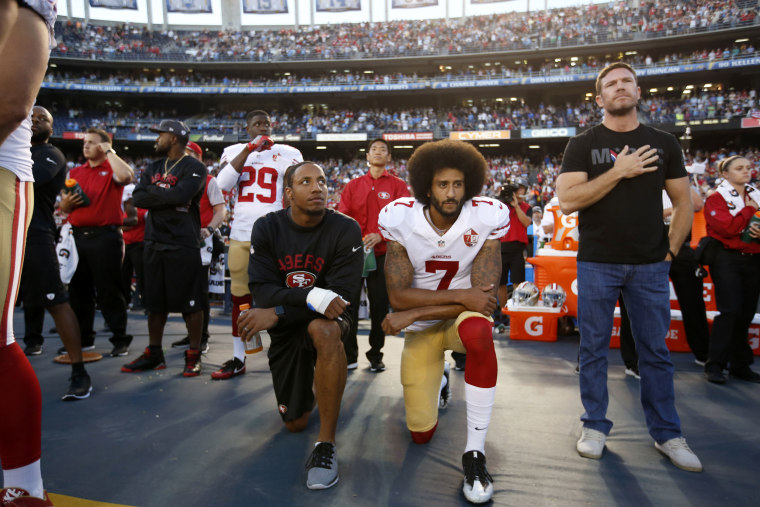

Reid and Kaepernick take a knee on the sidelines of a football stadium while another player holds his hand over his heart.Eric Reid and Colin Kaepernick kneel in protest during the national anthem in San Diego on Sept. 1, 2016. Michael Zagaris / San Francisco 49ers via Getty Images file

On Sept. 1, 2016, Kaepernick and his San Francisco 49ers teammate Eric Reid took a knee during the national anthem before a preseason game. It was not the first time Kaepernick didn’t stand. His protest actually began a month earlier, on Aug. 14, when he sat on the bench during “The Star-Spangled Banner.”

The idea had simmered in the months prior to the season when, he writes in his memoir, he was recuperating from surgeries. He might not have taken a knee if he hadn’t injured it first.

The rehab gave him more free time than he ever had in his life. And in the midst of news of police violence, Kaepernick immersed himself in literature on Black liberation, reading books such as “The Autobiography of Malcolm X” and “Black Skin, White Masks” by Frantz Fanon.

Kaepernick says he hadn’t planned the initial protest in mid-August until he heard the opening of the anthem and felt he couldn’t bring himself to stand. No one seemed to notice him sitting at first. It wasn’t until after the 49ers’ third preseason game that Kaepernick was finally asked why he sat out the anthem.

“I am not going to stand up to show pride in a flag for a country that oppresses Black people and people of color,” Kaepernick told NFL Network’s Steve Wyche. “To me, this is bigger than football and it would be selfish on my part to look the other way. There are bodies in the street and people getting paid leave and getting away with murder.”

Kaepernick was unprepared for the response, he writes in the book. After the game, he called his partner, Nessa, and mentioned the reporter’s question.

“Hmm. Well, what did you tell him?” she asked. “On a scale of one to 10, with 10 being the worst, how hard did you go?”

“I don’t know. Maybe a four,” Kaepernick replied.
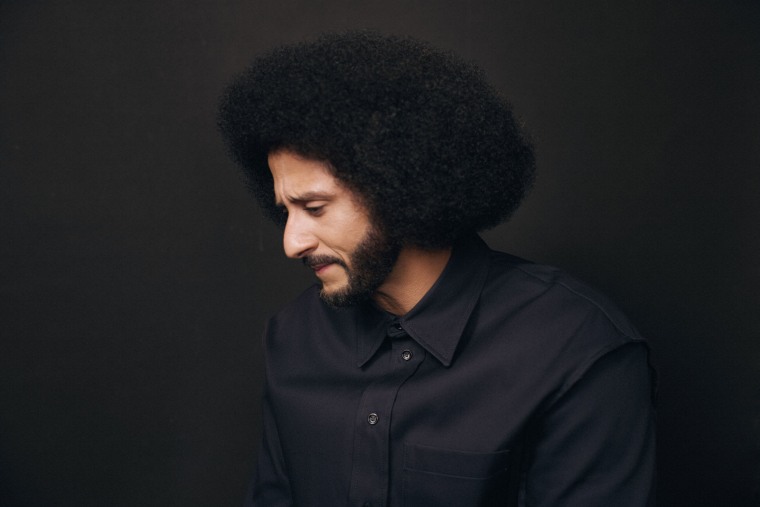
Colin Kaepernick looking downJesse Dittmar for NBC News

The backlash was immediate. Fans burned his jerseys. Current and former players said he disrespected the flag. Donald Trump, then a presidential candidate, said Kaepernick “should find a country that works better for him.”

“This is not a four, man,” Kaepernick recalls Nessa telling him when the news blew up.

Even though the story of the protest has been told countless times since 2016, Kaepernick set the record straight on one key detail: who came up with the idea to kneel in the first place.

Before the Sept. 1 game, Kaepernick was approached by Reid, who wanted to support the protest. It was Reid who suggested the idea to kneel, Kaepernick says. Not Army veteran Nate Boyer, as was widely reported at the time and since.

Boyer, a Green Beret and former Seattle Seahawk, had penned an open letter to Kaepernick in the Army Times, writing: “Even though my initial reaction to your protest was one of anger, I’m trying to listen to what you’re saying and why you’re doing it.”

On the day of the game, Boyer met with Kaepernick and Reid and relayed stories about how veterans responded to his open letter. The conversation, Boyer says, then shifted to how the protest could be respectful of the military.

“I think it was Colin specifically that asked it. He said, ‘Well, do you think there’s a way that we could protest that’s not going to offend people in the military?’” Boyer recalls. “And I said, ‘No. No matter what, some people will be offended.’”

Boyer then told Kaepernick he believed sitting on the bench “wasn’t the most inspiring” and that the protest could be more effective if he was next to his teammates, perhaps bowing his head while standing.

“He said no immediately, and I respect that,” Boyer says, and the conversation then logically turned to taking a knee. He doesn’t dispute that the two players may have come to that conclusion before meeting him.

“I remember them nodding their heads and looking at each other,” Boyer says. “Maybe Eric did suggest that, and that’s kind of what that look was.”

After the Sept. 1 game, Reid told reporters “[Boyer] agreed with” the idea for them to kneel. Kaepernick says the notion it was Boyer’s idea appealed to the media because the backing of a white military veteran made the protest seem more “palatable.”

As for why Kaepernick didn’t clear up the misconception at the time, he says he and Reid wanted to focus on their message, not get caught “in a personal back-and-forth over whose idea it was.”
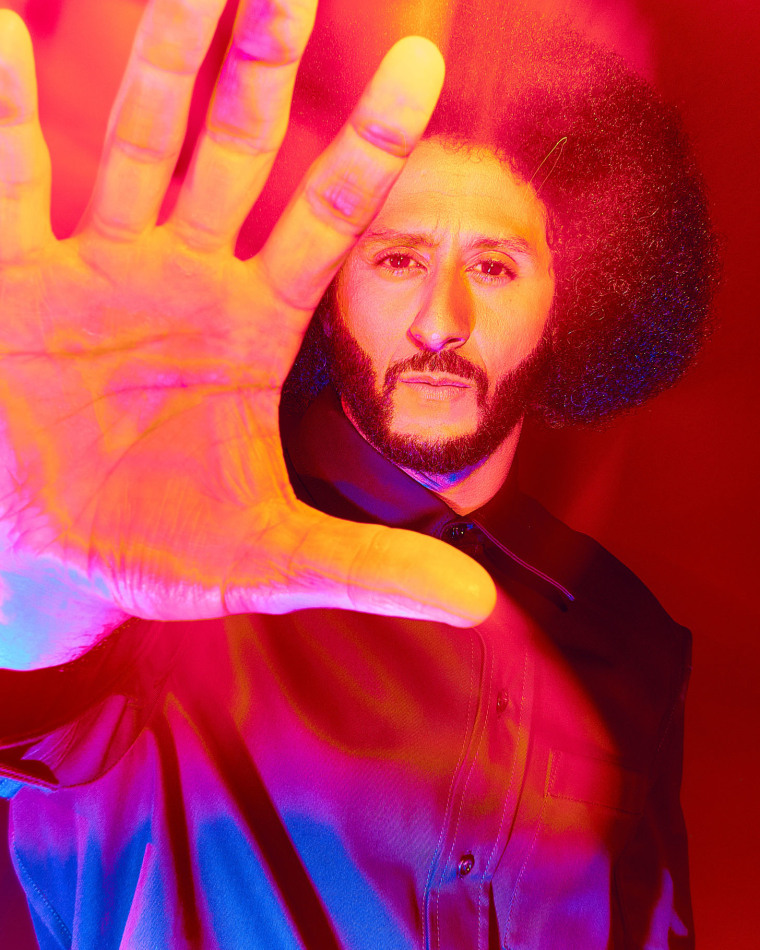
Colin Kaepernick holds his hand toward the cameraJesse Dittmar for NBC News

Though Kaepernick and Reid ultimately switched from sitting to kneeling, the protest continued to stoke controversy. Then-Supreme Court Justice Ruth Bader Ginsburg called it “dumb and disrespectful.” Even Kaepernick’s adoptive parents initially said it was “disgraceful.”

Along with the backlash, there was also a groundswell of support from the people he was protesting for, as well as athletes from other sports who joined the effort.

“Oftentimes we hear a lot of the side of the pushback, but I think what’s disconnected from a lot of that is actually the response directly in communities that we were seeing, and the momentum and the excitement around the effort of no, we’re actually going to change this,” Kaepernick told NBC News during a recent sit-down.

Those who condemned his protest chose to focus on his kneeling during the anthem — as opposed to the police violence that drove him to do it.

“The critique of the method is a way to distract from the actual message,” Kaepernick says. “The conversation that was being had is taking a knee is more problematic than Black people being killed. Just simply put, ‘Hey, we need to talk about taking a knee. This is urgent. We need to resolve this.’ But another Black person gets killed, and it’s like, ‘Oh well, that’s kind of normal.’”

In most of the coverage, Kaepernick’s assertion rang true. The conversation stuck to the red, white and blue, and not the disproportionate number of Black Americans killed by police that the quarterback tried to bring attention to.

As Kaepernick tried desperately to keep his protest on message, the rest of his life was picked apart, from his romantic partner to his clothing choices. When Kaepernick revealed he didn’t vote in the 2016 election, ESPN’s Stephen A. Smith called him “irrelevant” and a “flaming hypocrite.”

Reaction from players was also mixed. While Reid, Kaepernick and five other players kneeled in Week 1 of the 2016 season, many who said they were sympathetic to Kaepernick’s cause disagreed with his decision not to stand for the anthem.

There was a group chat with roughly 100 players from all 32 teams that often grew contentious. In his memoir, Kaepernick writes of a text exchange in September 2016 in which then-Seahawks cornerback Richard Sherman told him he shouldn’t tell players how to protest. (Through his podcast producer, Sherman declined to comment.)

The tension in the group chat was palpable, one former player in the chat who spoke on condition of anonymity tells NBC News. Some suggested Kaepernick was only kneeling for personal gain, even though by then it was clear he’d suffer a professional blow. In 2017, he became a free agent after the 49ers told him they would release him. The summer passed, and beyond a meeting with the Seattle Seahawks, no teams scheduled workouts.

“I thoroughly enjoyed meeting with Colin, we just didn’t get to the next level,” then-Seahawks coach Pete Carroll wrote NBC News in an email about the meeting. Kaepernick says his meeting with Carroll and general manager John Schneider focused on his political beliefs. (The Seahawks did not respond to a request for comment.)

“Which, in pretty much any environment outside the NFL, would be immediate litigation,” Kaepernick says.

The same league that let Michael Vick play again after he went to prison for dogfighting, and allowed Deshaun Watson to sign a contract for $230 million following accusations of sexual misconduct by over 20 women (Watson has maintained his innocence), was keeping Kaepernick out.

“There’s not a definitive moment that I would point to,” Kaepernick says about when he realized what was happening.

Instead, it was more of a culmination.

“Coming on the back of going to a Super Bowl, going to an NFC Championship, setting records, and not a single team would bring me in, even for a workout?” Kaepernick says.
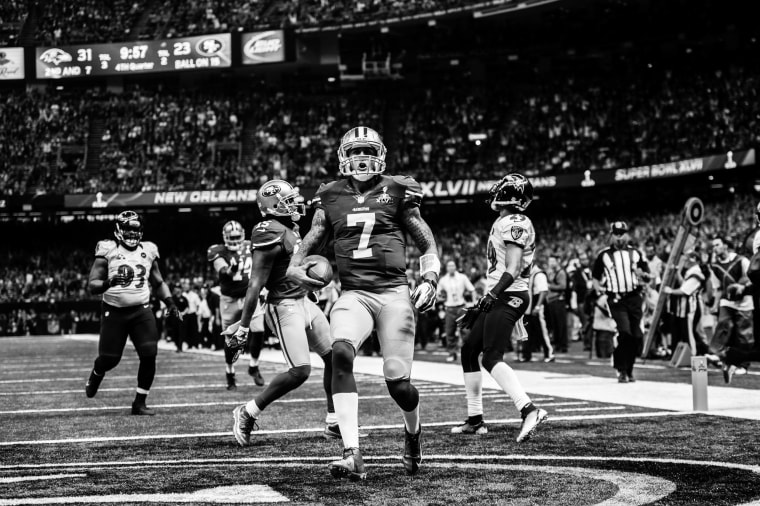
Colin Kaepernick celebrates on the field/Kaepernick celebrates after a touchdown in the fourth quarter of the Super Bowl in 2013.Rob Tringali / Getty Images file

In August 2017, the Miami Dolphins — whose owner Stephen Ross previously launched a nonprofit to fight systemic racism — signed quarterback Jay Cutler after an injury to starter Ryan Tannehill, even though Cutler had already retired. NFL team executives, meanwhile, used the media to try to throw water on the idea that Kaepernick was blackballed.

Some coaches and GMs did reach out, Kaepernick says, and explicitly told him, “Yeah, we want to bring you in, but it’s getting shut down above us.”

One of those coaches, writes Kaepernick in his book, was John Harbaugh, the then-head coach of the Baltimore Ravens. Kaepernick spoke extensively with Harbaugh during the summer of 2017. Harbaugh’s brother Jim was Kaepernick’s coach during the 49ers’ run to the Super Bowl.

Kaepernick writes that Harbaugh was “pushing” to sign him, but was “shut down from above.”

In October 2017, Kaepernick filed a grievance against the NFL under the terms of the league’s and players’ collective bargaining agreement, alleging that owners were colluding against signing him due to his protest.

“Everybody believes that he was blackballed,” says one former player who was in the league during 2016. “Players knew that this would happen. That was a firm belief around the league.”

Goodell pushed back on the notion of organized collusion to keep Kaepernick out of the NFL.

“Those are decisions that each individual owner has to make and their clubs, coaches, GMs,” Goodell told NBC in 2020. “And I’ve talked to a lot of our clubs about it and I’ve encouraged them. I’d love to see him play again.”
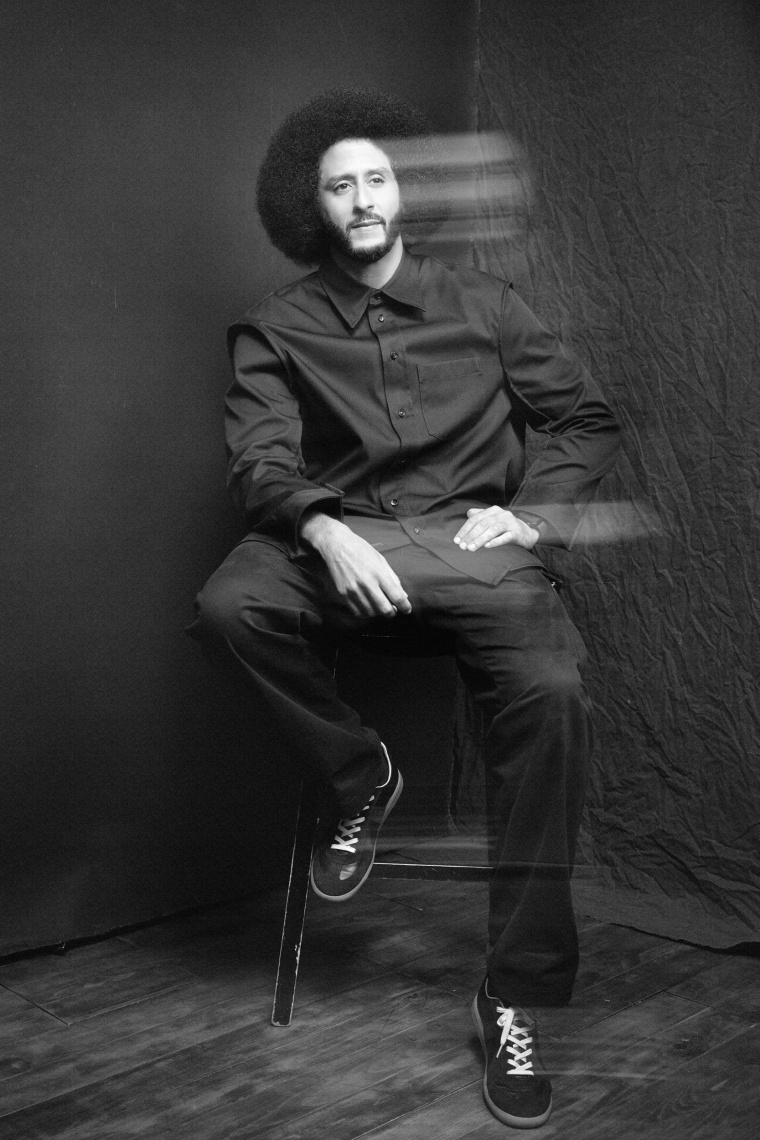
Colin Kaepernick looks at the camera during a portrait session; his hands and face have a motion blur.Jesse Dittmar for NBC News

In November 2019 — months after the NFL settled Kaepernick’s lawsuit — the league tried to arrange a midseason workout for him in front of all 32 teams. The details of this day are now infamous, as Kaepernick ultimately called off the NFL’s workout the morning of due to an extensive waiver he refused to sign — a waiver Kaepernick believed would sign away his employment rights and potential future claims — and instead managed to organize a workout of his own.

The dissolution of the workout drew another round of skepticism, with many claiming Kaepernick was pulling a media stunt or was not serious about wanting to play again.

While Kaepernick was out of the league, the NFL went about trying to turn the temperature down on his protest, battling the aftermath of an especially divisive election and a ratings slide some attributed to the player demonstrations.

The league partnered in 2017 with the Players Coalition, a group founded to address systemic racism, and has since committed over half a billion dollars to various social justice causes. Kaepernick wasn’t part of the group. (Reid said in 2017 that Kaepernick was kicked out of communications with the group by co-founder Malcolm Jenkins, which Jenkins denied.)

The NFL did whatever it could to stop the kneeling, the former player says, believing the league wanted to weed out players who kneeled: “What happened was the league and the Players Coalition came to a deal, and then the league did what they were going to do … They wanted their games to go back to normal.”

Kaepernick’s protest likely cost him tens of millions of dollars, even accounting for whatever he got from the NFL in the settlement.

But as his career was sacked, as television pundits continued to make personal attacks, and as 986 people were killed by police in 2017, Kaepernick stayed largely quiet.

He says that was by design.

“No individual should be speaking for everyone across the country. I don’t think that’s a responsible way to approach things,” Kaepernick says. “It’s also being able to enable other people to step into leadership positions, because that’s what movements actually are. It’s not one person just driving things.”


Months after his workout snafu, events unrelated to Kaepernick raised the volume on his protest once more.

On May 25, 2020, 46-year-old George Floyd was killed by police officer Derek Chauvin in Minnesota.
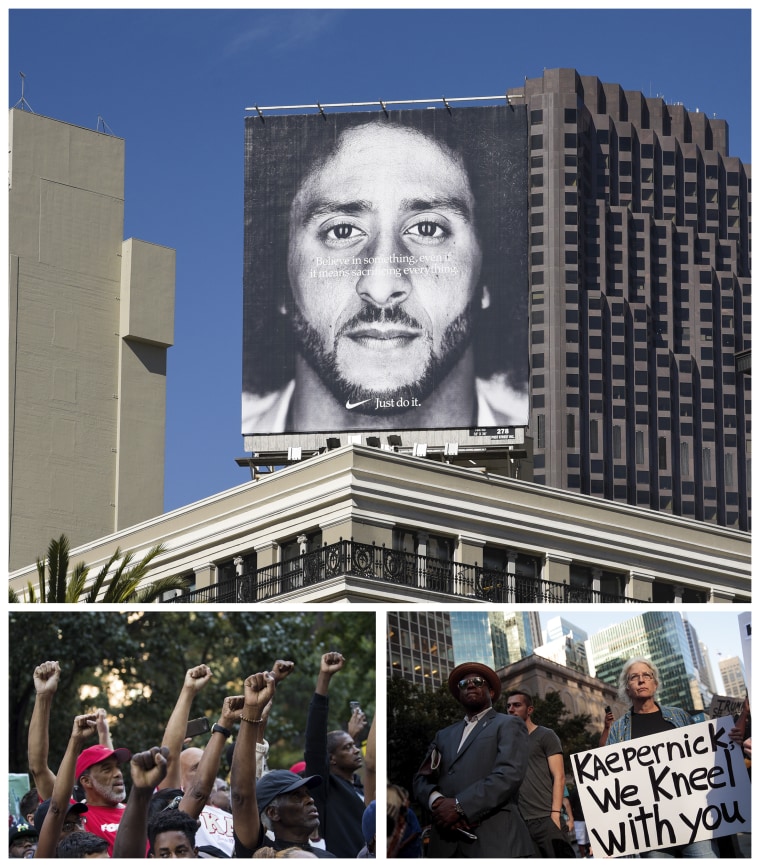
A triptych image showing a billboard of Colin Kaepernick and two protest scenes. Nike included Kaepernick in its 30th anniversary "Just Do It" campaign in 2018. Supporters gathered outside NFL headquarters in New York City after Kaepernick filed a grievance against the league alleging that owners were colluding against signing him because of his protest. Getty Images file

Video revealed Chauvin kneeled on Floyd’s neck for over nine minutes, killing him. Chauvin was convicted on multiple murder charges in 2021.

Nearly four years after Kaepernick kneeled in response to police brutality, worldwide protests emerged in the wake of Floyd’s killing. Kaepernick says seeing the protests around the world made him hopeful in the moment, especially as people in some cases risked their own well-being to be heard in the middle of the pandemic.

“There was a significant portion of the population that previously was disconnected from these realities,” Kaepernick says. “It was like, oh, actually I have to sit with this now and I have to grapple with this. And am I OK with this? And what is my role within this? Am I complicit?”

Corporations also scrambled to meet the moment, including the NFL. In June 2020, several NFL players coordinated social media posts asking for the league to condemn racism and “admit wrong in silencing our players from peacefully protesting.”

The next day, Goodell responded in a video message.

“We, the National Football League, condemn racism and the systematic oppression of Black people,” Goodell said in the video, echoing the words players demanded from him. “We, the National Football League, admit we were wrong for not listening to NFL players earlier and encourage all to speak out and peacefully protest. We, the National Football League, believe Black lives matter.”

Kaepernick wasn’t impressed.

“His response through that video was only because of pressure from players, not because it was altruistic,” Kaepernick says.

The idea that the league should have listened to protesting players “is so laughable in my mind, and so disingenuous,” Kaepernick says. “We had been trying to address the issue that the NFL created with blackballing me for years. To come out and say we should have listened on the back of that — while I’m still actively trying to play in the NFL — it’s so performative.”

Starting the season after Goodell’s video, the NFL began adding messages such as “Choose Love” and “End Racism” in the end zones of every stadium. It continued donating millions to the Inspire Change fund. In 2021, the league expanded on its Rooney Rule, which requires teams to interview at least two minority candidates for certain jobs.

“‘End Racism’ in the back of the end zone is a great marketing campaign, but what are the actions behind it?” Kaepernick says. He adds that at the same time the league was putting slogans on the field, it was employing the practice of “race norming,” arguing that Black players began their careers with lower cognitive function in an effort to deny them payments as a result of a 2013 concussion lawsuit. (The NFL halted the practice in 2021.)

“I don’t think the NFL has materially changed. None of their actions show that,” Kaepernick says. “We have seen it time and time again. For them it has gone back to business as usual, and I think that is a tragedy that we have allowed them to be able to get to that point.”

In a statement to NBC News, the NFL said: “The issues Colin and other NFL players raised remain important to the league and deserving of continued attention and action,” noting the league still works with Inspire Change to “support meaningful progress.”

The NFL added: “Since 2017, that work has reached thousands of national and grassroots partners, backed by more than $575 million in contributions. We remain committed to listening, collaborating, and taking action that creates lasting impact.”
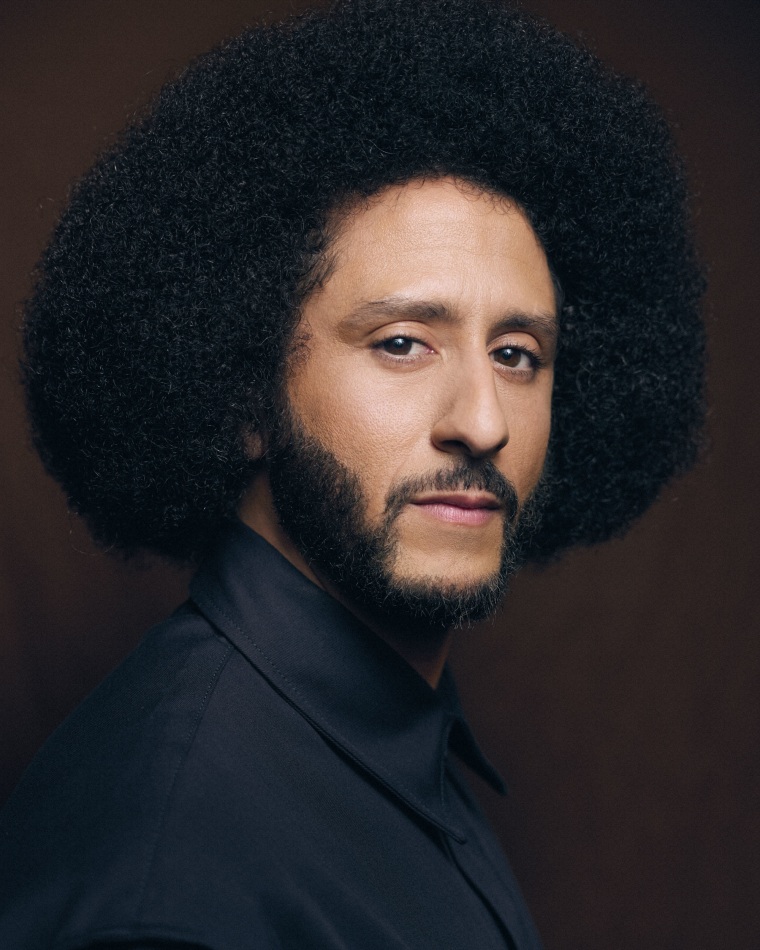
Colin Kaepernick looks at the camera.Jesse Dittmar for NBC News

While 2020 appeared to cast Kaepernick’s protest in a more favorable light, the country’s collective backlash seemed even more pronounced after Trump was elected to a second term.

Many corporations and college campuses rolled back their diversity, equality and inclusion practices. Many politicians disavowed or walked back their anti-police stances from the aftermath of Floyd’s death.

Meanwhile, high-profile athletes, including some who supported Kaepernick, have retreated on taking political stances on issues such as the killing of Americans by immigration enforcement agents this year.

“We have seen on the corporate side a shift in capitulation to the administration,” Kaepernick says, which he says in turn has had an effect on athletes.

In this environment, Kaepernick says he tries to be strategic about when to speak up.

“I try not to just flood things and be a stream of consciousness of everything because it does lose some of the impact,” he says. “I try to be intentional. When is it the right time and place for me to speak up on something?”
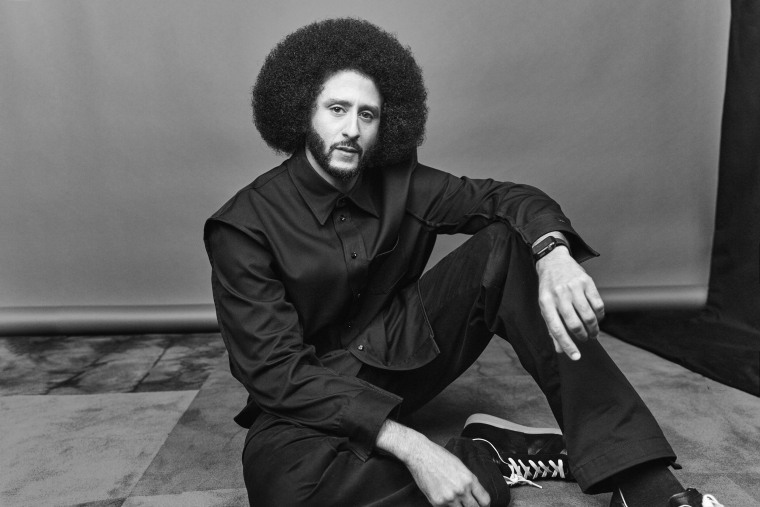

Colin Kaepernick looks at the camera during a portrait session.Jesse Dittmar for NBC News

Though his prospects of getting back on the field have dimmed, Kaepernick says he still trains as if he’s in the NFL.

His daily routine typically begins with his early morning workout. Then, he says, his real work begins: He helps get his 4-year-old daughter ready for school. He devotes time to his various business endeavors, ranging from the Know Your Rights Camp to his AI company Lumi Story to his production house, Kaepernick Media.

Being a father has especially added a new sense of urgency, he says.

“You no longer have the luxury of thinking about it from a perspective of, it’s just me going through this world,” he says. “You think about it from the responsibility of creating an environment and a society that allows someone that is like your child to be able to grow up and thrive.”

Kaepernick says his approach to politics has also evolved. He’s voted in the last two presidential elections and says he recognizes now that the strategy of not voting wasn’t right.

Though still committed to his cause, Kaepernick says he often does his work behind the scenes. His Know Your Rights Camp has helped pay for 150 independent autopsies — such as the one for Nolan Wells this year — and has also paid hundreds of thousands in legal grants and bail relief. In August, Kaepernick pledged another $1 million to community organizations.
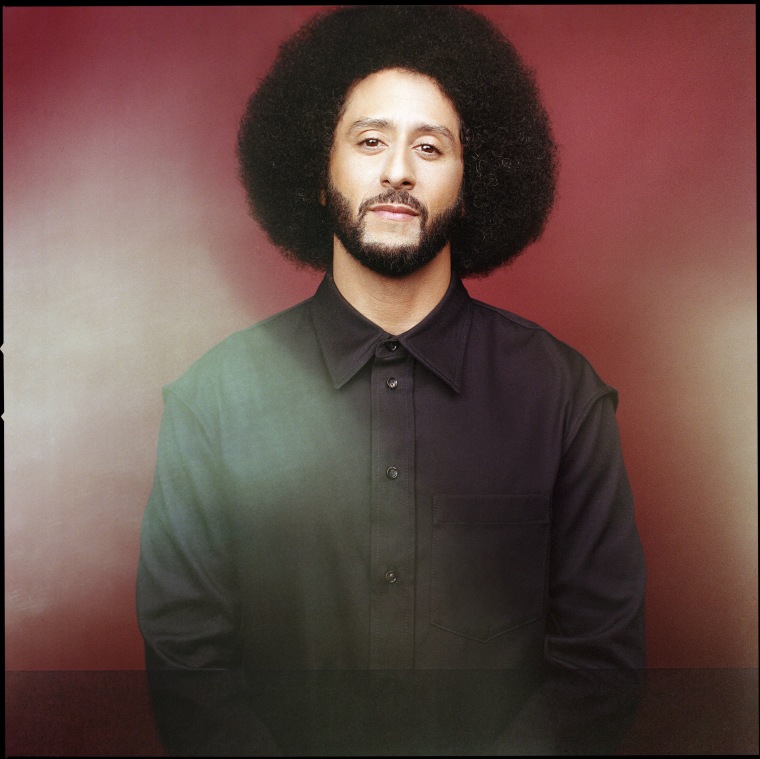
Colin Kaepernick looks at the camera.Jesse Dittmar for NBC News

Even as the country rubber-bands between the hyperactivism of 2020 and the cultural and political backlash since, Kaepernick — after all he’s been through — remains optimistic.

“I’m very hopeful when I think about the moment that we are in,” Kaepernick says.

Does that mean he feels his legacy is vindicated?

“Candidly, I don’t think about legacy a whole lot,” he says. “What I think about is what are the areas that I can do work that I think are going to have an impact and help us move towards that future together. At the end of the day, people will decide what that legacy is, and hopefully that’s a positive one.”

Colin Kaepernick still puts in a workout at 4:30 a.m. most days. His football life may be long over, but his life’s work is not.

Ten years after taking a knee to stand against racism and police brutality at great cost to his career and finances, the former star quarterback is stepping back into the spotlight.

His memoir, “The Perilous Fight,” comes out on Sept. 15. And in interviews with NBC News, his first time speaking in depth about his protest’s fallout in years, Kaepernick reveals the story behind how he came to take a knee in 2016, an act that made him both a hero and a pariah, and one of the most divisive figures in the country.

Kaepernick, 38, is now also a father to a 4-year-old girl. That, he says, helped him understand he has unfinished business in his life and cause. Being a dad “increases the responsibility and urgency of the work we’re doing,” he says. He doesn’t want his daughter — or anyone else — to think he stopped fighting or that the fight was not worth it. “I don’t want my community to watch me and have the takeaway be that if you fight for Black folks, it’s over for you,” he writes in his book.

More NBC News coverage of Colin Kaepernick

  • Kaepernick will be the first guest on "Before & After with Lester Holt," available as soon as Sept. 7.
  • Kaepernick is set to appear on "TODAY" on Sept. 16.
  • Read Kaepernick's response to Jay-Z's recent freestyle rap about him on NBC News Sept. 2.

Much has shifted in American politics, culture, sports and policing since 2016. And much work still needs to be done, Kaepernick says, which is why he chose now to recount the decade-long odyssey that began with a quiet protest during the national anthem.

Though the years have provided perspective, Kaepernick says they haven’t dulled his displeasure with the NFL. The quarterback who once led the San Francisco 49ers on a Disney movie-esque run to the Super Bowl in 2012 says he hasn’t watched an NFL game since he was exiled from the league.

“I’m not gonna support an organization that one, is actively blackballing me, but two, has targeted my brothers who have been protesting as part of this as well,” Kaepernick says. “I watch college football.”

(NFL Commissioner Roger Goodell has said on multiple occasions he doesn’t believe Kaepernick was blackballed.)


Reid and Kaepernick take a knee on the sidelines of a football stadium while another player holds his hand over his heart.Eric Reid and Colin Kaepernick kneel in protest during the national anthem in San Diego on Sept. 1, 2016. Michael Zagaris / San Francisco 49ers via Getty Images file

On Sept. 1, 2016, Kaepernick and his San Francisco 49ers teammate Eric Reid took a knee during the national anthem before a preseason game. It was not the first time Kaepernick didn’t stand. His protest actually began a month earlier, on Aug. 14, when he sat on the bench during “The Star-Spangled Banner.”

The idea had simmered in the months prior to the season when, he writes in his memoir, he was recuperating from surgeries. He might not have taken a knee if he hadn’t injured it first.

The rehab gave him more free time than he ever had in his life. And in the midst of news of police violence, Kaepernick immersed himself in literature on Black liberation, reading books such as “The Autobiography of Malcolm X” and “Black Skin, White Masks” by Frantz Fanon.

Kaepernick says he hadn’t planned the initial protest in mid-August until he heard the opening of the anthem and felt he couldn’t bring himself to stand. No one seemed to notice him sitting at first. It wasn’t until after the 49ers’ third preseason game that Kaepernick was finally asked why he sat out the anthem.

“I am not going to stand up to show pride in a flag for a country that oppresses Black people and people of color,” Kaepernick told NFL Network’s Steve Wyche. “To me, this is bigger than football and it would be selfish on my part to look the other way. There are bodies in the street and people getting paid leave and getting away with murder.”

Kaepernick was unprepared for the response, he writes in the book. After the game, he called his partner, Nessa, and mentioned the reporter’s question.

“Hmm. Well, what did you tell him?” she asked. “On a scale of one to 10, with 10 being the worst, how hard did you go?”

“I don’t know. Maybe a four,” Kaepernick replied.

Colin Kaepernick looking downJesse Dittmar for NBC News

The backlash was immediate. Fans burned his jerseys. Current and former players said he disrespected the flag. Donald Trump, then a presidential candidate, said Kaepernick “should find a country that works better for him.”

“This is not a four, man,” Kaepernick recalls Nessa telling him when the news blew up.

Even though the story of the protest has been told countless times since 2016, Kaepernick set the record straight on one key detail: who came up with the idea to kneel in the first place.

Before the Sept. 1 game, Kaepernick was approached by Reid, who wanted to support the protest. It was Reid who suggested the idea to kneel, Kaepernick says. Not Army veteran Nate Boyer, as was widely reported at the time and since.

Boyer, a Green Beret and former Seattle Seahawk, had penned an open letter to Kaepernick in the Army Times, writing: “Even though my initial reaction to your protest was one of anger, I’m trying to listen to what you’re saying and why you’re doing it.”

On the day of the game, Boyer met with Kaepernick and Reid and relayed stories about how veterans responded to his open letter. The conversation, Boyer says, then shifted to how the protest could be respectful of the military.

“I think it was Colin specifically that asked it. He said, ‘Well, do you think there’s a way that we could protest that’s not going to offend people in the military?’” Boyer recalls. “And I said, ‘No. No matter what, some people will be offended.’”

Boyer then told Kaepernick he believed sitting on the bench “wasn’t the most inspiring” and that the protest could be more effective if he was next to his teammates, perhaps bowing his head while standing.

“He said no immediately, and I respect that,” Boyer says, and the conversation then logically turned to taking a knee. He doesn’t dispute that the two players may have come to that conclusion before meeting him.

“I remember them nodding their heads and looking at each other,” Boyer says. “Maybe Eric did suggest that, and that’s kind of what that look was.”

After the Sept. 1 game, Reid told reporters “[Boyer] agreed with” the idea for them to kneel. Kaepernick says the notion it was Boyer’s idea appealed to the media because the backing of a white military veteran made the protest seem more “palatable.”

As for why Kaepernick didn’t clear up the misconception at the time, he says he and Reid wanted to focus on their message, not get caught “in a personal back-and-forth over whose idea it was.”

Colin Kaepernick holds his hand toward the cameraJesse Dittmar for NBC News

Though Kaepernick and Reid ultimately switched from sitting to kneeling, the protest continued to stoke controversy. Then-Supreme Court Justice Ruth Bader Ginsburg called it “dumb and disrespectful.” Even Kaepernick’s adoptive parents initially said it was “disgraceful.”

Along with the backlash, there was also a groundswell of support from the people he was protesting for, as well as athletes from other sports who joined the effort.

“Oftentimes we hear a lot of the side of the pushback, but I think what’s disconnected from a lot of that is actually the response directly in communities that we were seeing, and the momentum and the excitement around the effort of no, we’re actually going to change this,” Kaepernick told NBC News during a recent sit-down.

Those who condemned his protest chose to focus on his kneeling during the anthem — as opposed to the police violence that drove him to do it.

“The critique of the method is a way to distract from the actual message,” Kaepernick says. “The conversation that was being had is taking a knee is more problematic than Black people being killed. Just simply put, ‘Hey, we need to talk about taking a knee. This is urgent. We need to resolve this.’ But another Black person gets killed, and it’s like, ‘Oh well, that’s kind of normal.’”

In most of the coverage, Kaepernick’s assertion rang true. The conversation stuck to the red, white and blue, and not the disproportionate number of Black Americans killed by police that the quarterback tried to bring attention to.

As Kaepernick tried desperately to keep his protest on message, the rest of his life was picked apart, from his romantic partner to his clothing choices. When Kaepernick revealed he didn’t vote in the 2016 election, ESPN’s Stephen A. Smith called him “irrelevant” and a “flaming hypocrite.”

Reaction from players was also mixed. While Reid, Kaepernick and five other players kneeled in Week 1 of the 2016 season, many who said they were sympathetic to Kaepernick’s cause disagreed with his decision not to stand for the anthem.

There was a group chat with roughly 100 players from all 32 teams that often grew contentious. In his memoir, Kaepernick writes of a text exchange in September 2016 in which then-Seahawks cornerback Richard Sherman told him he shouldn’t tell players how to protest. (Through his podcast producer, Sherman declined to comment.)

The tension in the group chat was palpable, one former player in the chat who spoke on condition of anonymity tells NBC News. Some suggested Kaepernick was only kneeling for personal gain, even though by then it was clear he’d suffer a professional blow. In 2017, he became a free agent after the 49ers told him they would release him. The summer passed, and beyond a meeting with the Seattle Seahawks, no teams scheduled workouts.

“I thoroughly enjoyed meeting with Colin, we just didn’t get to the next level,” then-Seahawks coach Pete Carroll wrote NBC News in an email about the meeting. Kaepernick says his meeting with Carroll and general manager John Schneider focused on his political beliefs. (The Seahawks did not respond to a request for comment.)

“Which, in pretty much any environment outside the NFL, would be immediate litigation,” Kaepernick says.

The same league that let Michael Vick play again after he went to prison for dogfighting, and allowed Deshaun Watson to sign a contract for $230 million following accusations of sexual misconduct by over 20 women (Watson has maintained his innocence), was keeping Kaepernick out.

“There’s not a definitive moment that I would point to,” Kaepernick says about when he realized what was happening.

Instead, it was more of a culmination.

“Coming on the back of going to a Super Bowl, going to an NFC Championship, setting records, and not a single team would bring me in, even for a workout?” Kaepernick says.

Colin Kaepernick celebrates on the field/Kaepernick celebrates after a touchdown in the fourth quarter of the Super Bowl in 2013.Rob Tringali / Getty Images file

In August 2017, the Miami Dolphins — whose owner Stephen Ross previously launched a nonprofit to fight systemic racism — signed quarterback Jay Cutler after an injury to starter Ryan Tannehill, even though Cutler had already retired. NFL team executives, meanwhile, used the media to try to throw water on the idea that Kaepernick was blackballed.

Some coaches and GMs did reach out, Kaepernick says, and explicitly told him, “Yeah, we want to bring you in, but it’s getting shut down above us.”

One of those coaches, writes Kaepernick in his book, was John Harbaugh, the then-head coach of the Baltimore Ravens. Kaepernick spoke extensively with Harbaugh during the summer of 2017. Harbaugh’s brother Jim was Kaepernick’s coach during the 49ers’ run to the Super Bowl.

Kaepernick writes that Harbaugh was “pushing” to sign him, but was “shut down from above.”

In October 2017, Kaepernick filed a grievance against the NFL under the terms of the league’s and players’ collective bargaining agreement, alleging that owners were colluding against signing him due to his protest.

“Everybody believes that he was blackballed,” says one former player who was in the league during 2016. “Players knew that this would happen. That was a firm belief around the league.”

Goodell pushed back on the notion of organized collusion to keep Kaepernick out of the NFL.

“Those are decisions that each individual owner has to make and their clubs, coaches, GMs,” Goodell told NBC in 2020. “And I’ve talked to a lot of our clubs about it and I’ve encouraged them. I’d love to see him play again.”

Colin Kaepernick looks at the camera during a portrait session; his hands and face have a motion blur.Jesse Dittmar for NBC News

In November 2019 — months after the NFL settled Kaepernick’s lawsuit — the league tried to arrange a midseason workout for him in front of all 32 teams. The details of this day are now infamous, as Kaepernick ultimately called off the NFL’s workout the morning of due to an extensive waiver he refused to sign — a waiver Kaepernick believed would sign away his employment rights and potential future claims — and instead managed to organize a workout of his own.

The dissolution of the workout drew another round of skepticism, with many claiming Kaepernick was pulling a media stunt or was not serious about wanting to play again.

While Kaepernick was out of the league, the NFL went about trying to turn the temperature down on his protest, battling the aftermath of an especially divisive election and a ratings slide some attributed to the player demonstrations.

The league partnered in 2017 with the Players Coalition, a group founded to address systemic racism, and has since committed over half a billion dollars to various social justice causes. Kaepernick wasn’t part of the group. (Reid said in 2017 that Kaepernick was kicked out of communications with the group by co-founder Malcolm Jenkins, which Jenkins denied.)

The NFL did whatever it could to stop the kneeling, the former player says, believing the league wanted to weed out players who kneeled: “What happened was the league and the Players Coalition came to a deal, and then the league did what they were going to do … They wanted their games to go back to normal.”

Kaepernick’s protest likely cost him tens of millions of dollars, even accounting for whatever he got from the NFL in the settlement.

But as his career was sacked, as television pundits continued to make personal attacks, and as 986 people were killed by police in 2017, Kaepernick stayed largely quiet.

He says that was by design.

“No individual should be speaking for everyone across the country. I don’t think that’s a responsible way to approach things,” Kaepernick says. “It’s also being able to enable other people to step into leadership positions, because that’s what movements actually are. It’s not one person just driving things.”


Months after his workout snafu, events unrelated to Kaepernick raised the volume on his protest once more.

On May 25, 2020, 46-year-old George Floyd was killed by police officer Derek Chauvin in Minnesota.

A triptych image showing a billboard of Colin Kaepernick and two protest scenes. Nike included Kaepernick in its 30th anniversary "Just Do It" campaign in 2018. Supporters gathered outside NFL headquarters in New York City after Kaepernick filed a grievance against the league alleging that owners were colluding against signing him because of his protest. Getty Images file

Video revealed Chauvin kneeled on Floyd’s neck for over nine minutes, killing him. Chauvin was convicted on multiple murder charges in 2021.

Nearly four years after Kaepernick kneeled in response to police brutality, worldwide protests emerged in the wake of Floyd’s killing. Kaepernick says seeing the protests around the world made him hopeful in the moment, especially as people in some cases risked their own well-being to be heard in the middle of the pandemic.

“There was a significant portion of the population that previously was disconnected from these realities,” Kaepernick says. “It was like, oh, actually I have to sit with this now and I have to grapple with this. And am I OK with this? And what is my role within this? Am I complicit?”

Corporations also scrambled to meet the moment, including the NFL. In June 2020, several NFL players coordinated social media posts asking for the league to condemn racism and “admit wrong in silencing our players from peacefully protesting.”

The next day, Goodell responded in a video message.

“We, the National Football League, condemn racism and the systematic oppression of Black people,” Goodell said in the video, echoing the words players demanded from him. “We, the National Football League, admit we were wrong for not listening to NFL players earlier and encourage all to speak out and peacefully protest. We, the National Football League, believe Black lives matter.”

Kaepernick wasn’t impressed.

“His response through that video was only because of pressure from players, not because it was altruistic,” Kaepernick says.

The idea that the league should have listened to protesting players “is so laughable in my mind, and so disingenuous,” Kaepernick says. “We had been trying to address the issue that the NFL created with blackballing me for years. To come out and say we should have listened on the back of that — while I’m still actively trying to play in the NFL — it’s so performative.”

Starting the season after Goodell’s video, the NFL began adding messages such as “Choose Love” and “End Racism” in the end zones of every stadium. It continued donating millions to the Inspire Change fund. In 2021, the league expanded on its Rooney Rule, which requires teams to interview at least two minority candidates for certain jobs.

“‘End Racism’ in the back of the end zone is a great marketing campaign, but what are the actions behind it?” Kaepernick says. He adds that at the same time the league was putting slogans on the field, it was employing the practice of “race norming,” arguing that Black players began their careers with lower cognitive function in an effort to deny them payments as a result of a 2013 concussion lawsuit. (The NFL halted the practice in 2021.)

“I don’t think the NFL has materially changed. None of their actions show that,” Kaepernick says. “We have seen it time and time again. For them it has gone back to business as usual, and I think that is a tragedy that we have allowed them to be able to get to that point.”

In a statement to NBC News, the NFL said: “The issues Colin and other NFL players raised remain important to the league and deserving of continued attention and action,” noting the league still works with Inspire Change to “support meaningful progress.”

The NFL added: “Since 2017, that work has reached thousands of national and grassroots partners, backed by more than $575 million in contributions. We remain committed to listening, collaborating, and taking action that creates lasting impact.”

Colin Kaepernick looks at the camera.Jesse Dittmar for NBC News

While 2020 appeared to cast Kaepernick’s protest in a more favorable light, the country’s collective backlash seemed even more pronounced after Trump was elected to a second term.

Many corporations and college campuses rolled back their diversity, equality and inclusion practices. Many politicians disavowed or walked back their anti-police stances from the aftermath of Floyd’s death.

Meanwhile, high-profile athletes, including some who supported Kaepernick, have retreated on taking political stances on issues such as the killing of Americans by immigration enforcement agents this year.

“We have seen on the corporate side a shift in capitulation to the administration,” Kaepernick says, which he says in turn has had an effect on athletes.

In this environment, Kaepernick says he tries to be strategic about when to speak up.

“I try not to just flood things and be a stream of consciousness of everything because it does lose some of the impact,” he says. “I try to be intentional. When is it the right time and place for me to speak up on something?”


Colin Kaepernick looks at the camera during a portrait session.Jesse Dittmar for NBC News

Though his prospects of getting back on the field have dimmed, Kaepernick says he still trains as if he’s in the NFL.

His daily routine typically begins with his early morning workout. Then, he says, his real work begins: He helps get his 4-year-old daughter ready for school. He devotes time to his various business endeavors, ranging from the Know Your Rights Camp to his AI company Lumi Story to his production house, Kaepernick Media.

Being a father has especially added a new sense of urgency, he says.

“You no longer have the luxury of thinking about it from a perspective of, it’s just me going through this world,” he says. “You think about it from the responsibility of creating an environment and a society that allows someone that is like your child to be able to grow up and thrive.”

Kaepernick says his approach to politics has also evolved. He’s voted in the last two presidential elections and says he recognizes now that the strategy of not voting wasn’t right.

Though still committed to his cause, Kaepernick says he often does his work behind the scenes. His Know Your Rights Camp has helped pay for 150 independent autopsies — such as the one for Nolan Wells this year — and has also paid hundreds of thousands in legal grants and bail relief. In August, Kaepernick pledged another $1 million to community organizations.

Colin Kaepernick looks at the camera.Jesse Dittmar for NBC News

Even as the country rubber-bands between the hyperactivism of 2020 and the cultural and political backlash since, Kaepernick — after all he’s been through — remains optimistic.

“I’m very hopeful when I think about the moment that we are in,” Kaepernick says.

Does that mean he feels his legacy is vindicated?

“Candidly, I don’t think about legacy a whole lot,” he says. “What I think about is what are the areas that I can do work that I think are going to have an impact and help us move towards that future together. At the end of the day, people will decide what that legacy is, and hopefully that’s a positive one.”

*** Disclaimer: This Article is auto-aggregated by a Rss Api Program and has not been created or edited by Bdtype.

(Note: This is an unedited and auto-generated story from Syndicated News Rss Api. News.bdtype.com Staff may not have modified or edited the content body.

Please visit the Source Website that deserves the credit and responsibility for creating this content.)

Watch Live | Source Article