.png)
 1 week ago
19
1 week ago
19
Article content
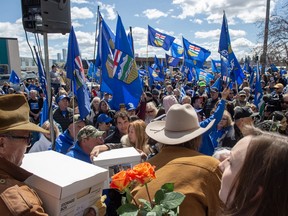
On Wednesday morning the Canadian Press wire ran a story in which reporter Fakiha Baig talked to a few political scientists about the unusual nature of the Alberta separatist movement. Which is fair enough. I started reading the story half expecting a historian or two to turn up eventually, but those people are often off somewhere catching extinct respiratory diseases in dusty archives. Political scientists, by contrast, make it real easy for reporters to get hold of them. Oh, hey, look, there’s Duane Bratt again.

THIS CONTENT IS RESERVED FOR SUBSCRIBERS
Enjoy the latest local, national and international news.
- Exclusive articles by Conrad Black, Barbara Kay and others. Plus, special edition NP Platformed and First Reading newsletters and virtual events.
- Unlimited online access to National Post.
- National Post ePaper, an electronic replica of the print edition to view on any device, share and comment on.
- Daily puzzles including the New York Times Crossword.
- Support local journalism.
SUBSCRIBE FOR MORE ARTICLES
Enjoy the latest local, national and international news.
- Exclusive articles by Conrad Black, Barbara Kay and others. Plus, special edition NP Platformed and First Reading newsletters and virtual events.
- Unlimited online access to National Post.
- National Post ePaper, an electronic replica of the print edition to view on any device, share and comment on.
- Daily puzzles including the New York Times Crossword.
- Support local journalism.
REGISTER / SIGN IN TO UNLOCK MORE ARTICLES
Create an account or sign in to continue with your reading experience.
- Access articles from across Canada with one account.
- Share your thoughts and join the conversation in the comments.
- Enjoy additional articles per month.
- Get email updates from your favourite authors.
THIS ARTICLE IS FREE TO READ REGISTER TO UNLOCK.
Create an account or sign in to continue with your reading experience.
- Access articles from across Canada with one account
- Share your thoughts and join the conversation in the comments
- Enjoy additional articles per month
- Get email updates from your favourite authors
Sign In or Create an Account
or
Article content
Article content
Baig’s story commences with the observation that most separatist gangs start out in places that have a prior history of independent nationhood or at least some objective cultural differences from the central authority in the state. “There are no significant secessionist movements that hinge only on fiscal and economic grievances,” pronounces UOttawa’s Andre Lecours. This put me on alert, hoping someone or other would mention one arguable counterexample, one that is for my money the most significant historical parallel for Alberta separatism.
Article content
Article content
By signing up you consent to receive the above newsletter from Postmedia Network Inc.
Article content
Instead, the parade of political scientists continues, helpfully informing us that, for example, the United States once had a civil war. (Over cultural differences, if you like.) And Scotland’s 2014 independence referendum comes up, which is interesting. Baig’s article emphasizes that Alberta premier Danielle Smith has been negotiating with separatists and trying to create an open opportunity for them to pass or fail a democratic test, although she is not an avowed separatist herself. This, too, is deemed unusual — but, of course, Scotland’s IndyRef was allowed to take place with the permission of the U.K.’s prime minister of the day, David Cameron, a pro-Union Conservative of Scottish descent.
Article content
Article content
No one talks much, in the Alberta context, about the Cameron gambit. Cameron’s goal was to open the door for the Scottish Nationalist Party, score a victory for the Union, settle the secession issue for a generation, and let the SNP wither when they were deprived of their fundamental reason for existing. It may still be too soon to judge the success of this strategy. Cameron did get his win; the Union is still intact.
Article content
Article content
But the SNP was able to adapt by cycling through leaders, and is still firmly in power in devolved Scotland. The party wasn’t discredited by the loss, and the trans-national centralized parties of Britain are in blazing, nightmarish crisis. There is a real possibility, from the 2026 point of view, that the SNP could outlast the U.K. Conservative Party itself.
Article content
That’s an instructive situation (or a warning) for Canada and for Smith’s United Conservatives. But what I was waiting for someone to mention in the CP article — the thing that the Alberta separatists really remind me of — is the “Padanian independence” movement that surfaced in Italy in the 1990s. This movement was a sort of wild fantasy creation of one man, a politician from Lombardy named Umberto Bossi (1941-2026). “Padania” is an old word for the basin of the Po River, Padus in Latin; Bossi used it to develop a dollar-store national myth for the rich, productive north of Italy, writing a full-fledged Declaration of Independence, and he found a rich vein of regional anger that enabled him to build a political party, the Lega Nord.





















/https%3A%2F%2Fsportsmole-media-prod.s3.gra.io.cloud.ovh.net%2Fuploads%2F2026%2F05%2Fns-collage-background-v2-email-3-6a086d6eaa1a0057506880.jpg)
 Bengali (BD) ·
  English (US) ·