.png)
 1 hour ago
7
1 hour ago
7
BEIJING — China loves electric cars: making them, driving them and selling them to the rest of the world.
Subscribe to read this story ad-free
Get unlimited access to ad-free articles and exclusive content.

Electric vehicles have been widely adopted in China, thanks in part to years of now-defunct government subsidies and a fast-growing network of charging stations. According to the International Energy Agency, almost half of the cars sold in China in 2024 were electric, compared with about 1 in 10 in the U.S.
But despite growing global interest in the innovative sector, Chinese electric cars remain out of reach for consumers in the world’s second-largest auto market, the United States.
Advanced technology and affordable prices have driven the explosive success of Chinese electric vehicles such as BYD’s Sealion 06, a midsize SUV that “NBC Nightly News” took on a test drive in Beijing.
The Sealion 06 has leather seats, massage features, an infotainment touch screen and a mini fridge and charges in minutes — and sells in China for the equivalent of about $20,000.
“This feels like luxury, but not a luxury price,” said Lei Xing, a Chinese American podcaster and consultant who covers the auto industry, likening BYD to the “Volkswagen of China.”
The Sealion 06, which launched almost a year ago, is not yet available in the United States, but “the key word is yet,” Xing said in an interview Monday at a BYD dealership in Beijing.
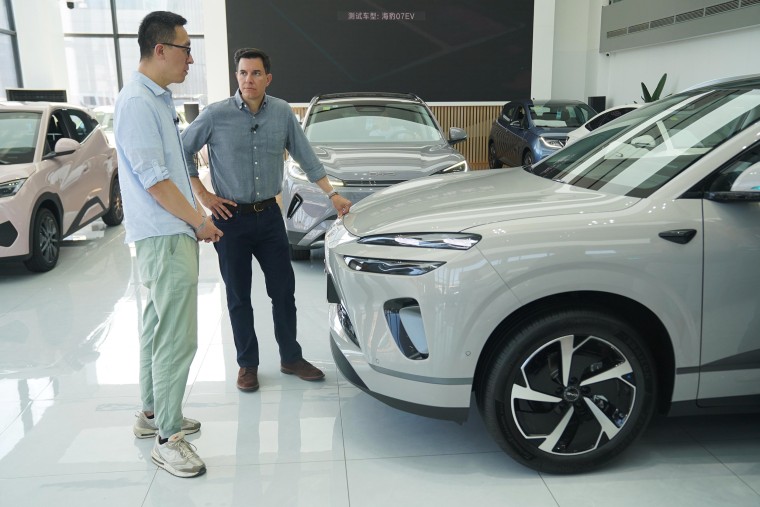 NBC News' Tom Llamas at a BYD dealership in Beijing this week.Ignacio Torres / NBC News
China dominates the EV industry, with its brands responsible for about two-thirds of global sales in 2024, according to the IEA. None of those sales were in the U.S., where Chinese EVs are shut out of the market.
Interest in Chinese EVs appears to be growing among Americans, especially as energy shocks from the U.S.-Israeli war with Iran send gas prices soaring.
According to a recent study by Cox Automotive, 38% of Americans say they would be extremely or very likely to consider purchasing a Chinese-made electric vehicle. The most recognizable brand, Shenzhen-based BYD — which overtook Elon Musk’s Tesla last year as the world’s largest electric carmaker — was cited by 35% of respondents, followed by Chery and Geely.
That interest comes despite steep U.S. trade and regulatory barriers based on concerns about national security and the threat to American industry. In 2024, the Biden administration announced a 100% tariff on all electric vehicles imported from China and a ban on Chinese technology in connected vehicles on American roads, a measure that Congress is now trying to codify.
Though they have yet to face direct competition from their Chinese counterparts, U.S. automakers are well aware of their success, said Dan Wang, a technology analyst and a research fellow at Stanford University’s Hoover Institution.
“You can’t find a major automaker today whose CEO hasn’t been to China in the last few months and last few years, observed what’s been really selling well in China and hasn’t come back slack-jawed,” said Wang, author of the new book “Breakneck: China’s Quest to Engineer the Future.”
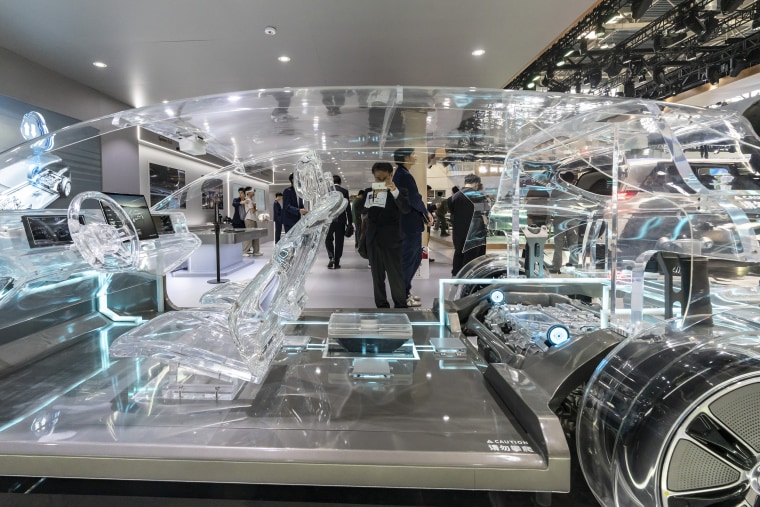 A display of the BYD Denza e3 at the Beijing auto show on April 25. China's premier automotive event showcased the new technologies emerging out of cutthroat competition. Qilai Shen / Bloomberg via Getty Images
The rise of EVs in China has also been driven by fierce competition among dozens of carmakers that has spurred innovation and price wars. One popular BYD vehicle, a small hatchback called the Seagull, sells in China for about the equivalent of $13,000.
That has put pressure on Tesla, whose models are comparatively pricey in China at more than $30,000. According to data released Monday by the China Passenger Car Association, Tesla’s retail sales in China were down almost 10% in April compared with a year earlier — though its Model Y is still one of China’s top-selling passenger vehicles, electric or otherwise.
The American company, which has a production facility in Shanghai, is developing a cheaper, compact SUV to better compete in the Chinese market, Reuters reported last month, citing four people familiar with the matter. Musk is one of more than a dozen American chief executives expected to travel to China this week as part of President Donald Trump’s state visit.
Guo Fengjin, 54, paid about 130,000 yuan ($18,000) for his BYD Qin Plus sedan.
“I feel I trust domestic brands,” he said in an interview at a charging station in Beijing, saying he wouldn’t consider an American brand because “the repair and maintenance costs are too high.”
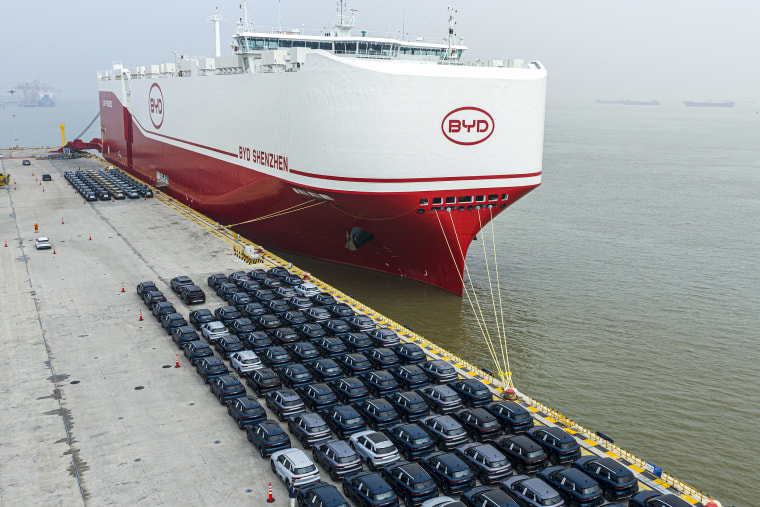 BYD's Shenzhen car carrier docked in the port of Suzhou, China, on April 17.AFP via Getty Images
Even Ford Motor Co. CEO Jim Farley drove an electric car from Chinese brand Xiaomi for six months in 2024, telling a podcast at the time, “I don’t want to give it up.” Farley told reporters last month that Ford plans to expand its partnerships with Chinese companies outside the U.S. while guarding against the potentially “devastating” impact Chinese EVs could have on American manufacturing if they were to enter the U.S. market.
TikTok and other social media platforms have also been flooded with videos by Americans promoting Chinese EVs, some of whom attend events in China on all-expense-paid trips.
“There were so many American YouTubers” doing car reviews at this year’s Beijing auto show, which ended May 3, Xing said.
While allowing Chinese cars into the U.S. could make EVs more affordable in the short term, there could be serious economic consequences, said Michael Dunne, founder and CEO of Dunne Insights, a San Diego-based advisory firm that specializes in global electric and autonomous vehicle markets.
“There’s costs associated with that decision, and I wish that the American consumer would be less naive about those costs,” he said.
Wang said he favored greater Chinese investment in the U.S. because “greater competition generally improves product quality as well as the price points.” He pointed to the improvements in American cars that resulted from Japanese competition and investment in the 1980s.
Trump has expressed openness to the idea.
“If they want to come in and build a plant and hire you and hire your friends and your neighbors, that’s great, I love that,” he said in January. “Let China come in.”
Dunne noted that Chinese EV makers are hungry for a new market, giving the U.S. its own leverage if it decides to open up.
“What are you going to do for us if we give you access to the U.S. market? How much are you going to invest? Where? What technologies will you transfer?” he said. “Make it not so easy for the Chinese to get in here, just as they made it hard for us to get into the Chinese market.”
Tom Llamas and Jennifer Jett reported from Beijing, and Jay Ganglani from Hong Kong.


























/https%3A%2F%2Fsportsmole-media-prod.s3.gra.io.cloud.ovh.net%2Fuploads%2F2026%2F05%2Fchamp-69fa166311171530187348.jpg)
 Bengali (BD) ·
  English (US) ·