.png)
 6 days ago
28
6 days ago
28
Diesel fuel is brutally expensive at the wrong time for Canadian agriculture and food distribution
Published Sep 20, 2026 • 4 minute read
See more Toronto Sun on Google — save as a Preferred Source
Advertisement 2

THIS CONTENT IS RESERVED FOR SUBSCRIBERS ONLY
Subscribe now to read the latest news in your city and across Canada.
- Unlimited online access to articles from across Canada with one account.
- Get exclusive access to the Toronto Sun ePaper, an electronic replica of the print edition that you can share, download and comment on.
- Enjoy insights and behind-the-scenes analysis from our award-winning journalists.
- Support local journalists and the next generation of journalists.
- Daily puzzles including the New York Times Crossword.
SUBSCRIBE TO UNLOCK MORE ARTICLES
Subscribe now to read the latest news in your city and across Canada.
- Unlimited online access to articles from across Canada with one account.
- Get exclusive access to the Toronto Sun ePaper, an electronic replica of the print edition that you can share, download and comment on.
- Enjoy insights and behind-the-scenes analysis from our award-winning journalists.
- Support local journalists and the next generation of journalists.
- Daily puzzles including the New York Times Crossword.
REGISTER / SIGN IN TO UNLOCK MORE ARTICLES
Create an account or sign in to continue with your reading experience.
- Access articles from across Canada with one account.
- Share your thoughts and join the conversation in the comments.
- Enjoy additional articles per month.
- Get email updates from your favourite authors.
THIS ARTICLE IS FREE TO READ REGISTER TO UNLOCK.
Create an account or sign in to continue with your reading experience.
- Access articles from across Canada with one account
- Share your thoughts and join the conversation in the comments
- Enjoy additional articles per month
- Get email updates from your favourite authors
Article content
Food does not move by magic. In Canada, it moves largely by diesel.
Article content
Article content
Diesel powers tractors and combines. It carries ingredients to processors, distribution centres and refrigerated loads to restaurants and grocers. It supports fishing, storage and last-mile delivery. When diesel rises sharply, the food system is not hit once. The shock travels through the chain several times before reaching consumers.
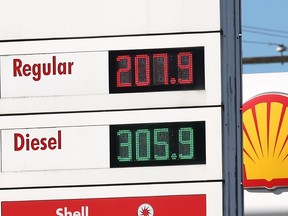
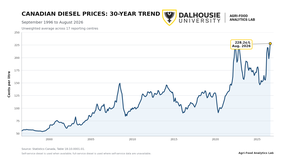
That is why diesel markets should keep Ottawa awake. September rack quotes placed diesel above $2.10 per litre in Central and Eastern Canada, roughly $2.35 to $2.40 across the Prairies and above $2.48 at British Columbia terminals. Regional prices differ, but diesel is brutally expensive at the wrong time for agriculture and food distribution.
Costs take months to show up
Farmers feel it first. Harvest is not discretionary. A producer cannot park a combine and wait for energy markets to settle. Crops move when weather allows, not when fuel becomes affordable. Farmers burn cash now, while cost recovery may not arrive until a later contract or crop cycle. This is a working-capital problem.
By signing up you consent to receive the above newsletter from Postmedia Network Inc.
Article content
Advertisement 3
Article content
Processors come next. They pay for ingredients and freight, plus packaging, refrigeration and agricultural inputs. Smaller processors and independent distributors are exposed. They lack the purchasing power and hedging options of larger companies. With thin margins, there is nowhere for the shock to hide.
Then comes distribution. Contracts and fuel surcharges do not reset together, so shelves do not immediately reprice. Inventories and contracts delay the impact, but delay is not relief. As both reset, pressure reaches wholesalers, restaurants and retailers. The grocery aisle is the last stop, not the starting point.
The relationship is difficult to ignore. From September 1996 through August, monthly diesel prices and the food-purchased-from-stores consumer price index have a Pearson correlation of about 0.89. That is high, but two rising price series do not establish causation. Using year-over-year changes, correlation peaks near 0.63 when diesel leads grocery inflation by nine months; the same-month relationship is weak. Diesel works through inventories and contracts slowly.
Advertisement 4
Article content
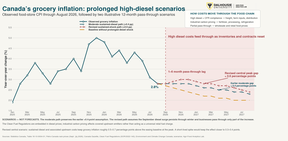
Our Agri-Food Analytics Lab scenario illustrates the risk. If high diesel persists through winter, grocery inflation could peak 0.5 to 0.7 percentage points above an easing baseline, with a central gap near 0.6 points. A short-lived spike would keep the effect near 0.3 or 0.4 points. These are scenarios, not forecasts. Waiting for confirmation means waiting until costs are embedded in prices.
Excise tax suspension still needed
To Ottawa’s credit, it recognized the danger. On Sept. 2, it extended the four-cent-per-litre diesel excise tax suspension through Jan. 31, 2027. The rate will return at two cents during February and March before reaching four cents on April 1. That was the right decision ahead of harvest and winter distribution.
The extension matters. For major fuel users, the savings are real. It also prevents government from adding costs while energy markets remain unstable. But four cents cannot defeat this shock. Ottawa bought the food system time; it did not insulate it from diesel.
Advertisement 5
Article content
That distinction matters. Relief softens the increase, but producers, processors and carriers still face higher fuel bills. Those costs remain in the system, moving through contracts, inventories and prices. Ottawa should resist declaring victory because it chose not to make the problem worse.
Next, offer targeted working-capital support to farms, small processors and independent distributors with documented fuel exposure. Faster access to risk-management programs and loan guarantees would beat broad cheques. Temporary compliance flexibility could ease pressure without abandoning emissions goals. Clean Fuel Regulations are embedded in diesel prices, while industrial carbon pricing applies to covered upstream emitters, not as a universal retail fuel charge. Conflating them is analytically lazy. Ottawa can adjust near-term timing and credit banking during an exceptional shock.
RECOMMENDED VIDEO

We apologize, but this video has failed to load.
More focus needed on productivity
Canada also needs transparency. A dashboard should track rack prices, retail diesel, freight surcharges and farm inputs. Businesses need visibility and consumers deserve to see how costs move. Better data would separate legitimate pass-through from opportunistic pricing instead of reducing every debate to grocer bashing.
Advertisement 6
Article content
Longer term, Canada must tackle productivity: Efficient trucks, rail and intermodal links, cold storage, precision agriculture and competitive domestic processing. Canada needs new plants, not just new owners. Price controls would be a mistake. So would an affordability gimmick disconnected from the source of pressure.
No participant can absorb costs indefinitely. If costs cannot move through prices, they appear elsewhere: Lower farm income, weaker processors, promotions, investment or emptier shelves. Pretending otherwise is good politics, but it is terrible economics.
Diesel is not merely an energy story. In a country as uniquely demanding as Canada, diesel is food policy. Ottawa cannot control oil markets, but it can stop amplifying the shock, help exposed businesses bridge it and build a system using less energy per unit. Ottawa has acted, but the job remains unfinished. Today’s fuel bill is becoming tomorrow’s grocery bill.
— Charlebois is senior director of the Agri-Food Analytics Lab at Dalhousie University and co-host of The Food Professor Podcast.
Read More
-

CHARLEBOIS: Ottawa wants $1 trillion in investment, but agri-food is starving for capital
-

CHARLEBOIS: Canada's food inflation problem isn’t Donald Trump, it’s Canada


Article content





























 Bengali (BD) ·
  English (US) ·