.png)
 3 hours ago
8
3 hours ago
8

Article content
“Where words fail, sounds can often speak,” Hans Christian Andersen writes in What the Moon Saw, and he knew a thing or two about how to infiltrate the unconscious mind.

THIS CONTENT IS RESERVED FOR SUBSCRIBERS
Enjoy the latest local, national and international news.
- Exclusive articles by Conrad Black, Barbara Kay and others. Plus, special edition NP Platformed and First Reading newsletters and virtual events.
- Unlimited online access to National Post.
- National Post ePaper, an electronic replica of the print edition to view on any device, share and comment on.
- Daily puzzles including the New York Times Crossword.
- Support local journalism.
SUBSCRIBE FOR MORE ARTICLES
Enjoy the latest local, national and international news.
- Exclusive articles by Conrad Black, Barbara Kay and others. Plus, special edition NP Platformed and First Reading newsletters and virtual events.
- Unlimited online access to National Post.
- National Post ePaper, an electronic replica of the print edition to view on any device, share and comment on.
- Daily puzzles including the New York Times Crossword.
- Support local journalism.
REGISTER / SIGN IN TO UNLOCK MORE ARTICLES
Create an account or sign in to continue with your reading experience.
- Access articles from across Canada with one account.
- Share your thoughts and join the conversation in the comments.
- Enjoy additional articles per month.
- Get email updates from your favourite authors.
THIS ARTICLE IS FREE TO READ REGISTER TO UNLOCK.
Create an account or sign in to continue with your reading experience.
- Access articles from across Canada with one account
- Share your thoughts and join the conversation in the comments
- Enjoy additional articles per month
- Get email updates from your favourite authors
Sign In or Create an Account
or
Article content
The sounds of music especially can be a powerful shortcut to that secret solitary place where our deepest self lurks, only one bittersweet love song away from opening a vein.
Article content
Article content
Musicians can make you cry on cue, but, sentimentality aside, more respectable emotions rarely exist in a vacuum, so just exactly what are we crying about? What does it mean to strike a chord?
Article content
Article content
Novelists intuit what musicians exploit — there’s always a story.
Article content
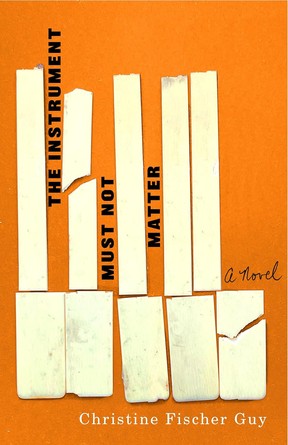
And sometimes words make their own special kind of music. Toronto journalist and author Christine Fischer Guy’s exquisitely rendered sophomore novel, The Instrument Must Not Matter, not only sings, it also plays the piano.
Article content
Article content
Article content
The Instrument Must Not Matter
Christine Fischer Guy
Buckrider Books: Wolsak & Wynn
Article content
Article content
Lila Rys, a musical prodigy and synesthete has just arrived in current-day New York City from her hometown of Toronto, to study with an elite piano instructor George Vrubel, who only accepts one pupil a year. A cranky old guy with onion breath who expects his students to do as they’re told, he’s met his match in eccentric socially inept Lila, a cranky 21-year-old who “stares too much, smiles too little,” who experienced “blinding white rages as a child,” and whose massive musical talent is exceeded only by her inability to do what’s she told.
Article content
So, that goes well.
Article content
Lila’s also navigating the male-centric world of classical music, where women are still expected to perform in dresses while dodging the leers of aging predators who wield power and influence like an unwanted pinch on the ass. She’s also torn between two lovers, the attentive Henrik Thomas, a rising composer, and the galvanizing Sofia Perez, a free-spirited concert pianist who wears pants on stage and encourages Lila to prioritize idiosyncrasy over convention.
Article content
Article content
Her desire to walk out Vrubel’s door and never come back is fraught — her agent projecting career suicide, even as Lila must reckon with her family’s sacrifices in service of her talent. They are counting on her to stay the course — her twin brother relying on her support as he pursues a future in academia, her mother and uncle viewing her professional promise as the culmination of a dream once held by her grandmother, a gifted violinist whose own career track was demolished decades earlier during the Prague Spring, in the aftermath of crackdowns on freedom.
Article content
Tasked with honouring her grandmother and restoring the family’s claim on music, Lila experiments with different playing techniques, while struggling against the ponderous weight of a history that both encumbers and fuels her desire to not just play the instrument, but become the instrument, “her own untransferable voice.”
Article content
For Lila, emotionally volatile, but constrained on all sides by an implacable industrial-strength earnestness, being a musical artist is not just an occupation or even a calling, but an opportunity to attune her soul to Bach, “who speaks a language I wasn’t aware I knew,” to understand firsthand “divine truth revealed.”


























/https%3A%2F%2Fsportsmole-media-prod.s3.gra.io.cloud.ovh.net%2Fuploads%2F2026%2F03%2Ficonsport-361551-0102-1-69b560866f7b6508942731.jpg)
 Bengali (BD) ·
  English (US) ·