.png)
 3 hours ago
13
3 hours ago
13
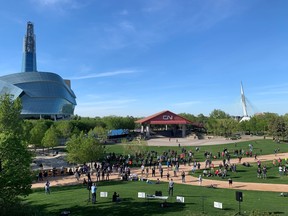
Article content
There is a powerful and probably controversial warning to the Jewish community that comes with the so-called, “Nakba” exhibit opening at the Canadian Museum of Human Rights in Winnipeg: the dream of opening a human rights museum in Canada by the late Israel Asper was well-intentioned and may still have a future, but these days funding public institutions must come with a buyer-beware sticker.

THIS CONTENT IS RESERVED FOR SUBSCRIBERS
Enjoy the latest local, national and international news.
- Exclusive articles by Conrad Black, Barbara Kay and others. Plus, special edition NP Platformed and First Reading newsletters and virtual events.
- Unlimited online access to National Post.
- National Post ePaper, an electronic replica of the print edition to view on any device, share and comment on.
- Daily puzzles including the New York Times Crossword.
- Support local journalism.
SUBSCRIBE FOR MORE ARTICLES
Enjoy the latest local, national and international news.
- Exclusive articles by Conrad Black, Barbara Kay and others. Plus, special edition NP Platformed and First Reading newsletters and virtual events.
- Unlimited online access to National Post.
- National Post ePaper, an electronic replica of the print edition to view on any device, share and comment on.
- Daily puzzles including the New York Times Crossword.
- Support local journalism.
REGISTER / SIGN IN TO UNLOCK MORE ARTICLES
Create an account or sign in to continue with your reading experience.
- Access articles from across Canada with one account.
- Share your thoughts and join the conversation in the comments.
- Enjoy additional articles per month.
- Get email updates from your favourite authors.
THIS ARTICLE IS FREE TO READ REGISTER TO UNLOCK.
Create an account or sign in to continue with your reading experience.
- Access articles from across Canada with one account
- Share your thoughts and join the conversation in the comments
- Enjoy additional articles per month
- Get email updates from your favourite authors
Sign In or Create an Account
or
Article content
Article content
The Jewish community has consistently been at the forefront of leading and participating in human rights advocacy. “Tikkun Olam,” the repair of the world, has been part of our heritage for millennia. It’s at the core of our religion. Our bible commands us to pursue justice: “Justice, justice you shall pursue” (Tzedek, Tzedek, tirdof — Deuteronomy, 16:20). Jewish women like Gloria Steinem played an outsized role in the feminist movement in the 1960s while Rabbi Abraham Heschel marched alongside Martin Luther King Jr. from Selma to Montgomery.
Article content
Article content
By signing up you consent to receive the above newsletter from Postmedia Network Inc.
Article content
Holocaust survivors like Elie Wiesel in America and Max Eisen in Canada drew from its lessons to educate the world about the consequences of hatred. Wiesel’s warning that “indifference is the greatest sin in the world” — the ultimate danger in other words — is the very reason Jews build places that promote human rights, like Holocaust museums and the Canadian Museum of Human Rights.
Article content
In his own memoir, By Chance Alone, Eisen described his wishful hope toward educating the public about the Holocaust: “I believe that a new generation can relate to the Holocaust and its lessons with an understanding of how evil can operate when it remains unchecked. It is my hope that the students I meet will combat racism and bigotry wherever they see it, and that they will speak out and make a positive difference in Canadian society.”
Article content
Article content
The betterment of the world around us is the very drive that gives rise and context to Jewish philanthropy and support of our public institutions here in Canada. The Jewish community’s outrage is legitimate. The Nakba exhibit is there to undermine the legitimacy of Israel. In many ways, it is contradictory to the museum’s Holocaust exhibit, which is based on truth, consultation and transparency, something it appears the museum’s curators avoided.
Article content
The Nakba was indeed a “catastrophe” for the Arabs who were upset they lost the war they launched after rejecting the United Nations partition plan to create a Palestinian and Jewish State. After declaring statehood in 1948, the State of Israel was attacked by six armies (Egypt, Transjordan, Iraq, Syria, Lebanon and Saudi Arabia) and the Arabs themselves from within. The catastrophe (the Nakba) was a failure by the Arabs to eliminate Israel and drive the Jews into the sea.
Article content
The museum is apparently being weaponized to tell an alternative reality about the Middle East conflict. Resigning from its board of trustees this week, Professor Mark Berlin accused the museum of putting forth “ideology” instead of accurate history: “Presenting the Palestinian displacement of 1948 without its proper historical and political context offers a narrow, one-sided argument of history that can only deepen the distrust and animosity that currently exists between Jews and Muslims in this country.”























/https%3A%2F%2Fsportsmole-media-prod.s3.gra.io.cloud.ovh.net%2Fuploads%2F2026%2F05%2Fscheffler-6a034d9fca412032057779.jpg)
/https%3A%2F%2Fsportsmole-media-prod.s3.gra.io.cloud.ovh.net%2Fuploads%2F2026%2F06%2Ficonsport-111147-0089-1-6a27d006a81d1227497324.jpg)
/https%3A%2F%2Fsportsmole-media-prod.s3.gra.io.cloud.ovh.net%2Fuploads%2F2026%2F06%2Fimago-xinhua-nestory-irankunda-celebrates-scoring-for-australia-in-the-world-cup-on-june-14-2026-6a2f348854d1b663111439.jpg)
 Bengali (BD) ·
  English (US) ·